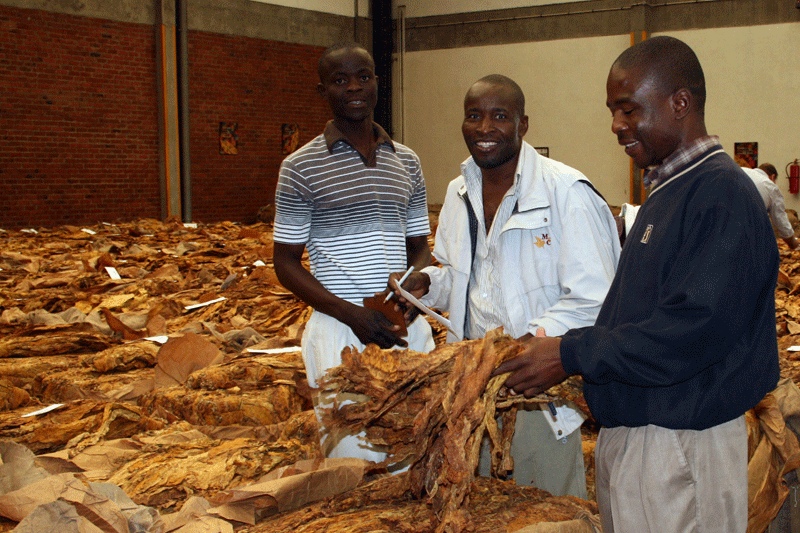
Zimbabwe’s tobacco auction floors are set to open March 4, with contract floors following a day later, as authorities express confidence in their readiness for the marketing season. Deputy Minister Vangelis Haritatos said inspections last week showed strong preparation across the three auction floors, which are expected to handle increased volumes following a 15% rise in planted area to about 164,500 hectares. The government is targeting 500 million kg of output by 2030 as part of plans to build a $7 billion industry, with officials projecting around 400 million kilograms this season. Floor operators, including Premier Tobacco Auction Floor and Ethical Sales Floor, said systems are in place to ensure smooth operations and prompt payments, with some farmers expected to receive funds within an hour, while the Tobacco Industry and Marketing Board highlighted new biometric measures to curb side marketing.
Tag: Zimbabwe
-

ZIMRA Wins Appeal Against Pacific Cigarette Company
The Zimbabwe Revenue Authority (ZIMRA) successfully appealed a High Court ruling, with the Supreme Court siding with it in its refusal to issue a Tax Clearance Certificate (TCC) to Pacific Cigarette Company Ltd. while it owed over $19.5 million in taxes and was under corporate rescue. The court found that the High Court had misdirected itself by compelling ZIMRA to issue the TCC despite Pacific’s $19.2 million in income tax arrears and $330,000 in non-resident tax. ZIMRA had rejected the TCC application in January 2025 because the company had settled current obligations but made no payments toward the arrears.
The Supreme Court ruled that ZIMRA’s refusal was an administrative decision, not an enforcement action, and that tax obligations remain enforceable during corporate rescue. The court also dismissed Pacific’s claim that withholding the TCC violated the moratorium on enforcement actions, noting the company’s corporate rescue plan lacked a proper repayment arrangement for its arrears.
The Supreme Court overturned the High Court’s decision, affirming ZIMRA’s right to enforce its statutory mandate without penalty.
-

Zimbabwe Getting ‘Climate Smart’ in its Climb to 500M Kg
Zimbabwe’s tobacco industry is set to transition from rain-fed farming to “climate-smart production” (i.e. drought-tolerant varieties, improved crop rotation, improved soil management, etc.) under the Tobacco Value Chain Transformation Plan 2 (2026–2030), unveiled at a stakeholder workshop on February 19. The blueprint targets production of 500 million kg of tobacco annually and aims to grow the sector’s value from $1.2 billion to $7 billion by 2030, while increasing value addition from 11% to 30%. Officials said the plan will localize at least 70% of industry financing, expand export markets under the “Zimbabwe Tobacco” brand, and align production with Environmental, Social and Governance standards, including mandatory afforestation, elimination of child labor, and implementation of a digital traceability system to enhance sustainability and global competitiveness.
-

Zimbabwe Hopes PMI Return Stabilizes Tobacco Market
Philip Morris International is set to re-establish its presence in Zimbabwe nearly two decades after exiting the market, with a high-level delegation led by Chief Corporate Affairs Officer Christos Harpantidis scheduled to visit Harare this week following talks between Foreign Affairs Minister Amon Murwira and PMI executives at the World Economic Forum in Davos. Discussions are expected to focus on value addition, local manufacturing, sustainability and ESG standards, aligning with the Government’s Tobacco Value Chain Transformation Plan to grow the sector into a $5 billion industry as planted hectarage for 2025/26 rises 42%.
Industry observers say PMI’s return could help offset reduced purchases from China Tobacco International Group, which plans to cut Zimbabwe orders by up to 15%, potentially stabilizing demand for the country’s 120,000 smallholder farmers. While some analysts caution about global anti-smoking trends, others view the move as renewed investor confidence and a boost to diversification, especially as PMI signals interest in integrating Zimbabwe more deeply into its global supply chain.
-

NCV Sparks Agricultural Transformation in Zimbabwe
Naturally cured Virginia (NCV) tobacco is driving what officials describe as an agricultural breakthrough in Zimbabwe’s Matabeleland North and South provinces, with 325 growers planting 370 hectares this season — up from 122 growers and 84 hectares last year. Backed by contracts with Atlas Agri and supported by the Tobacco Industry and Marketing Board, the crop’s rapid expansion marks a shift beyond the country’s traditional tobacco regions in Mashonaland and Manicaland.
Introduced as a 10-hectare pilot just three seasons ago, NCV is gaining traction as a climate-smart alternative that requires no firewood for curing, lowering costs and environmental impact while offering smallholder farmers in drier regions a viable new income stream. With growing global demand for sustainably produced tobacco and the establishment of a local sales floor to ease market access, stakeholders say NCV is helping to decentralize production and unlock fresh economic potential in previously underrepresented farming communities.
“As global markets increasingly demand sustainably produced tobacco, buyers are paying premiums for crops with low environmental footprints,” Rhyne Chikuni wrote for News Day. “NCV tobacco answers this global call, positioning Zimbabwe as a responsible and forward-looking producer. This is sustainability paired with economic viability.”
-

Zimbabwe Tobacco Farmers Want Forex Review as Season Approaches
As Zimbabwe prepares for the March 4 opening of the 2026 tobacco marketing season, growers are urging authorities to review the 70:30 foreign currency retention policy, arguing that receiving 30% of payments in local currency (ZiG) erodes profits as most production costs are pegged in U.S. dollars. Zimbabwe Tobacco Growers Association chairman George Seremwe said farmers are ready for the season but want the policy aligned with input costs, while Tobacco Farmers Union Trust president Edward Dune noted that fertilizers and other inputs are sold in foreign currency, reducing the real value of local currency payments. The marketing season, announced by the Tobacco Industry and Marketing Board (TIMB), will coincide with the launch of the Tobacco Value Chain Transformation Plan 2, which targets 500 million kg annually by 2030, with more than 400 million kg expected this year.
TIMB said it has licensed 48 contractors and 46 Class A buyers for the 2025/26 season, with three auction floors — Tobacco Sales Floor, Premier Tobacco Auction Floors and Ethical Sales Floor — set to operate. Authorities are also cracking down on side marketing and informal buyers offering low prices, while farmer groups including the Zimbabwe National Farmers Union have urged growers to sell through formal channels to secure better returns. With 113,327 registered growers and a 15% increase in planted hectarage, officials say the 2026 crop outlook remains positive, reinforcing Zimbabwe’s position as Africa’s leading tobacco producer.
-

Zimbabwe’s Increased Efficiency Base for Market Growth
Zimbabwe’s Tobacco Industry and Marketing Board (TIMB) released projections for the 2025/26 growing season, interpreting the numbers as a nation that is becoming more efficient. Registered farmers declined 19.3% to 101,443, yet planted area increased 21.7% to 113,536 hectares, suggesting rising productivity and capital intensity. One such example of progress, according to the TIMB, is the irrigated planted area increasing to 24,000 hectares this season, up from 19,700 hectares last season.
Contract farming continues to dominate, accounting for about 75.6% of planted area, though industry observers note that the 15% share of self- or bank-financed growers offers renewed support for Zimbabwe’s traditional auction system.
Output is projected to climb to 400 million kg this year from 354 million kg last season, reinforcing tobacco’s position as Zimbabwe’s largest agricultural export and second-biggest foreign currency earner after gold. Export earnings reached $1.4 billion by mid-December 2025, down slightly year on year, as weaker demand from traditional Asian markets—particularly China—was offset by strong growth in Europe and steady gains within Africa. The European Union stood out, with export earnings surging 64.5% to $169.6 million, reflecting rising demand for Zimbabwe’s flue-cured Virginia leaf, while the Far East remains the largest market, accounting for 60% of total export value despite a 14% decline.
-

Zimbabwe Tells Tobacco Farmers to Stop Planting, Get Tending
This week, Zimbabwe announced that it exceeded its tobacco planting target for the 2025/26 season, surpassing a record 140,000 hectares, prompting the government to urge farmers to halt further planting and focus on crop management to maximize yields and leaf quality. Agriculture Permanent Secretary Prof. Obert Jiri said late-planted dryland tobacco should be curtailed, with emphasis now on pest and disease control, weed management, and split fertilizer application amid heavy rains. A national crop and livestock assessment later this month is expected to confirm strong early performance and yield prospects, with fertilizer supplies largely adequate despite short-term top-dressing delays.
-

Europe Helping Offset China Losses in Zimbabwe’s Tobacco Exports
Zimbabwe’s tobacco exports dipped 0.7% from the previous year to $1.36 billion (as of mid-December), thanks in part to exports to China dropping from $953.2 million to $819.3 million. Despite the 14% decline, the Far East still accounted for 60% of the nation’s total tobacco export value, all data according to the Tobacco Industry and Marketing Board (TIMB).
While traditional Asian markets cooled, a massive surge in European demand and steady growth within Africa helped offset the overall decline. The European Union emerged as the standout growth market this season, with export values skyrocketing by 64.5%, going from $103.1 million to $169.6 million. According to the TIMB, the surge reflects a growing preference for Zimbabwe’s high-quality, flue-cured Virginia leaf among continental manufacturers.
-

Zimbabwe Pushing Tobacco Processing for Value Addition
Zimbabwe will intensify tobacco processing and value addition from 2026 as part of efforts to boost exports of finished tobacco products, a senior government official said. Lands, Agriculture, Fisheries, Water, and Rural Development permanent secretary Professor Obert Jiri said plans are underway to encourage the establishment of local processing plants, shifting the industry away from raw leaf exports toward higher-value products, including cigarettes.
Zimbabwe produced a record 355 million kg of tobacco in 2025, generating about $1.2 billion in sales, and production has the potential rise to 500 million kg by 2030, Jiri said. He argued that converting locally grown tobacco into finished products could dramatically increase export earnings, estimating the potential value of more than $40 billion if current volumes were processed domestically.
The industry has also undergone a structural shift, with more than 140,000 farmers—over 80% of them smallholders—now involved following land reform. The government says expanding beneficiation will help farmers capture more value and create jobs, building on recent investments such as a $100 million tobacco processing plant commissioned in Harare in November.