Year: 2023

  • New Leadership at Tobacco-Free Kids

    New Leadership at Tobacco-Free Kids

    Yolonda C. Richardson | Photo: CTFK

    Matthew L. Myers is stepping down as the president of the Campaign for Tobacco-Free Kids (CTFK) effective July 1. The board of directors has appointed Yolonda C. Richardson, currently the organization’s executive vice president for global programs, as the new president and CEO.

    “I want to thank Matt for the extraordinary leadership he has provided to the Campaign for Tobacco-Free Kids and throughout his long career fighting the tobacco industry,” said Bill Novelli, chair of Tobacco-Free Kids’ board of directors and president of the organization from 1996 to 1999, in a statement. “Matt and his team at Tobacco-Free Kids have contributed enormously to driving down smoking rates to record lows among both youth and adults in the U.S. and to reversing the tide of the global tobacco epidemic.

    “It has been the privilege of a lifetime to serve as president of the Campaign for Tobacco-Free Kids, and I am incredibly proud of what our team and our many partners have accomplished,” said Myers. “Through smart, tenacious advocacy and a commitment to health and social justice, we have helped bring about transformative change in the U.S. and around the world. No one is more qualified than Yolonda Richardson to take this organization to new heights and achieve even greater progress in saving lives not only from tobacco, but also from other critical public health issues.”

    No one is more qualified than Yolonda Richardson to take this organization to new heights and achieve even greater progress in saving lives.”

    “I am deeply honored to be named president of the Campaign for Tobacco-Free Kids and to continue the work started by Matt Myers and Bill Novelli 27 years ago. There is much to do, but there is also immense opportunity to make large-scale impact,” Richardson said.

    The CTFK was created in 1996 with primary funding from the Robert Wood Johnson Foundation. Since 2006, it has been a partner in the Bloomberg Initiative to Reduce Tobacco Use.

  • BAT Appoints Tadeu Marroco as CEO

    BAT Appoints Tadeu Marroco as CEO

    Tadeu Marroco | Photo: BAT

    BAT has appointed Tadeu Marroco as CEO to succeed Jack Bowles, who is stepping down from the board of directors May 15.

    Marroco joined BAT in 1992 and was appointed to the BAT board in 2019 as group finance director. He has also served on the BAT management board since 2014, with previous roles including regional director for Europe and North Africa and group transformation director. A comprehensive search for a new group finance director will now commence. Javed Iqbal, who has had an extensive finance career in the group and is currently the director of digital and information, will take on the role of interim group finance director until a permanent successor has been appointed.

    “Since our ‘A Better Tomorrow’ strategy was articulated in 2019, we have achieved clear momentum in our New Categories business, have established leadership in key markets and expect to deliver New Categories profitability earlier than originally planned,” said BAT chair Luc Jobin in a statement. “During this time, we have also continued to deliver solid financial results and have returned over £20 billion [$25.03 billion] to our shareholders. On behalf of the board, I would like to thank Jack for his significant contribution as chief executive during this important period.

    “To fully deliver on our transformation in a fast-changing environment, we must continue to evolve as a high-performing and agile consumer goods company. In considering succession, the board recognized Marroco’s outstanding track record of developing teams that deliver on our transformation alongside a consistent focus on strong execution and financial performance. We are confident that under his leadership we will further strengthen our relationships with key stakeholders and continue to build A Better Tomorrow and deliver long-term sustainable value for our shareholders.”

    “I am honored to be appointed as chief executive of BAT. I wish to thank Jack, who has been instrumental in establishing our A Better Tomorrow strategy,” said Marroco. “Having been at the center of the formulation of this strategy, I am convinced that this is the right strategic path for BAT. In this dynamic environment, I remain firmly committed to focusing on results delivery through executional excellence.

    “Throughout my 30-year career with this great company, inclusivity and collaboration have always been at the heart of my leadership approach. My commitment as the new chief executive will be to nurture the passion in BAT for our people, our consumers and our brands. My management team and I will continue to build an increasingly agile and progressive BAT.”

    “It has been my privilege to lead BAT since 2019,” said Bowles. “In the last four years, we have set out to transform the business toward ‘A Better Tomorrow’ through a focus on growth of New Category consumer brands, which account for almost £3 billion of revenue. It is now the time for a change of leadership to take the business to the next level.”

    In considering succession, the board recognized Tadeu’s outstanding track record of developing teams that deliver on our transformation alongside.

    “As I leave, I thank all my colleagues and the board for their support and dedication to this strategy and to the transformation of the business which we achieved. After 20 years in the company I look forward to my next steps. I wish my successor Marroco , who has been our group finance director for four years, and the great team at BAT, all the success to continue the journey. Given the quality of BAT’s talent pipeline, I am confident that BAT will continue to be successful.”

  • KAC Explains COP

    KAC Explains COP

    Gerry Stimson | Photo courtesy of GNF

    Knowledge Action Change (KAC) has published a briefing to help policymakers, health officials and consumers better understand the Conference of the Parties (COP) to the World Health Organization Framework Convention on Tobacco Control (FCTC). The 10th edition of this event, which normally takes place every two years, is scheduled for November in Panama.

    While decisions made at the conference are likely to significantly impact tobacco companies and their customers, industry representatives and organizations advocating for access to safer nicotine products have traditionally been barred from attending the event.

    As a result, tobacco harm reduction has been getting short rift at COP meetings despite the fact that the concept is an integral part of the FCTC.

    “Harm reduction is explicitly named as one of three tobacco control strategies in the opening lines of the Framework Convention on Tobacco Control, but at present, the indications are that COP10 is unlikely to result in any decisions that support consumer access to safer nicotine products,” said KAC Director Gerry Stimson in a statement.

    “Parties to the FCTC must seize the opportunity in Panama to consider evidence from countries where tobacco harm reduction is saving lives, including the U.K., New Zealand, Sweden, Norway and Japan—and ask why the WHO and its influential philanthropic funders are refusing to do the same.

    “With no media present, FCTC COP meetings are shrouded in a secrecy more akin to a U.N. Security Council meeting—and in direct contrast to other COP meetings, for example those on climate change. This briefing paper gives policymakers, health officials and consumers more insight into the processes of COP10 and the opportunity to engage more fully prior to and during the event in Panama,” said Stimson

  • Australia Cracks Down on Tobacco and Vapor

    Australia Cracks Down on Tobacco and Vapor

    Photo: Photo: nui7711

    The government of Australia plans to crack down on illicit tobacco trade and increase tobacco excise by 5 percent annually for three years from Sept. 1, reports The Guardian.

    “These changes to tobacco excise are part of the government’s response to the National Tobacco Strategy and related initiatives on vaping and smoking prevention and cessation, and an enhanced regulatory approach to vaping,” the budget papers say.

    In addition, Australia will ban the import of all vaping products sold without a prescription, including e-liquid and hardware that contains no nicotine, reports Vaping360.

    In a recently published document, the government outlined its long-term vaping and tobacco plan.

    The government’s plan comes in the wake of growing concern about disposable nicotine vapes sold in convenience stores. Its proposed measures, however, will also impact Australia’s specialized vape shops.

    Rules for non-nicotine vapes will be tightened as well, with a ban on nontobacco flavors and a requirement to sell products in plain packaging.

    The government says it will also reduce allowable nicotine strengths and ban disposable vapes outright.

    Health Minister Mark Butler blames the tobacco industry—which sells no vaping products in Australia—for creating a “new generation of nicotine addicts.”

    Critics say the plan will not benefit public health because it will continue to allow consumers to buy cigarettes—and without a prescription—at every corner store in Australia.

    In its press release announcing the new measures, Butler says new tobacco taxes will raise an additional $3.3 billion over the next four years. Australia already has one of the highest cigarette tax rates in the world, which has led to a large illicit tobacco market.

    Nicotine vaping products have been illegal in Australia without a prescription for many years, but the laws have been widely ignored by vapers, who imported nicotine from overseas and made their own e-liquid or bought zero-nicotine vape juice from vape shops and added nicotine, according to Vaping360.

    In 2021, the previous Liberal coalition government launched a revised prescription-only model for nicotine vaping products and promised to ramp up border enforcement. However, few doctors chose to participate in the prescription program, and most consumers weren’t interested. Vape shops were allowed to continue selling zero-nicotine e-liquid and vaping hardware that contained no nicotine. Soon after, disposable vapes flooded Australia (and the rest of the world).

    The current government says it will make it “easier to get a prescription for legitimate therapeutic use,” but it’s not clear that vaping consumers will be eager to jump through medical hoops to buy flavorless or tobacco-flavored, low-nicotine vape products.

  • FEELM Max Disposable Launched at UK Expo

    FEELM Max Disposable Launched at UK Expo

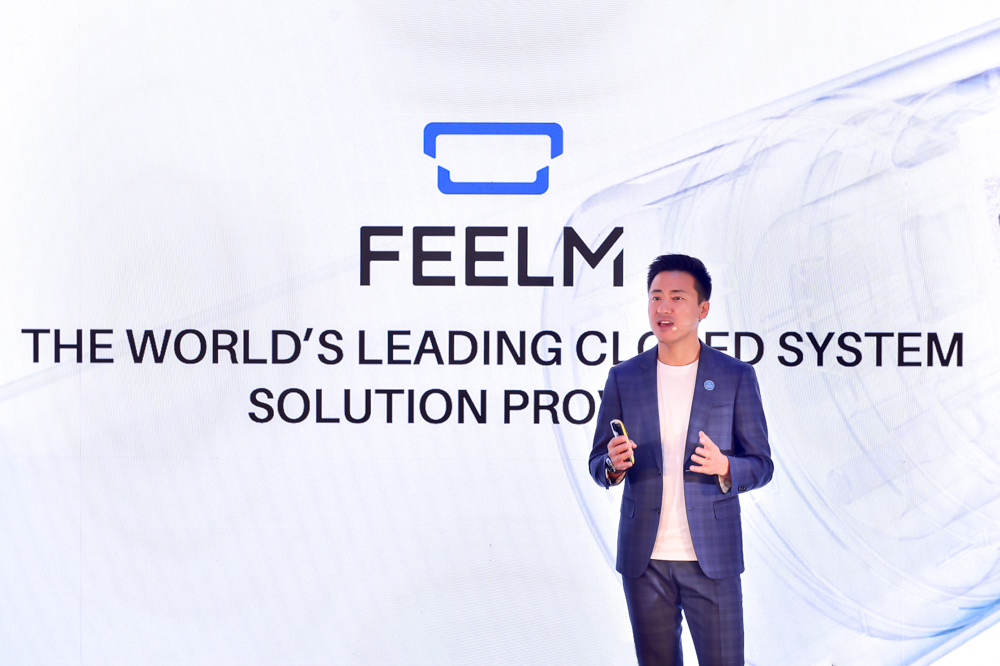
    The innovative new disposable vaping system FEELM Max was launched during the UK Vaper Expo in Birmingham on May 13.

    The FEELM Max is now available in the UK and EU markets. The event was attended by many top-level e-cigarette industry representatives and FEELM clients, including BAT, RELX International, Totally Wicked and KIWI.

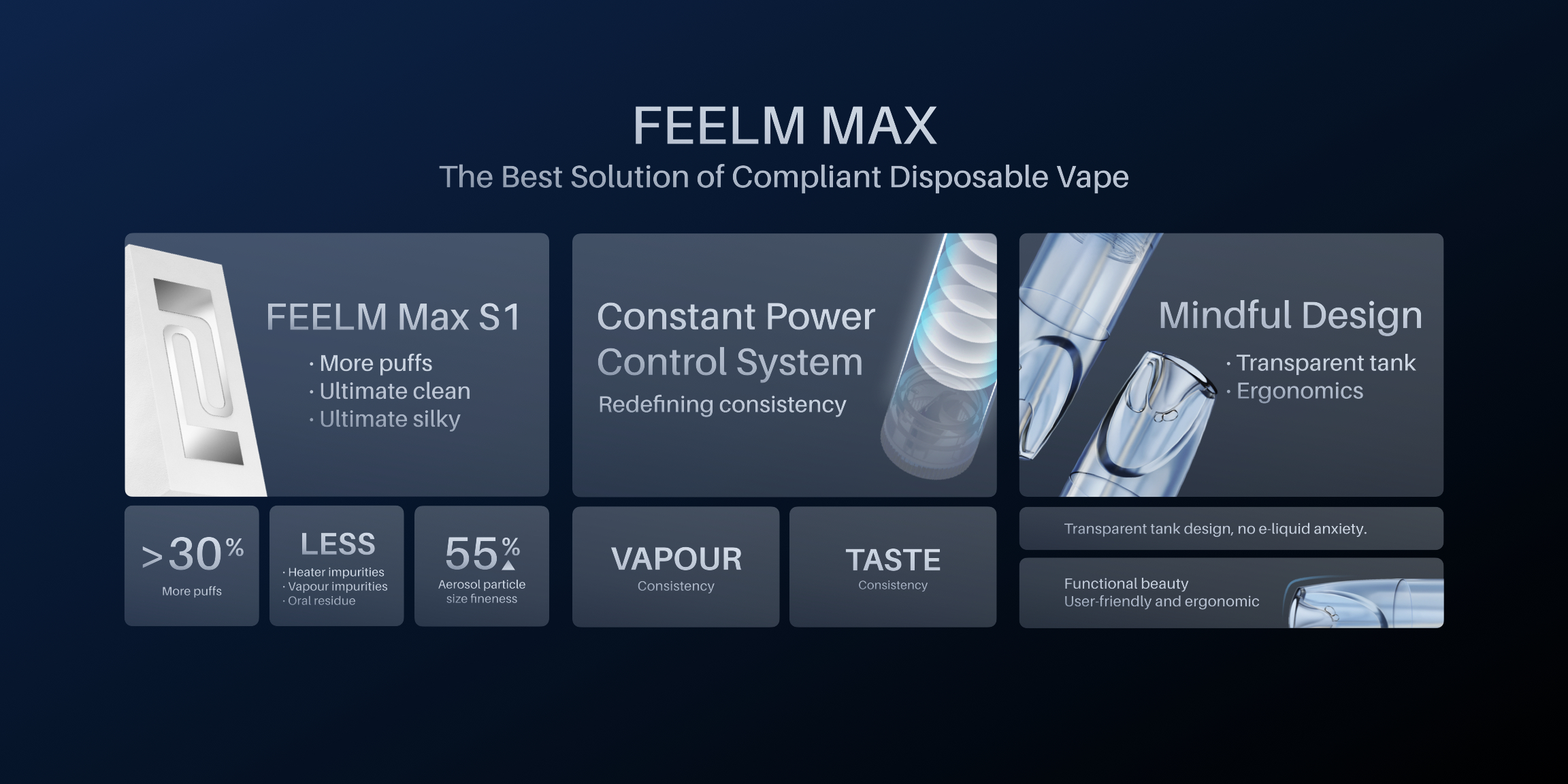
    A subsidiary of Smoore Technology, the world’s largest vaping company, SMOORE, FEELM unveiled the advanced FEELM Max solution that the company says brings three major breakthroughs to vaping, including the advanced heating technology of the Ceramic Coil S1, a constant power control system and “mindful design,” according to a press release.

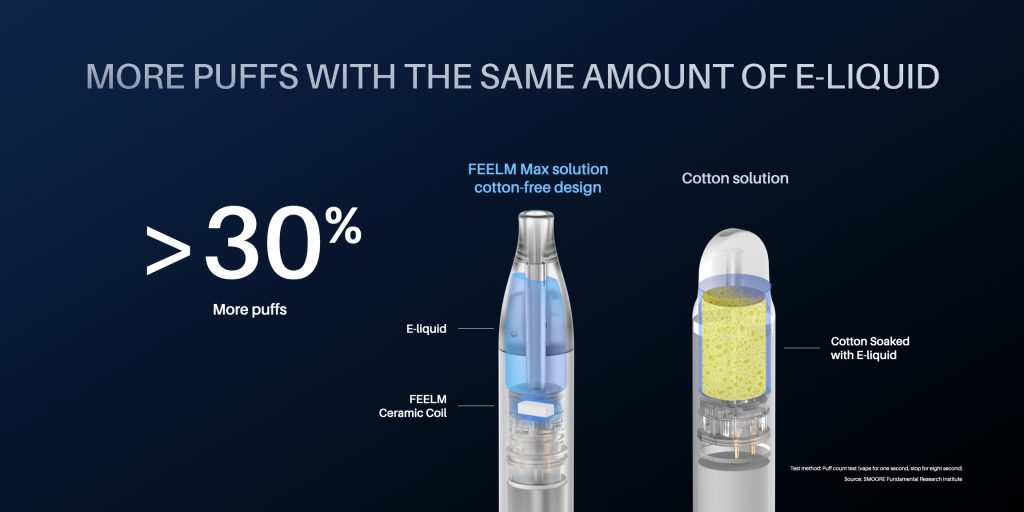
    The FEELM Max uses the new Ceramic Coil S1, which is designed to deliver “a superior vaping experience” and offers an increased puff count that sets a new benchmark in the market.

    Johnny Zhang, assistant president at FEELM

    “Benefitting from its cotton-free design and the resulting improvement of e-liquid utilization, the FEELM Max is able to boost puff count by more than 30 percent compared to cotton coil disposable solutions, providing 800 more puffs and setting a new benchmark for 2ml (e-liquid volumes),” said Johnny Zhang, assistant president at FEELM. “This innovation allows products using the FEELM Ceramic Coil S1 to offer increased puff counts while remaining totally compliant with all local regulations.”

    Additionally, the new S1 coil decreases the number of impurities created in the heating process by 78 percent, resulting “in fresher breath and no unpleasant aftertaste.”

    The new system also has several technological innovations. The FEELM Max solution uses a constant power energy management system for stable vaping. This technology improves taste consistency by 35 percent, which further enhances the user experience, according to the release.

    FEELM Max products have a transparent e-liquid tank for both aesthetics and user convenience that allows consumers to easily see how much e-liquid is left in the device.

    The first industrial whole-chain recycling program was also introduced by FEELM during the UK event. Collaborating with RELX International in the UK, FEELM has “taken the responsibility for implementing a scheme that will facilitate vape recycling to a fuller extent, thereby minimizing the environmental impact.”

    Bing Du, the CEO and founder of RELX International stated at the event: “Thanks to the groundbreaking technology of FEELM Max, and driven by our legendary partnership with FEELM, RELX International is on course to revolutionize the vaping experience across the globe.”

    The company’s commitment to making recycling more accessible demonstrates its dedication to environmental sustainability, according to the release. As the initiative gains traction, it could serve as a model for other industries looking to implement eco-friendly practices and engage adult customers in sustainability efforts.

    FEELM intends to continue pushing the boundaries of what’s possible in vaping technology, while keeping its commitment to sustainability and compliance at the heart of its operations, according to the release. “The company’s mission to shape a better vaping industry, not only for today but for generations to come, remains stronger than ever,” Zhang said.

  • Portugal Mulls New Rules for Tobacco

    Portugal Mulls New Rules for Tobacco

    Credit: Sezerozger

    New legislation aims to restrict the use and sale of all tobacco products in Portugal, including e-cigarettes and heated tobacco.

    A new bill would ban smoking in outdoor spaces next to public buildings such as schools, colleges and hospitals. It will also tighten control over the sale and marketing of cigarettes and other tobacco products in the country.

    The aim is that by 2025 tobacco products will only be available for purchase in tobacconists, petrol stations and airports, reports EuroNews.

    If enacted, it will no longer be possible to sell tobacco directly or through vending machines in places such as restaurants, bars, concert halls and venues, casinos, fairs and exhibitions. The products will also be prohibited at music festivals.

    Portugal is also complying with the European directive of June 29, 2022, which puts heated tobacco products on an equal footing with other tobacco products.

  • Momentum Building for Tobacco Tax Hike

    Momentum Building for Tobacco Tax Hike

    Photo: Taco Tuinstra

    Momentum is building for higher tobacco duties in Nepal , reports MyRublica.

    During a discussion with health reporters on May 10, Health and Population Minister Mohan Bahadur Basnet said he is prepared to increase the tax on tobacco products and spend the money on health services.

    While developed countries subject tobacco products to tax rates of more than 70 percent, Nepal is currently taxing at a low percentage, according to Basnet.

    Basnet aims to invest the money earned from additional tobacco taxation in government hospitals. Nepal’s budget has struggled in the wake of an economic crisis caused by the Ukraine war and Covid-19.

  • FDA Rejects 6,500 Flavored Vape Products

    FDA Rejects 6,500 Flavored Vape Products

    Photo: Surendra

    On May 12, the U.S. Food and Drug Administration issued marketing denial orders (MDOs) to 10 companies, which collectively manufacture and market approximately 6,500 flavored e-liquid and e-cigarette products. The companies may not market or distribute these products in the U.S., and retailers who sell these illegal products risk FDA enforcement action.

    According to the FDA, the premarket tobacco product applications (PMTAs) provided insufficient evidence to show that permitting the marketing of these products would be appropriate for the protection of the public health. The flavor names of some of the products denied include Citrus, Strawberry Cheesecake, Cool Mint, and Menthol. 

    Since the spring of 2020, the FDA has received applications for over 26 million new tobacco products, the majority of which were for e-cigarette products. To date, FDA has completed review and taken action on over 99 percent of these applications, according to the agency.

    “Science is a cornerstone of FDA’s tobacco product review process,” said Matthew Farrelly, director of the Office of Science within FDA’s Center for Tobacco Products in a statement. “Today’s decision to deny approximately 6,500 products was based on the lack of scientific evidence provided in the applications. We will continue to ensure all new tobacco products undergo robust, scientific premarket evaluation to determine whether they meet the appropriate public health standard to be legally marketed.”  

    The companies that received MDOs include Imperial Vapors, Savage Enterprises, Big Time Vapes, SWT Global Supply, Great Lakes Vapor, DNA Enterprise (“Mech Sauce”), Absolute Vapor and ECBlend.

    FDA is withholding the names of the other two companies that received MDOs to protect potential confidential commercial information.

  • California Officials Sued Over ‘Flavored’ Smokes

    California Officials Sued Over ‘Flavored’ Smokes

    Photo: RAI

    R.J. Reynolds Tobacco Co. (RJRT) has filed a lawsuit against California state officials, including Attorney General Robert Bonta, in response to the Attorney General’s issuance of several Notices of Determination that allege certain Camel and Newport cigarettes styles are “presumptively” flavored based on their promotional materials. The lawsuit, filed in California state court, seeks declaratory and injunctive relief, including that the notices be rescinded.

    In a press note, RJRT said it stands by its new products and believes that they comply with California state law and therefore can continue to be sold. Before introducing the products for sale, RJRT followed all applicable pre-market regulatory requirements.

    According to RJRT, the new Camel and Newport styles do not impart a distinguishable taste or aroma other than tobacco and are marketed to clearly indicate that they are non-menthol. The California Attorney General’s Notices do not acknowledge the fact that RJRT’s new product introductions are prominently labeled and marketed as non-menthol.

    “Reynolds has repeatedly called on enforcement officials in California to take action to combat the flood of illegal, unregulated, disposable vapes in kid-friendly flavors like Watermelon Bubble Gum and Rainbow Candy that are being shipped into the state’s ports from unknown origins,” RJRT wrote. Prioritizing enforcement of these illicit vapor products, rather than focusing on compliant products, would better serve Californians.”

  • Poll Reveals ‘Trust Gap’ In Vaping

    Poll Reveals ‘Trust Gap’ In Vaping

    Photo: Taco Tuinstra

    There is a major trust gap in vaping among smokers, with over half now believing they’re just as harmful as cigarettes or more harmful than cigarettes.

    The poll of 2,000 smokers revealed a growing distrust in switching to vapes. Nearly 38 percent who lack trust, say it could stop them from attempting to quit their smoking habits through vaping in the future.

    The government’s independent Kahn Review said vaping had a central role to play in a smokefree future across the country, with more than 6.5 million people still smoking in the U.K. And evidence last year by the Office for Health Improvement and Disparities (OHID) re-confirmed that vaping was at least 95 percent less harmful than smoking.

    But according to the Adult Smokers Trust in Vaping study conducted by One Poll and commissioned by SMOORE, pioneers in inhalation technology, 29 percent only trust vaping a little as a method to quit smoking, whilst 13 percent do not trust it at all.

    And of those whose trust is diminishing, 35 percent cite the lack of independent long term clinical research showing vaping to be less harmful than smoking. While 31 percent are concerned about the lack of any information available about the harm profile of different vape products.  Other factors that had caused a lack of trust included: negative reports and studies that smokers had come across, inconsistency of government attitudes across the world towards vaping, the growing black market for vapes, and the view of the World Health Organization on vaping.

    “There’s a major push to get smokers to move to vape products, but as of now, they just do not have all the information they need to make an informed decision to switch,” said Chenxing Pei, a senior aerosol engineer at the Smoore Centre for Analysis, Testing, and Safety Assessment, in a press release publish by the U.K. Vaping Industry Association.

    “It’s vital smokers are confident enough to switch, especially since health minister Neil O’Brien said the government must ‘exploit the huge potential of vaping to help adult smokers to quit.’

    “But reducing or quitting is incredibly difficult, it’s imperative to give them the belief that what they are attempting isn’t going to be a waste of time.

    “And if vaping is to be viewed as a credible way to quit, urgent efforts need to be made to ensure smokers trust these products to have the desired impact.”

    The research also revealed how trust among these smokers could be regained, with 30 percent claiming public health campaigns promoting the evidence-based facts could turn the tide. Better education of doctors to give more advice on how vaping can be an effective way to reduce harm caused by smoking, was cited as another key way to build trust.

    Meanwhile, 21 percent would welcome advertising regulations for vaping companies to be lifted—as long as they are promoting evidence from credible sources.

    But confusion persists among 68 percent of smokers when it comes to understanding which products would be suitable to help quit. And 70 percent now “don’t know who to believe” when it comes to vape products.

    Three quarters of smokers want information to be made available on the harm profile of the vape product at the point of purchase. With 87 percent of these saying it is important to know exactly what it is you are inhaling. Many are looking for clarification about the chemical constituents (60 percent), carbon residues (46 percent) and heavy metal content (44 percent) in their vapes.

    However, of those who smoke and vape, 74 percent initially started to reduce their reliance on cigarettes, with 58 percent of these claiming they were successful.

    The study coincides with Smoore establishing an independent think tank of scientific, smoking cessation and compliance experts from the U.K. and U.S. to lay the foundations for an industry-wide harm reduction rating system that can be communicated to consumers on product packaging or accessed via a QR code.

    “The concept of tobacco harm reduction is not widely understood by smokers, and there are widespread misperceptions regarding the relative safety of vaping products compared with cigarette smoking among the general public,” said Ian Fearon, one of the experts on the panel, who has previously worked for Juul Labs and BAT in senior scientific and clinical roles.

    “The development of a harm reduction label may help smokers to understand the reduced risk potential of vaping and encourage switching, in addition to reassuring vapers regarding the quality of the products they use and allowing them to differentiate between different products.

    “Government statistics last year showed that the proportion of smokers in the U.K. was at its lowest level since records begun, a decline which was attributed largely to the major role played by vapes.

    “However, the findings of this study, highlight a significant trust gap amongst adult smokers and it’s crucial for the vaping industry, government, regulators and healthcare professionals to come together to bridge it and support smokers on their quitting journey.

    “It’s clear that open and transparent communication is essential in this process and to supporting the government’s ambitions for the country to go smokefree.”

    Click here to view the report