Blog

  • Dispelling Myths

    Dispelling Myths

    Photo: Elena Milevska

    A disturbingly larges share of doctors believe that nicotine causes smoking-related diseases.

    By George Gay

    For a long time, people involved in tobacco harm reduction (THR) have bemoaned the fact that many doctors wrongly believe that consuming nicotine causes smoking-related diseases. Clearly, the concern as far as THR advocates are concerned is that, logically, these doctors are unlikely to recommend that smokers transition from combustible cigarettes to other forms of nicotine delivery, such as those afforded by electronic cigarettes, nicotine pouches and, one must assume, even nicotine patches.

    This concern was highlighted in a July 20 press note issued on behalf of the Foundation for a Smoke-Free World (FSFW), which said that a survey of more than 15,000 physicians in 11 countries had found, in part, that 77 percent of doctors mistakenly believed nicotine caused lung cancer, and 78 percent mistakenly believed it caused atherosclerosis. The Doctors’ Survey was carried out online by Sermo with doctors based in China, Germany, Greece, India, Indonesia, Israel, Italy, Japan, South Africa, the U.K. and the U.S.

    “It is imperative that doctors get the proper training to learn the facts about nicotine and tobacco harm reduction options that can help their smoking patients quit,” Muhammad Ahmed, the FSFW’s director of health and science research, was quoted in the press note as saying. “With more than 7 million smokers dying annually from smoking-related diseases worldwide, many lives can be saved if doctors become more knowledgeable about the cessation tools available.”

    Now, the FSFW is inviting researchers to submit (contact support@smokefreeworld.org) proposals to further analyze the Doctors’ Survey findings and propose programs to help improve doctors’ “fluency about smoking cessation and tobacco harm reduction.”

    The report of the Doctors’ Survey has much to recommend it, and I would urge anybody interested in THR to read it. One of its strengths, I would suggest, is that it is a practical attempt to help address the chronic problems associated with doctors being generally ill-informed about nicotine. And it is to be hoped that this practical emphasis continues as researchers further analyze the survey’s findings and propose remedial actions. It would be unfortunate if there were a focus on analysis that led to academic drift. We should not lose sight of the fact that this is about helping smokers, not about helping indigent academics—the words “more research is needed” should be proscribed.

    Primary Sources

    While generally supporting this initiative, I have a few concerns and questions about some of the issues that the survey raises. There is what looks like an unnecessary reference to IQOS in one of the report’s tables, something of an “own goal” I would have thought, given that the FSFW comes under attack for the source of its funding, notwithstanding such attacks might be unwarranted and unfair.

    And I hope that whatever comes out of the proposals for improving doctors’ “fluency about smoking cessation and tobacco harm reduction,” it clears up a couple of questions. Doctors in Japan are said in the survey report to believe mistakenly that “light” cigarettes are less harmful than other cigarettes, but what are doctors working in the EU to make of this “mistake” when the authorities there impose a limit on deliveries? Is it out of malice or a sense of a lightness of being that the authorities in the EU allow only the sale of “lighter” cigarettes? And a related question would ask if anybody knows whether there is any point in doctors recommending smokers cut their consumption. Does anybody know if the risks of smoking are proportionate to consumption levels—in respect of delivery levels per stick and/or by daily stick consumption?

    More importantly, the question arises as to whether we know if doctors are the primary source of the information on smoking and quitting that people absorb and act upon. If so, the direction of the FSFW’s travel seems correct and important. If not, it would seem irrational to spend a lot of time and money trying to improve the training of doctors in this area, especially given that if they haven’t figured out the role of nicotine by now, it is possibly going to take a lot of effort to get through to them. I certainly cannot see how the doctor route could be universally applicable given that many governments oppose at least some aspects of THR, and many health services are at least partly state institutions.

    A cursory internet search indicated that, in the U.K., patients had on average 8.7 consultations with general practitioners during 2018–2019, 3.3 of them face-to-face. Compare that with the uncountable number of times these same people would have gawped at their mobile phones. So, in a country such as the U.K., where the government is convinced of the effectiveness of THR, it would perhaps be better for it to use social media to get messages across. I am not advocating the usual sort of official messages that comprise little more than a tissue of lies but messages simply about the relative safety of nicotine as the government sees it. Otherwise, messages could be included, for instance, on the shirts of professional sorts of people, on public transport and on public buildings. And given the increasingly authoritarian nature of the U.K. government, perhaps it might consider the compulsory tattooing of people with these important messages.

    Another problem was brought to light when Ahmed said that it was imperative for doctors to receive the proper training to learn the facts about nicotine and tobacco harm reduction options that can help their smoking patients quit. The obvious questions arise as to who gets to decide what amounts to proper training and what the facts are in a postmodern world. The facts, for example, as they apply to the use of THR principles and as they are decreed by the authorities in India and the U.K., are likely to be very different.

    The World Health Organization, though paying lip service to THR, opposes the shift from inhaling tar and nicotine to inhaling just nicotine. And the U.S. Food and Drug Administration, whose influence stretches beyond the U.S., while also paying lip service to THR, has done much to discourage smokers making such a shift. In fact, the FDA, at the same time, has de facto promoted the smoking of tar-delivering, low-nicotine combustible cigarettes. What is a trainee doctor to make of such policies—such implied facts?

    Of course, such issues will not have escaped the attention of those behind this initiative, but it concerns me that any attempt at trying to resolve them, either universally or on a state-by-state basis, will simply lead to delays in reaching THR objectives. The vaping advisory industry, in all its guises, should not be seen as being more important than the vaping industry.

    Evaluating the Curriculum

    But I have a bigger concern. The ad nauseam message coming from governments and organizations such as the WHO and the FDA is that “[c]igarette smoking remains the leading cause of preventable disease, disability and death ….” In fact, that quote comes from the Centers for Disease Control and Prevention and refers to the U.S.

    At the same time, the message coming from the Doctors’ Survey is that most doctors are ill-informed about issues surrounding smoking and nicotine consumption because they have received little or no training on smoking cessation. “This may reflect the cursory training they’ve received in smoking and harm,” is a quote from the survey referring to doctors in Italy.

    Let me paraphrase these two positions:

    1. Cigarette smoking is the leading cause of preventable disease, disability and death.
    2. Most doctors receive only cursory training in respect of the leading cause of preventable disease, disability and death.

    It seems I am being asked to believe that doctors, charged, in part, with helping people avoid sickness, are not being properly trained in respect of the most threatening health concern of all. How can I reconcile these two positions or overcome the apparent state of insanity they describe? I could assume, I suppose, that those who devise the curriculums at the base of doctor training courses are not in full control of their mental faculties, that they insist doctors should, when you visit them, be able to rattle off the names of the 206 bones in your body but not be able to give you sound advice on the leading cause of preventable disease, disability and death. On the whole, I find such an explanation unlikely given that we are talking about the curriculum advisers in 11 countries. They cannot all have taken leave of their senses.

    So, I am left with the conclusion that either No. 1 or No. 2 above must be wrong, and I am leaning toward the idea that it is No. 1 that is wrong. But before I expand on this idea, I need to make three points. Firstly, I am not saying cigarette smoking is anything but hugely harmful. I think it stands to reason that inhaling anything but pure air is not a good idea and is likely to cause you harm. Secondly, I am not saying cigarette smoking was never the leading cause of preventable disease, disability and death. Thirdly, I have read in recent times about three things reported to be the leading cause of early deaths in humans: tobacco smoking, outdoor pollution and poor diet.

    Above, I quote Ahmed as saying more than 7 million smokers die annually from smoking-related diseases worldwide. But what does this mean? It is arguably a completely open-ended figure, one that might or might not approach or even surpass the WHO’s 8 million. OK, you could argue the “more than 7 million” is just a throwaway, ballpark figure aimed at underlining the severity of this issue, but surely it is necessary to have more than a ballpark figure before we start trying to build a sturdy quit-smoking edifice?

    Recently, The Guardian newspaper’s health editor, Andrew Gregory, made the point that long-term exposure to air pollution is associated with chronic conditions such as heart disease, asthma and lung cancer.

    Clearly, separating many cigarette-smoking deaths from pollution-related deaths must be difficult, if not impossible, so I find it odd that health professionals are willing to accept and work on the basis of what seem to be highly dubious smoking-related-disease figures. Why are health professionals so keen on expending huge amounts of effort and money addressing what they blindly accept to be the problems caused by smoking, which, by the way, are likely decreasing and which individuals can address for themselves, rather than expend that effort and money addressing the much bigger and growing health problem posed by pollution, over which individuals have next to no control and which are going to get worse as the population of the world approaches 10 billion and becomes even more concentrated in megacities? It is time to ask “cui bono” and “cui malo”?

  • Major Tax Increase Introduced in Congress

    Major Tax Increase Introduced in Congress

    Credit: Roman R

    Last week, lawmakers in the U.S. introduced the CARE For Moms Act in Congress. That bill would increase healthcare for expecting and new mothers, while also exponentially increasing the taxes for vaping, roll-your-own, cigars and other tobacco products.

    The tobacco tax language in the CARE Act was copied and pasted out of the Tobacco Tax Equity Act, a bill that has been introduced as a rider in bills introduced in previous sessions of Congress but it failed to gain any traction, according to halfwheel.

    That could change after Sen. Ron Wyden and Sen. Dick Durbin have now introduced the Tobacco Tax Equity Act of 2023 in the Senate as a standalone bill, while Rep. Raja Krishnamoorthi introduced the bill in the House of Representatives.

    The tobacco tax-related language includes:

    • New taxes for e-cigarettes;
    • Doubling the tax on roll-your-own tobacco;
    • A more than 16x increase on pipe tobacco;
    • Doubling the tax on small cigars;
    • A massive tax hike for premium cigars;

    For premium cigars, the language removes the existing federal excise tax of 52.75 percent, capped at 40.26 cents per cigar, and replaces it with a weight-based tax of $49.56 per pound.

    Because it’s a weight-based tax, the difference between the existing tax and the new taxes would vary depending on how heavy the cigar is. For cigars robusto or larger, it would likely more than triple the current federal tax rate.

  • DOJ Appeals FDA Premium Cigar Decision

    DOJ Appeals FDA Premium Cigar Decision

    The premium cigar industry recently declared victory in the fight against oversight by the U.S. Food and Drug Administration. Celebrations may have been premature.

    The U.S. Department of Justice has filed an appeal on behalf of the FDA for a decision handed down from the United States District Court for the District of Columbia that fully vacated the Deeming Rule as it applied to premium cigars, according to media reports.

    The lawsuit was filed by the Cigar Association of America, the Cigar Rights of America (CRA) and the Premium Cigar Association. The case focused in part on the rulemaking process, which requires the FDA to inform the public about upcoming regulations and solicit feedback on those proposed rules.

    In last month’s decision in Cigar Association of America et al. v. United States Food and Drug Administration, Judge Amit P. Mehta made a sweeping, albeit expected, ruling that granted relief to the three cigar industry trade groups that sued the regulatory agency in 2016 on behalf of the premium cigar industry.

    The news confirms industry fears that warning labels, premarket tobacco product application (PMTA) review of cigars and other limitations that have impeded the ability of cigarmakers are still a possibility.

    Recently, the FDA acknowledged the decision and one of its impacts, telling cigar companies that it did not plan to assess user fees for “premium cigars” sold during Q4 FY23.

    The Department of Justice, which represents FDA on legal matters, had 60 days to appeal the ruling. It’s unclear whether the agency will ask a court for a stay, which could reenact the deeming regulations for “premium cigars” as the appeal process works itself out.

  • Reynolds Breaks Ground on WaterHub

    Reynolds Breaks Ground on WaterHub

    Image: Reynolds

    Reynolds American Inc., the BAT Group’s U.S. subsidiary, broke ground on the WaterHub at the Reynolds Operations Center in Tobaccoville, North Carolina. The WaterHub is an advanced water recycling facility and product of a subsidiary of NextEra Energy Resources. Several city and state leaders, NextEra Energy Resources and Reynolds representatives and others involved in the WaterHub project gathered Thursday as Reynolds demonstrated progress on its commitment to excellence in environmental stewardship with the project’s official groundbreaking celebration.

    Once construction is complete, the WaterHub is expected to reclaim more than 60 million gallons of water per year, equivalent to the annual water supply of approximately 550 average U.S. households. This installation aims to reduce Reynolds’ environmental footprint and conserve water in Forsyth County’s Yadkin Pee Dee River Basin.

    “Through the WaterHub, we expect to reduce water withdrawn at the Reynolds Operations Center by over 40 percent, which in turn would reduce the water withdrawn across our global operations sites by approximately 6 percent,” said Bernd Meyer, executive vice president of operations at the Reynolds organization, in a statement. “We are doing our part in preserving precious natural resources, and today celebrates a significant investment and long-term commitment to environmental sustainability.”

    The WaterHub at the Reynolds Operations Center will be one of the few projects of its size in the U.S. using advanced water reclamation technologies, allowing Reynolds’ operating facilities to reduce their dependence on potable water for factory utility operations. 

    “At NextEra Energy Resources, we are dedicated to offering innovative solutions that help businesses like Reynolds in achieving their sustainability and environmental responsibility objectives,” said Gary Morris, vice president of distributed generation for NextEra Energy Resources. “The WaterHub not only actively conserves water resources but also bolsters operational resilience.”

    This project complements Reynolds’ work to use water efficiently across its operations facilities. The American Snuff Company facility in Clarksville, Tennessee, and R.J. Reynolds Tobacco Company Whitaker Park site in Winston-Salem, North Carolina, both recently earned Alliance for Water Stewardship (AWS) Certification. Reynolds’ Operations Center in Tobaccoville earned this AWS designation in 2022.

  • Norm Bour: Current State of Vape Industry

    Norm Bour: Current State of Vape Industry

    vape shop customer

    “The more things change, the more they stay the same,” is an expression that has been around for almost two centuries, and it speaks to the fact that the small picture(s) of life may change, but the larger one does not. The vape industry and all the challenges and changes that have happened in the past decade are totally contrary to that famous saying.

    A decade ago, the vape industry was the epidemy of the Wild, Wild West, full of vape shops springing up on every corner, and any/everyone creating e-liquids in their bathtubs at home. Regulation and competition changed all that and brought some semblance of “orderliness” to the market, but as state and federal regulations bombarded the industry, and with the FDA creating onerous and unattainable guidelines, the vape space has truly become one of survival.

    I recently attended a vape event in Phoenix which brought together several dozen top manufacturers, distributors, and buyers, and universally everyone lamented the same concern: business is down.

    Why is business down?

    The reasons are many, including strict regulations, and now, even more enforcement of those regulations, but overall, the cause was much simpler. The huge COVID-19 rebound in 2020-22 put more money in consumers’ pockets and more time on their hands. Those issues combined created an artificial bubble that many thought would last. But time has passed. Add in the inflation that has pushed up food and other cost of living expenses, and some former necessities are now becoming unaffordable luxuries.

    “It’s a balancing act between the addictive nature of some nicotine products and the limitations of buyer’s budgets,” said Jamie Reed with Simple Vape Supply from Orange County California. “I’ve been in the industry for over ten years, and this is evolution in its purest form and based around ’survival of the fittest.’”

    Simple manufactures and distributes over 100 different assortments of nicotine cartridges, including disposables, including various iterations of CBD, Delta-8 and Kratom.

    “It’s interesting,” Reed added. “When I got hired, I was told that there was an ‘expiration date,’ and we all knew that this industry might not last, and that the cream would rise (to the top). We planned to be one of those surviving companies, and we’ve been able to adapt to the times.”

    Her company, along with many that are still around, were mostly run by rebels, radicals, and envelope pushers; and many have in fact changed accordingly, but some have merely learned how to “play the game” and outwardly appear to be toeing the line, but the reality may be different.

    “We were aware that the COVID blip was a one-time event. People were home, they had government money to spend, and no one was checking in on them or requiring any urine tests. The Delta (8,10) boom really added to that, and everyone jumped on that bandwagon,” she said excitedly.

    That line of CBD was an example of how the industry has and continues to push back. The FDA says you can’t do this, so the industry says, “F-you, then we’ll do that.”

    With regulation eliminating or reducing product selection, almost any industry will do the same thing: adapt; repurpose, or reposition.

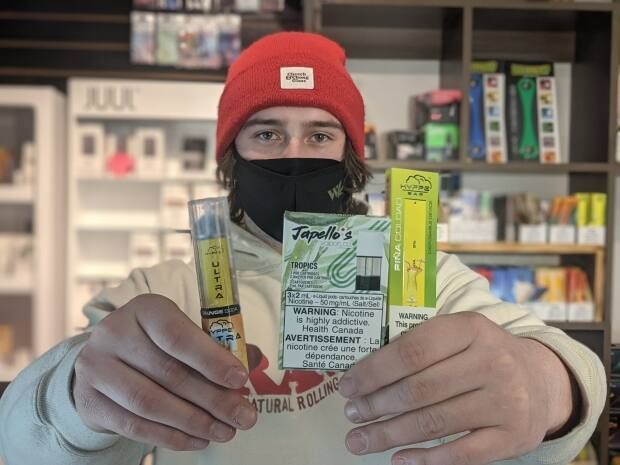
    Of the dozens of people I spoke with at the event, the numbers (from shop owners and manufacturers) were pretty consistent, and most of them were down 20 to 30 percent. Many were saying that purchase sizes were lower than normal and a typical ten-thousand-dollar order was now half that. They saw some shops closing, but most were working on smaller revenues.

    man holding flavored vape products
    Manager J-K Thorne holds some of the flavored products that are no longer available at Wild Impulse vape shop. (Shane Hennessey/CBC)

    Meanwhile, on the other side of the equation, vape liquid manufacturers who are trying to “play the game” right and submitting premarket tobacco product applications (PMTAs) to the U.S. Food and Drug Administration are frustrated at the amount of time it takes and how much money is being thrown into a (seemingly) dark hole.

    I spoke with one of the owners of a large vape manufacturing business and distribution company in Idaho, and he shared some facts and figures about their process of trying to make their products “legal.” Legal, in the eyes of the FDA, has caused his company to squander over $5 million in the past few years trying to get authorization.

    Mike Larsen is a detailed and focused vape guy who has been in the industry for over a decade and is with Lotus Vaping Technology, which started in 2011. As a partner and director of sales, he is on the front line of everything the company does to stay legal and compliant and is riding the roller coaster ride on a daily basis.

    “Disposables have really changed the game,” he said, “and they have reduced the role of vape shops where people used to come for education and guidance. Consolidations and closures have also reduced the shop numbers by 30 to 40 percent, and now you have larger conglomerates doing the work of the multitude of shops.”

    We spoke about a possible flavor ban nationally, and he said he was skeptical.

    “The PMTA process has already reduced or eliminated flavors, so it may not be necessary to go to that length. There have been between six and seven million submissions by thousands of companies, and so far, just 23 have been approved. I know of a few companies that submitted over a million applications themselves. And here’s the irony: everyone approved has been a Big Tobacco company, and they make up just a fraction of the total vaping market.”

    The second irony on top of that, is that those so-called approved products are ones that no one wants.

    We talked about whether those approvals were fair or were the result of favoritism and bias, and he smiled since we both knew the answer.

    “When you look at the PMTA process and the rigid requirements, it seems pretty obvious that they were written to the advantage of the larger, established companies, and the “small guy” had very little chance in this skewed game. You can’t even budget for something like this,” he continued. “The original filing costs over a million dollars, and I know several companies that have put another ten million in, only to get denied. Who has deep pockets like that? In 2016 I could have named over 150 liquid companies doing good business; today I can name about three dozen.”

    And that is why the number of companies manufacturing tobacco and vape products is half what it was and is getting smaller every year. The FDA changes the rules of the game continually.

    “There’s something happening here, but what it is ain’t exactly clear,” is the beginning line of a song that speaks to changes going on in society. That song by Buffalo Springfield may have nothing to do with vape, but the message says the same thing: there is something happening here although it may be clearer than we realize. We all knew this would happen; it was predicted a decade ago.

    In the vape space, the more things change…the more things change.

    Norm Bour is the founder of VapeMentors and works with vape businesses worldwide. He can be reached at norm@VapeMentors.com.

  • Retailers Face Civil Money Penalties

    Retailers Face Civil Money Penalties

    The retailers selling illegal flavored disposable vapes are under scrutiny. The U.S. Food and Drug Administration issued complaints for civil money penalties (CMPs) against 22 retailers for the illegal sale of Elf Bar/EB Design.

    The FDA previously warned each retailer in the form of a warning letter to stop selling unauthorized tobacco products, according to the agency. During follow-up inspections, the FDA observed the retailers had not corrected the violations, which resulted in the civil money penalty actions. 

    “The FDA has been abundantly clear that we are committed to using the full scope of our authorities, as appropriate, to hold those who break the law accountable,” said Brian King, director of the FDA’s Center for Tobacco Products (CTP). “These retailers were duly warned of what could happen if they failed to correct their violations. They chose inaction and will now face the consequences.”

    The complaints seek the maximum civil money penalty of $19,192 for a single violation from each retailer. While the FDA has issued civil money penalty complaints to retailers for selling unauthorized tobacco products in the past, this is the first time the agency is seeking CMPs for the maximum amount against retailers for selling illegal flavored disposable vapes.

    The retailers can pay the penalty, enter into a settlement agreement, request an extension of time to file an answer to the complaint or file an answer and request a hearing. Those that do not take action within 30 days after receiving the complaint risk a default order imposing the full penalty amount.

    Courtesy: US FDA

    In addition to the CMP complaints, today the FDA announced an additional 168 warning letters to brick-and-mortar retailers for illegally selling Elf Bar/EB Design products. These warning letters were the result of a coordinated nationwide retailer inspection effort conducted throughout the month of August, according to the agency.

    Warning letter recipients have 15 working days to respond with the steps they have taken to correct the violation and ensure compliance with the law. Failure to promptly correct the violations can result in additional FDA actions such as injunction, seizure or civil money penalties.

    “We continue to monitor closely all those in the supply chain, including retailers, for compliance with federal law,” said Ann Simoneau, director of the Office of Compliance and Enforcement in the CTP. “This includes follow-up inspections and surveillance of those who have received a warning letter, and taking additional action, as appropriate, to enforce the law.” 

  • U.S. Premium Cigar Imports Drop

    U.S. Premium Cigar Imports Drop

    Credit: Timothy S. Donahue

    The Cigar Association of America (CAA) has released a report showing that U.S. imports of premium cigars from January-July 2023 are down 3.4 percent compared to the record pace that was set in 2022.

    Through the end of July, CAA estimates the U.S. imported 252.81 million cigars, compared to 261.63 million in the same period during the year before.

    While the numbers are down compared to last year, the trend line for the first seven months of the year is actually closer to 2022 than the Q1 numbers. More importantly, the numbers are still significantly above pre-Covid-19 levels, reports Halfwheel.

    On a month-by-month basis, imports rose in four of the seven months, though March and April were down a combined 11.7 million cigars, or 14.41 percent compared to 2022. Addittionally, there were 6.5 million more cigars imported in May and July, or 8.33 percent over last year.

    Nicaragua remains the dominant supplier of premium cigars to the U.S., accounting for roughly 55 percent of imports through the first seven months, according to CAA. However, those imports are down 4.2 percent compared to last year.

    The CAA breaks down individual imports from seven countries and all were down except the Dominican Republic, which the group estimates has shipped 3.37 million more cigars compared to the same period last year, an increase of 4.8 percent.

  • Reynolds Expands American Snuff Facility

    Reynolds Expands American Snuff Facility

    Image: Reynolds

    Reynolds American Inc. announced the opening of the recently expanded American Snuff Company (ASC) operations facility in Clarksville, Tennessee. The investment in the facility will position the company for future growth and has already added over 70 roles to the facility’s workforce, with plans to add more in the coming months.

    ASC celebrated the newly enhanced space with a ribbon-cutting ceremony on Tuesday, Sept. 26, 2023. ASC’s significant investment in the property will increase certain production capabilities, optimize existing processes and allow for the installation of additional processing and packaging lines.

    “American Snuff Company has a long history of operations in Clarksville, and we are proud to further invest in our workforce and production capabilities at the site,” said David Waterfield, president and CEO of Reynolds, in a statement. “This expansion and considerable investment reflect our focus on delivering long-term, sustainable growth for the future of our business.”

    The site will further accommodate research and development and create capacity for additional shipping, receiving and tobacco curing. Additionally, the expanded site will include modernized quality labs, maintenance shops and employee areas.

    The Clarksville site expansion follows a strategic review of Reynolds’ U.S. operations that spanned several years. Historically, the facility used processed tobacco from regional farmers before being sent to other ASC factories for production. This move will bring processing and finished goods production under one roof.

    ASC Clarksville is the Reynolds organization’s second-largest production facility in the U.S.

  • France’s Last Cigarette Factory Closing

    France’s Last Cigarette Factory Closing

    Image: Smeilov

    The last cigarette-making factory in France is set to close by the end of the year, according to the site’s owner, reports The Straits Times.

    The Manufacture Corse des Tabacs (Macotab) is located in Corsica, and it manufactures cigarettes for Philip Morris, which recently ended the contract.

    The factory is owned by SEITA, the former French monopoly. Now, around 30 employees work at the factory, down from 143 in the 1980s.

    In 2019, SEITA closed France’s tobacco processing factory located in the traditional growing region of the Dordogne.

    Legislation to reduce smoking and its related health issues has led to reductions in cigarette sales. Majority of European tobacco product production takes place in Germany and Poland.

  • Healthcare Bill Could Raise Tobacco Taxes

    Healthcare Bill Could Raise Tobacco Taxes

    Image: JenkoAtaman

    The proposed U.S. Care for Moms Act would support the maternal health workforce, promote access to prenatal and postpartum care and provide resources to mothers as well as increase the excise tax on tobacco products, according to CSP.

    The National Association of Tobacco Outlets (NATO) outlined the tobacco-related proposals in the act: increasing tax on cigarettes from $1.01 to $2.02 per pack; implementing a new e-cigarette tax that would equalize the tax on cigarettes; increasing the tax on moist snuff from $0.11 per 1.2 oz tin to $2.02 per can; doubling the tax on small cigars from $50.33 to $100.66; implementing a new weight-based tax methodology on large cigars; doubling the tax on roll-your-own; and equalizing the tax on chewing tobacco and pipe tobacco to tax them like cigarettes.

    Similar tax legislation has failed in past congressional sessions, according to the NATO.

    The Care for Moms Act also includes provisions to establish a state-based perinatal quality collaborative grant program, establish regional centers of excellence to tackle implicit bias and promote cultural competence among health professionals, support federal efforts to grow and diversify the doula workforce and extend Medicaid coverage for postpartum mothers in all 50 states.