
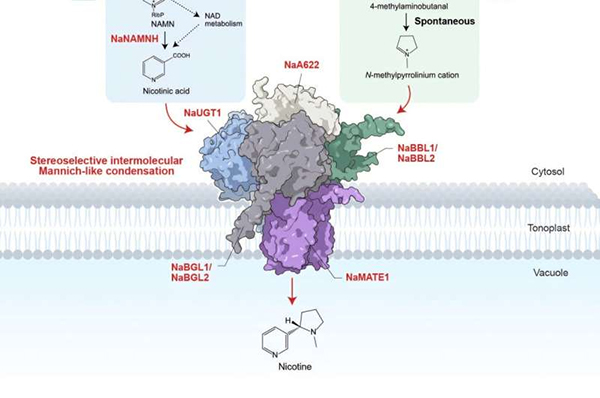
Researchers at the Chinese Academy of Sciences identified the complete biochemical pathway responsible for nicotine formation in wild tobacco, publishing the findings in Cell. Led by Prof. Li Dapeng, the work clarifies long-unknown steps in nicotine’s biosynthesis and provides new insight into how plants build complex alkaloids, with potential implications for synthetic biology and controlled production of high-value natural compounds.
Working in Nicotiana attenuata, the researchers uncovered a five-enzyme “dynamic metabolon” that coordinates the final assembly, stabilization, and transport of nicotine inside plant cells. Using multi-omics analysis, the group identified key enzymes and a transporter that enable a tightly controlled glycosylation and deglycosylation process, allowing the plant to safely produce and store nicotine without self-toxicity.