
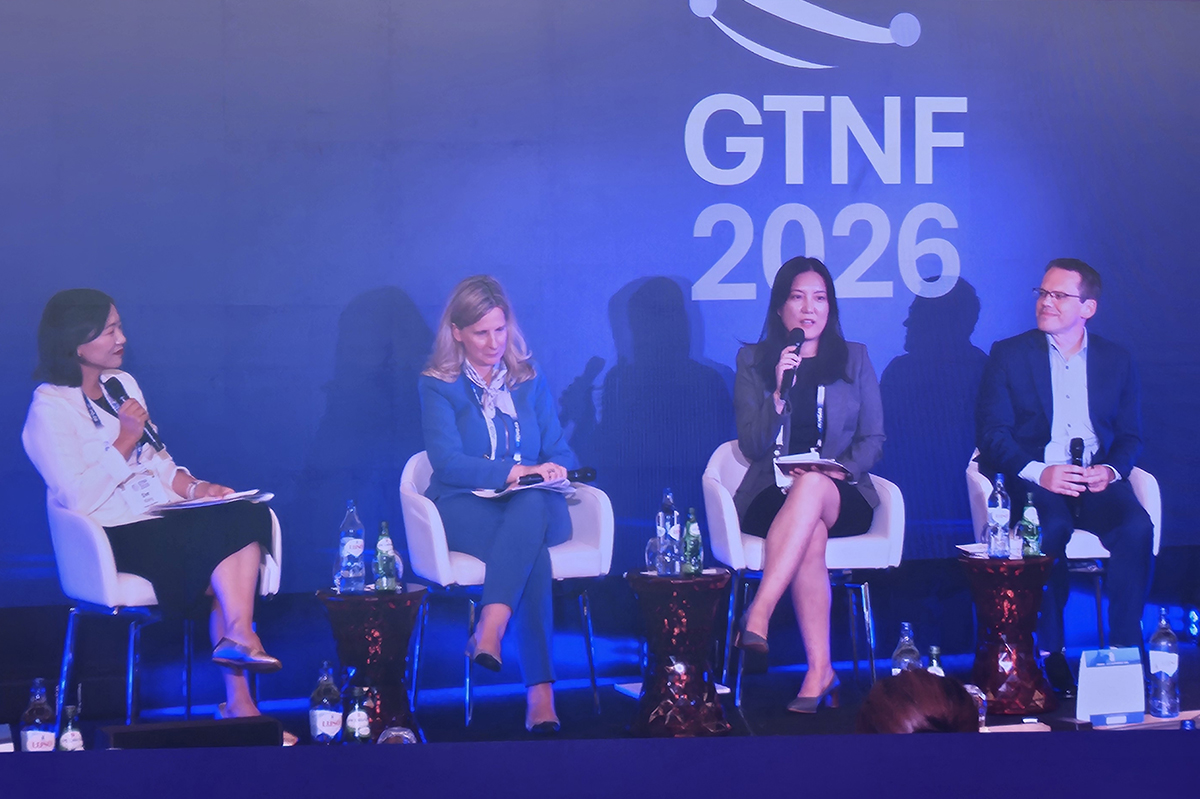
Innovation in tobacco and nicotine products is advancing rapidly, but companies must account for regulation, product standards and consumer needs alongside science and technology, speakers said at GTNF 2026 in Lisbon. In her keynote, Eve Wang, executive director at Smoore International, said the industry has moved from introducing new products into a growth phase, while noting the speed at which products can move from concept to commercialization in China. She compared the development process to a Chinese saying: “The journey is half complete when you are 90% of the way there. The last mile is always the hardest.”
During the subsequent Innovation 360 panel, moderated by Wang, Clio Boura, head of science operations at British American Tobacco, said innovation needs to work closely with science and an enabling regulatory framework that establishes clear quality and safety requirements. She also pointed to portability, convenience, digital technology and sustainability as factors likely to shape products over the next five years. Greg Conley, senior regulatory counsel at ITG Brands, said, “Regulatory viability has to be part of viability from day 1,” arguing that product standards could give companies clearer targets for meeting regulatory requirements. He said the industry’s priority should be the ability to “innovate repeatedly, to keep moving things forward.”
Yu Kang, head of research institute at Hangsen International, said rapid evolution is central to the e-cigarette industry but that innovation must include consumer protection and supply-chain oversight. He called for more efficient premarket review, collection of product standards across markets and closer cooperation among regulators and innovators, supported by scientific data demonstrating safety and compliance. Kang also emphasized the need to continually collect consumer feedback to develop products that meet quality expectations while supporting harm reduction.