Category: News This Week

  • Australia Steps Up Illicit Tobacco Crackdown

    Australia Steps Up Illicit Tobacco Crackdown

    Australia is ramping up its response to the illicit tobacco and vape market, with plans for tougher penalties, new offences, and expanded enforcement powers targeting organized crime, according to the Australian Broadcasting Corporation. More than half of tobacco products sold are estimated to be illegal, generating between A$4.1 billion and A$6.9 billion ($2.9-$4.8 billion) for criminal groups and costing up to A$11.8 billion ($8.3 billion) in lost excise revenue. Proposed reforms include tripling jail terms, enabling asset seizures, and elevating tobacco offences to “serious crime” status.

    Former Australian Border Force officer Rohan Pike said stronger penalties would be welcome if “enforced rigorously and in a sustained way,” but cautioned that enforcement alone is insufficient. He noted excise remains an “ongoing imbalance in the market” and argued it “needs to be reviewed… to reduce the incentive for criminals,” while also highlighting the need for greater consistency across state and territory enforcement frameworks.

    Authorities said enforcement efforts would increasingly focus on disrupting domestic distribution, including shutting illegal retail outlets, penalizing landlords, and targeting online sales channels, as well as addressing the rapid growth of illicit nicotine pouch imports.

  • Rising Costs Hurt Smoore’s Profits Despite Strong Revenue Growth

    Rising Costs Hurt Smoore’s Profits Despite Strong Revenue Growth

    Yesterday (March 17), Smoore International reported 2025 revenue of RMB 14.3 billion ($2.1 billion), up 20.8% year-on-year, driven primarily by strong growth in its enterprise (B2B) segment, which accounted for nearly 80% of total sales. Gross profit rose to RMB 4.9 billion ($729 million), but rising expenses dragged down its profitability, with its net profit for the year falling 18.5% to RMB 1.1 billion ($159 million). Its gross margin declined to 34.1% from 37.4% in 2024.

    Regionally, Europe and other international markets remained the company’s largest revenue drivers, followed by the U.S., with China contributing a relatively small share. The company ended the year with RMB 7.3 billion ($1.1 billion) in cash and proposed a final dividend of HK 0.20 ($0.026) per share.

    Today (March 18), Smoore’s shares on the Stock Exchange of Hong Kong dropped 18% in early trading before rebounding, opening at HK 12.08 ($1.57) before falling to HK 9.94 ($1.29) and closing at HK 11.90 ($1.55). The stock is down 45% over the past six months, according to Bamboo Works.

  • Zimbabwean Farmers Ordered to Destroy Tobacco Stalks

    Zimbabwean Farmers Ordered to Destroy Tobacco Stalks

    Zimbabwe’s Tobacco Industry and Marketing Board “strongly encouraged” tobacco growers to destroy stalks promptly after harvest to prevent the carryover of pests and diseases into the next production season. Under the Plant Pests and Disease Act (Chapter 19:08), farmers are required to uproot all living tobacco plants, including roots, by May 15, with fines or imprisonment for non-compliance. TIMB emphasized that simply cutting or slashing stalks encourages regrowth, which can harbor pests, spread disease, and deplete soil nutrients, threatening both crop yields and the broader tobacco industry.

    To reinforce compliance, stakeholders have suggested linking funding access for the next crop to proper stalk destruction, while grower associations are conducting awareness campaigns on the risks of non-compliance. First-time offenders face a $100 fine, with repeat offenders facing higher fines or imprisonment. Some farmers have also been flagged for growing crops from the same family as tobacco on the same land, a practice prohibited under the regulations.

  • Latvia Continues Plan of Raising Tobacco Taxes

    Latvia Continues Plan of Raising Tobacco Taxes

    Latvia has seen a dramatic rise in cigarette prices over the past decade, with the excise tax on popular brands like Winston doubling since 2017. According to an analysis by Latvian Television’s investigative program “Aizliegtais paņēmiens”, excise revenue from tobacco grew 53% between 2017 and 2025, reaching €291 million last year. The price of a pack of Winston cigarettes increased from €3 in 2017 to around €5.40 in 2025, with taxes now making up roughly 81% of the retail price. Planned further excise increases of 15% in both 2027 and 2028 could push prices near €8 per pack.

    While higher excise duties have boosted government revenue, they have also raised concerns about the growth of the illegal tobacco market, as retail sales volumes fell approximately 22% over the same period. Tobacco is not domestically produced in Latvia, presenting fewer variables for authorities to weigh when considering excise policy.

  • Kazakhstan to Regulate Hookah Bars, as Ban Proved Ineffective

    Kazakhstan to Regulate Hookah Bars, as Ban Proved Ineffective

    Kazakhstan is moving toward the formal legalization and regulation of hookah businesses after more than a decade of largely unenforced bans. Despite prohibitions on smoking in public places and hookah use in catering establishments since 2013, hookahs remain widely available in cafes and restaurants, with authorities acknowledging that enforcement has been ineffective. An early draft of amendments to the Public Health Code notes that the country now has roughly 22,000 hookah establishments, four times the number before the ban, highlighting the gap between law and practice.

    The proposed legislation would create a licensed legal category for hookah establishments, with operators required to pay a fee of about $1,700. While legalization aims to regulate the industry rather than allow unrestricted use, smoking would still be prohibited in malls, theaters, cinemas, and sports facilities. Restaurants and cafes serving hookah would need to meet ventilation standards and maintain designated smoking areas, signaling a shift toward controlled oversight rather than outright prohibition.

  • Pyxus Empowers Growers with New Mobile App

    Pyxus Empowers Growers with New Mobile App

    Pyxus International has launched Pyxus Alliance, a proprietary mobile application aimed at simplifying crop contracting and management for growers. The platform allows growers to self-submit contract-related data, request crop inputs, access essential crop information, and update personal records, all from a single, convenient interface. By reducing reliance on paper documentation and administrative tasks, the app is designed to give growers more time to focus on producing high-quality, sustainable, and compliant crops. According to Pyxus CEO Pieter Sikkel, the app represents an industry milestone as the first digital solution of its kind, streamlining operations while enhancing grower autonomy.

    The app is currently being piloted with select contracted growers in Brazil, where early feedback has been highly positive. Growers like Samuel Krambeck report that the platform has cut the time spent on contracting by roughly 80% compared to previous methods, allowing more focus on crop quality and productivity. Pyxus plans a global rollout following the pilot phase, and the app is now available for participating growers through Google Play and the Apple App Store, marking a significant step toward digitizing agricultural operations and improving efficiency across the company’s global grower network.

  • PMI Donates Drones to Help Lithuania Fight Smuggling

    PMI Donates Drones to Help Lithuania Fight Smuggling

    Philip Morris International donated seven drone systems to Lithuania to support efforts to combat cigarette smuggling, particularly illicit shipments transported by balloons from neighboring Belarus. The drones, equipped with high-resolution cameras and thermal imaging, will be operated by the Lithuanian Riflemen’s Union to monitor landing sites and track individuals collecting contraband, enhancing surveillance capabilities rather than direct interception. The move comes as Lithuanian authorities intensify enforcement against a persistent illicit tobacco trade that also involves road transport, with officials noting the challenge remains ongoing despite seizures and arrests.

  • 20mg of Nicotine Per Pouch Optimal, Expert Says

    20mg of Nicotine Per Pouch Optimal, Expert Says

    Haypp’s senior director of scientific affairs, Dr. Marina Murphy, touts the benefits of nicotine pouches as an alternative to smoking, and recommends a maximum nicotine strength of 20mg per pouch to ensure these products serve as an effective harm-reduction tool. This recommendation comes as U.K. lawmakers continue to navigate progress toward a smoke-free future, with pouches growing in popularity. The 20mg dosage, Murphy says, provides an experience comparable to a cigarette, encouraging adult smokers to switch while avoiding the risks associated with ultra-strong products — some that reach 150mg per pouch.

    The 20mg limit aligns with Swedish and British industry standards and sets a clear, understandable benchmark for consumers and retailers, she says. Murphy says that by incorporating this limit into U.K. regulations, the government can make nicotine pouches a viable, safer alternative to cigarettes, balancing public health objectives with adult consumer choice, and supporting the country’s broader smoke-free goals.

  • Riot Labs Completes Flavor Rollout

    Riot Labs Completes Flavor Rollout

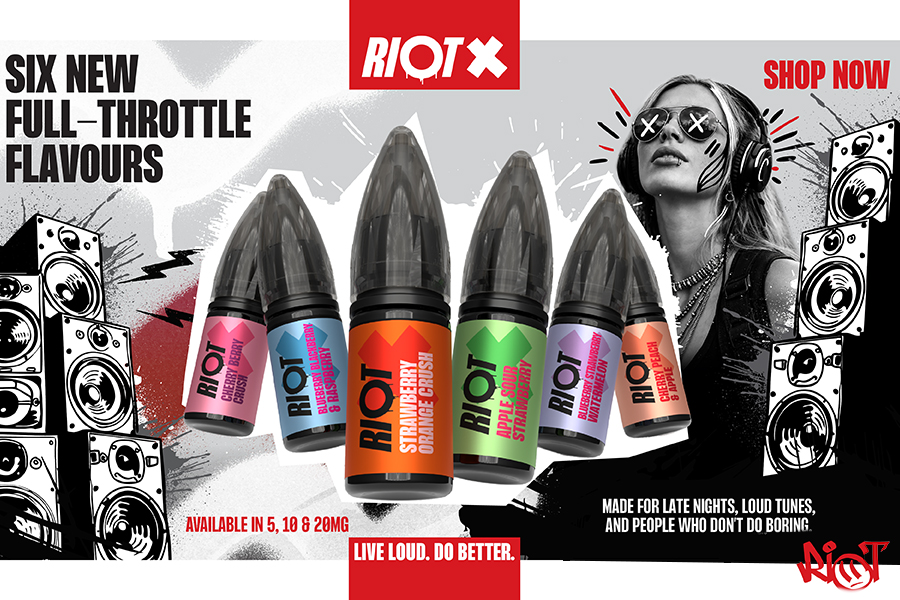
    Riot Labs unveiled the full lineup of its new Riot X range, expanding on last month’s launch of its Strawberry Orange Crush flavor. The updated collection introduces five bold new blends: Apple Sour Strawberry, Blueberry Blackberry Raspberry, Cherry Berry Crush, Cherry Peach Apple, and Blueberry Strawberry Watermelon, all developed in Riot’s U.K.-based, award-winning lab.

    Designed to support smokers on their cessation journey, Riot X combines Riot Labs’ signature daring flavors with “disruptive customer engagement.” Sales Director Matt Crann described the range as “loud and unapologetic,” intended for “late nights, loud tunes, and people who don’t do boring.” The products are available in 5mg, 10mg, and 20mg nicotine strengths, priced from £3.99, and are now on sale online and in vape stores across the U.K.

  • EU Approves Bulgaria’s Vape Ban

    EU Approves Bulgaria’s Vape Ban

    The European Commission approved Bulgaria’s legislation banning the marketing, sale, and distribution of disposable e-cigarettes, triggering a three-month phase-out period for existing products on the market. The decision, issued under the EU Tobacco Products Directive framework, concludes that the measure is justified, necessary, and proportionate to protect public health, particularly in response to rising youth vaping rates. Bulgarian authorities cited data showing that one in four students aged 13–15 use vapes, alongside concerns over youth-targeted product design, nicotine-related health risks, and environmental harm from disposable devices.

    With the approval in place, Bulgaria will proceed with implementation, requiring retailers to clear inventory within the transition period or remove products from sale, with the option to export remaining stock. The move follows similar actions by other EU countries and reflects growing regional momentum toward stricter regulation of disposable e-cigarettes as policymakers seek to curb underage use and limit nicotine addiction among younger populations.