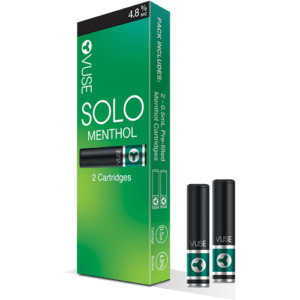
The U.S. Food and Drug Administration issued marketing denial orders (MDOs) for two menthol e-cigarette products currently marketed by R.J. Reynolds Vapor Company under the Vuse Solo brand.
Reynolds is expected to challenge the order.
The currently marketed products include the Vuse Replacement Cartridge Menthol 4.8% G1 and the Vuse Replacement Cartridge Menthol 4.8% G2, according to a statement. The company may resubmit applications or submit new applications to address the deficiencies for the products that are subject to these MDOs.
The FDA evaluates premarket tobacco product applications (PMTAs) based on a public health standard that considers the risks and benefits of the product on the population as a whole.
After reviewing the company’s PMTAs, the FDA determined that the applications lacked sufficient evidence to demonstrate that permitting the marketing of the products would be appropriate for the protection of the public health, which is the applicable standard legally required by the 2009 Family Smoking Prevention and Tobacco Control Act.
Specifically, the evidence submitted by the applicant did not demonstrate that its menthol-flavored e-cigarettes provide an added benefit for adult smokers relative to tobacco-flavored e-cigarettes.
In October last year, the FDA issued MDOs for several menthol-flavored vaping products marketed by Logic Technology Development. It was the first time the FDA issued MDOs for menthol products after receiving a scientific review.
A few days after the order was issued, Logic obtained a court order from the U.S. Circuit Court of Appeals for the 3rd Circuit that temporarily stayed the order.
The U.S. Food and Drug Administration has authorized U.S. Smokeless Tobacco Co.’s (UST) Copenhagen Classic Snuff, a loose moist snuff smokeless tobacco product, to be marketed as a modified-risk tobacco product (MRTP). Copenhagen’s moist snuff smokeless tobacco product has been marketed in the U.S. for years without modified-risk information.
The FDA’s action now allows UST to market the product as a modified-risk product with the claim: “If you smoke, consider this: Switching completely to this product from cigarettes reduces risk of lung cancer.”
After a rigorous review of the available evidence, including recommendations from the Tobacco Products Scientific Advisory Committee, public comments and other available scientific information, the FDA says it concluded that the specific claim related to lung cancer risk is scientifically accurate with respect to Copenhagen Classic Snuff. The review also found the public health gains are unlikely to be offset by nonusers starting to use the product.
UST will be required to conduct post-market surveillance and studies that include an assessment of product users’ behavior, understanding and any previous use of cigarettes as well as a scientific model to assess continued impact on population health.
This modified-risk granted order will expire in five years.
In an update, the U.S. Food and Drug Administration said it has made determinations on more than 99 percent of the nearly 26 million deemed products for which applications were submitted. To date, the agency has authorized 23 new e-cigarette products.
This includes determination on applications for nearly 6.7 million products received by the Sept. 9, 2020, deadline, more than 18 million products received after the Sept. 9 deadline, and applications for nearly 1 million nontobacco nicotine products submitted by May 14, 2022, in accordance with the new federal law passed in April 2022.
Under a federal court order, manufacturers of deemed new tobacco products that were on the market as of the deeming rule’s effective date (Aug. 8, 2016) were required to submit premarket review applications by Sept. 9, 2020.
On Feb. 21, 2023, the FDA issued a refuse-to-accept (RTA) letter to one applicant notifying the company that their premarket tobacco product applications, which are associated with approximately 17 million individual tobacco products, do not meet the acceptance requirements outlined in the FDA’s regulations. The applications were for a grouped submission of e-liquids in varying size, nicotine strength and flavor combinations, each of which was treated as an individual product application according to existing premarket review processes.
During the acceptance phase of application review, the FDA reviews applications to ensure they meet a minimum threshold for acceptability for FDA scientific review. If required contents for acceptance are missing, the FDA refuses to accept the application. This company was issued an RTA letter because the company’s applications for these products lacked required environmental assessments. The company may submit a new application for these products at any time; however, the products may not be marketed unless the FDA reviews the applications and determines that marketing of the products is appropriate for the protection of the public health.
Registration is open for U.S. Food and Drug Administration’s upcoming public oral hearing on April 12, 2023, from 9:30 a.m. to 5 p.m.
The hearing is an opportunity for the public to verbally comment on the agency’s proposed rule Requirements for Tobacco Product Manufacturing Practice. The FDA is proposing new requirements for tobacco product manufacturers regarding the manufacture, design, packing and storage of their products. Registration also includes a “listen-only” option for those who want to attend the session but do not want to request to speak.
Speaking spots are limited, and the FDA says it cannot guarantee that it will be able to accommodate all requests. Groups and organizations should select a single spokesperson to help the agency hear as many different perspectives as possible. While speaking spots are limited, listening spots are unlimited. Registration to provide oral comments will close on March 31, 2023.
The oral session will be recorded, and a transcript will be added to the docket of the proposed rule.
Dutch parliamentarians want e-cigarettes and other vaping products to have a uniform appearance, reports RTL Nieuws.
According to the D66, which will submit the proposal in parliament today, the new rules will make vaping less attractive to teenagers. A majority in parliament supports the plan, RTL Nieuws reports.
“Young people now think it’s cool to have such an accessory with glitter while vaping is extremely unhealthy,” D66 parliamentarian Jeanet van der Laan told the broadcaster. “The vapes resemble a lip gloss or a marker. They are often colorful, and there are vapes full of glitter. Parents often have no idea exactly what the young people are carrying. Super worrying.”
There are even e-cigarettes in circulations that look like airpods, Van der Laan said. “That makes it look like a glamor accessory, while it is just smoking and therefore harmful to health. And young people are tempted by all those frills to start smoking.”
“E-cigarettes should look as neutral and uniform as possible. Preferably they should resemble regular cigarettes. Or else just white or black. Because it’s just smoking,” D66’s MP said. She believes a more boring appearance will make vaping less attractive to young people.
The lower house of the Dutch parliament is discussing smoking on Wednesday. D66’s proposal seems to have majority support, according to RTL.
The U.S. Food and Drug Administration is proposing new requirements for tobacco product manufacturers regarding the manufacture, design, packing and storage of all tobacco products.
The proposed requirements would help protect public health by, among other things, minimizing or preventing contamination and limiting additional risks by ensuring product consistency, according to an FDA statement.
“While no tobacco product is safe, this proposed rule is intended to minimize or prevent additional risks associated with these products,”
Brian King / Credit: FDA
said Brian King, director of the FDA’s Center for Tobacco Products. “Once finalized, it would establish requirements for tobacco product manufacturers that will help protect public health.”
The proposed new requirements would help manufacturers comply with the Federal Food, Drug, and Cosmetic Act by helping minimize or prevent the manufacture and distribution of tobacco products contaminated with foreign substances—such as metal, glass, and plastics—which have been found in tobacco products. T
The proposed rule would also help address issues related to inconsistencies between e-liquid product labeling and the actual concentrations in e-liquids, “Such variability can be misleading to consumers, potentially intensifying addiction and exposure to toxins,” the agency states.
The proposed rule would also establish several requirements related to the identification, tracing and corrective actions for tobacco products that don’t meet specifications or are contaminated, including for tobacco products that have already been distributed.
In the event of an issue, these requirements would require manufacturers to take corrective actions, which may include conducting a recall.
The proposed requirements apply to manufacturers of finished and bulk vaping and other tobacco products. As laid out in the proposed rule, a finished tobacco product is a tobacco product, including any component or part, sealed in final packaging; for example, an e-cigarette, a pack of cigarettes or a can of moist snuff.
A bulk tobacco product is a tobacco product that isn’t sealed in final packaging, but is otherwise suitable for consumer use.
The proposed rule establishes a framework for manufacturers to adhere to, including:
establishing tobacco product design and development controls;
ensuring that finished and bulk tobacco products are manufactured according to established specifications;
minimizing the manufacture and distribution of tobacco products that don’t meet specifications;
requiring manufacturers to take appropriate measures to prevent contamination of tobacco products;
requiring investigation and identification of products that don’t meet specifications to institute appropriate corrective actions, such as a recall; and
establishing the ability to trace all components or parts, ingredients, additives and materials, as well as each batch of finished or bulk tobacco product, to aid in investigations of those that don’t meet specifications.
The FDA will hold a public oral hearing on April 12 to gather additional comments from stakeholders, including industry, the scientific community, advocacy groups, and the public.
The proposed rule also will be available for public comment for 180 days. The agency will review all comments as part of the rulemaking process for this foundational rule.
“We remain committed to transparency and stakeholder engagement, including providing clarity to industry so that they are equipped to comply with the law,” said King. “We encourage all interested individuals and organizations to participate in the rulemaking process. When the public submits a comment based on sound grounds, that can make an important difference in the agency’s decision-making.”
The FDA will also hold a meeting of the Tobacco Products Scientific Advisory Committee (TPSAC) on May 18 to seek recommendations from the agency’s outside panel of experts on the requirements laid out in the proposed rule. As part of the TPSAC meeting, the public will have an opportunity to make oral presentations. The FDA intends to make TPSAC meeting materials available on its website no later than 48 hours before the meeting.
The U.S. Food and Drug Administration has posted a new webinar to help manufacturers and vape shop owners respond to warning letters from the agency’s Center for Tobacco Products (CTP).
The webinar outlines the appropriate items for a response to a warning letter, which should be received by FDA within 15 business days. The webinar also includes an explanation of proper documentation concerning corrective actions that entities have taken.
The government of Malaysia wants to regulate and tax nicotine liquids, reports New Straits Times, citing Prime Minister Anwar Ibrahim.
Speaking during the presentation of the government’s 2023 buget, Anwar said that although vape with nicotine is illegal, the product is still being sold widely with an estimated market size of more than MYR2 billion. “Would it not be great if it is monitored and taxed to discourage the usage of vape,” asked Anwar, who is also the finance minister.
While welcoming the proposal to introduce a regulatory and taxation framework for e-cigarettes, industry groups insisted on consultations. “Regulations and tax rates need to be balanced given it will impact local industry players,” said The Malaysian Vape Chamber of Commerce.
In his presentation, Anwar also expressed support for the Generational Endgame (GEG) bill, which would make it illegal for people born after 2007 to buy tobacco products, including e-cigarettes.
The Advanced Centre for Addiction Treatment Advocacy (ACATA) said the government must conduct more studies on the GEG proposal before making any decision.
While ACATA is encouraged by the government is taking steps to regulate vape, the agency said prohibition was likely to backfire. “There is substantial and credible evidence to prove that vape products are less harmful than smoking cigarettes,” the organization stated. It also cited evidence showing that vaping is effective in helping smokers to quit smoking cigarettes without attracting many never-smokers. ACATA cited a 2020 study, which found that only 0.6 percent of Malaysian nonsmokers vape.
The Malaysian Vapers Alliance, meanwhile, expressed disappointment that the government supported the GEG proposal, saying that cigarettes and vapor products should be treated differently, given the vast difference in risk they present.
The U.S. Food and Drug Administration’s Center for Tobacco Products (CTP) on Feb. 24 outlined the steps it plans to take in response to an external evaluation of its operations conducted by evaluators working through the Reagan-Udall Foundation.
The expert panel issued its final report on Dec. 19, 2022, and included 15 recommendations across a number of areas.
To address concerns raised in the report about transparency, the CTP said it would appoint internal transparency liaisons within each CTP Office, who will be responsible for objectively identifying areas for transparency enhancement. The center will also create a new webpage to feature its responses to citizen petitions and will resume posting scientific policy memos and reviewer guides “when appropriate.”
To enhance efficiency of its premarket tobacco product application review process, the CTP said it has started developing a more efficient framework for high-quality reviews. The center said it aims to better communicate on scientific issues and practices; hire additional staff and increase internal communication to improve scientific engagement and deliberation. Among other activities, the CTP said it will resume posting of scientific policy memos and reviewer guides, along with communication through public events, such as workshops and listening sessions.
The CTP also expressed its intention to hold more frequent meeting of the Tobacco Products Scientific Advisory Committee to obtain input on scientific issues.
To improve its operations in the areas of regulations and guidance, the CTP said it will create a new policy unit within the Office of the Center Director that would be responsible for providing overall policy coordination across the CTP.
The FDA has advocated for the authority to collect user fees from e-cigarette companies, which currently do not pay user fees despite the enormous workload to review and make decisions regarding these products.
Recognizing opportunities to enhance its compliance and enforcement work, the CTP said it will convene a summit related to enforcement with senior officials from the Department of Health and Human Services, the FDA, and the Department of Justice (DOJ). The CTP will consider whether statutory changes are needed to assist the center in enforcing the law. It will also explore approaches to achieve compliance outside of judicial enforcement actions through DOJ.
The CTP said it plans to create a comprehensive webpage for all enforcement activities for products that are illegally marketed without FDA authorization; routinely reach out to industry stakeholders to keep them apprised of new enforcement priorities and updates; and enhance the FDA’s tobacco product marketing order webpage. Planning has already begun for development of a searchable public database of all tobacco products that have an FDA marketing order, according to the center.
To improve engagement on its public education campaigns, the CTP said it will develop, publish and promote resources that describe the mechanisms it currently uses to solicit and consider public input on its campaigns. It will also explore new ways for soliciting and considering public input on its campaign program.
Consistent with the Reagan-Udall report recommendation, the CTP is also engaging with relevant entities within FDA, the Department of Health and Human Services, and the Office of Personnel Management to identify solutions to facilitate more timely and efficient hiring of professionals that match CTP’s needs.
To achieve its goals, the CPT stressed the importance of having appropriate resources, which it suggested could be raised through additional user fees for regulated products, including e-cigarettes. “Since the agency’s fiscal year 2020 budget request, the FDA has advocated for the authority to collect user fees from e-cigarette companies, which currently do not pay user fees despite the enormous workload to review and make decisions regarding these products,” said FDA Commissioner Robert Califf in a statement.
A detailed description of the CTP’s plan for addressing the Reagan-Udall recommendations is available at the center’s new website.
Health advocates are urging the U.S. Food and Drug Administration to ban menthol cigarettes and flavored cigars, reports WGBO. The FDA issued draft measures to ban menthol in April 2022. Final regulations are expected later this year.
“Menthol is an analgesic; it numbs the throat, so it lets the poison go down easier,” said Carol McGruder, co-chair of the African American Tobacco Control Leadership Council. “It dilates the alveoli in the lungs, the little sacs in your lungs, and so it allows the toxins to stay longer and deeper in the lungs.”
Lincoln Mondy made a documentary called Black Lives/Black Lungs about the marketing of menthol cigarettes to Black communities, something many have pointed out as a trend in tobacco marketing.
“We say predatory because it was indeed predatory; they went in neighborhoods like Detroit and New York and majority Black neighborhoods and gave out free cigarettes. They just handed out free cigarettes; they drove up in Newport vans and Kool vans and handed out free cigarettes,” Mondy said.
As a result of this “predatory” marketing, 85 percent of Black smokers smoke menthol cigarettes. Some states like California passed laws banning flavors. However, McGruder says that the industry is still finding ways around such bans.
“They’ve already introduced new products that have some chemicals in there that mimic menthol, but they’re not menthol, and they’re actually on the market right now in California, and so now we have to deal with that, and so, the industry will never stop. They are going to continue to recruit their new smokers to replace the folks who are dying,” McGruder said.


 The U.S. Food and Drug Administration issued marketing denial orders (MDOs) for two menthol e-cigarette products currently marketed by R.J. Reynolds Vapor Company under the Vuse Solo brand.