
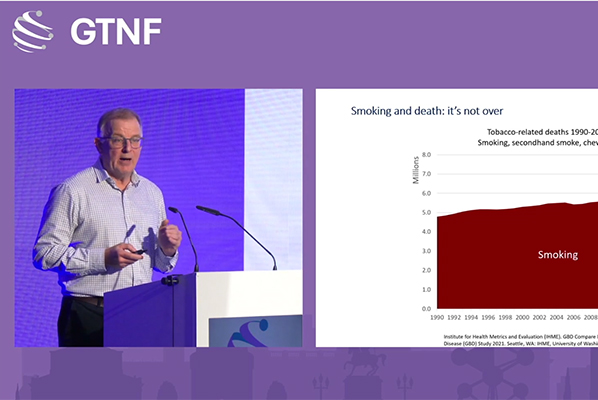
In a forceful keynote at the Global Tobacco and Nicotine Forum (GTNF) in Brussels, Clive Bates, Director of Counterfactual, called for a fundamental reset in global tobacco control policy, arguing that current frameworks such as the WHO Framework Convention on Tobacco Control (FCTC) have failed to adapt to innovation and evidence.
“Prevalence is falling, but the global population is rising,” Bates said. “That means the total number of smokers is still going up — and so are the 7.5 million deaths each year caused by smoking.” He emphasized that quitting smoking at any age provides significant health benefits, but argued that international tobacco control remains stuck in the past. “The mission hasn’t changed — stop people from smoking — but the methods are outdated. We have new tools, and ignoring them is indefensible.”
Bates described alternative nicotine products such as vaping, heated tobacco, and smokeless options as “the disruption the FCTC never anticipated.” He pointed to Sweden’s success as proof of concept: “Sweden has higher nicotine use than Germany but lower cancer rates. That’s what harm reduction looks like.” Yet, he criticized the European Union for maintaining its ban on snus — the very product that helped Sweden virtually eliminate smoking. “What if, instead of banning snus, we promoted it?” he asked. “Why are we still doing things that contradict our stated public health goals?”
Turning his critique toward the WHO, Bates condemned the organization’s stance that there is “no evidence” reduced-risk products are safer than cigarettes. “That’s shocking,” he said. “Harm reduction is being dismissed as a tobacco industry ploy, using the industry’s reputation to poison good science.”
He argued that the FCTC has institutionalized a “toxic” anti-industry bias that blocks collaboration and progress. “If the tobacco industry likes it, it must be bad — that’s the logic codified into policy. There’s no room for alignment with that attitude,” he said. Bates noted that several major companies have already shifted dramatically — “PMI now earns 41% of its revenue from smoke-free products” — yet the global framework continues to punish rather than encourage transformation.
“The WHO gave an award to a man in India for banning reduced-harm products in a country with 100 million smokers,” Bates said. “That’s not leadership — that’s negligence.”
He concluded with a clear call to action: “If you want better outcomes, get the smoking rate down as fast as possible. The demand for nicotine won’t disappear, but we can make it vastly safer — and we can do it without coercion. Let consumers make informed choices. That’s how we save lives.”