Tag: illicit tobacco

  • BAT Uganda Points to Illicits for 18% Revenue Drop

    BAT Uganda Points to Illicits for 18% Revenue Drop

    British American Tobacco Uganda Ltd. reported an 18% drop in gross revenue to Shs 67 billion ($18.1 million) for fiscal 2025, citing a surge in illicit cigarette sales, according to audited results. Net revenue fell 21% to Shs 36.3 billion ($9.8 million), while total comprehensive income declined 19% to Shs 9.8 billion ($2.6 million). The company attributed the decline to rising tax-evaded cigarette consumption, which research shows reached 45% of the market by December 2025, up from 34% the previous year — equivalent to an estimated Shs 53 billion ($14.3 million) loss in government revenue. Operating costs fell 21% to Shs 24 billion ($6.5 million), but net asset value dropped sharply to Shs 32.5 billion ($8.8 million) from Shs 49.3 billion ($13.3 million) in 2024.

    Despite the downturn, BAT Uganda’s tax contributions rose 4% to Shs 46.4 billion ($12.5 million), aided by capital gains from the sale of a non-strategic asset. The board proposed a final dividend of Shs 199 ($0.054) per share, down 5% from 2024, payable July 31 to shareholders on record as of July 24. Company secretary Paul Mbuga emphasized the need for a multi-agency government response, particularly at the South Sudan border, to combat illicit imports, noting that contraband cigarettes often bypass digital tax stamps and health warnings, undercutting prices and presenting public health risks.

  • Concerns Loom Over S. Africa Tobacco Control Bill

    Concerns Loom Over S. Africa Tobacco Control Bill

    South Africa’s tobacco policy debate sharpened this week after Finance Minister Enoch Godongwana used his Budget speech to warn that illicit trade is inflicting serious damage on the economy, while hours later the Department of Health faced pointed pushback in Parliament over whether its Tobacco Products and Electronic Delivery Systems Control Bill adequately addresses that crisis. Appearing before the Portfolio Committee on Health, officials defended the Bill’s public health rationale, arguing it does not ban cigarettes and that smoking imposes greater economic costs than it generates. However, MPs from multiple parties pressed the Department on estimates that as much as 70% of the cigarette market may be illicit, questioning whether the proposed measures meaningfully target the dominant illegal segment.

    Lawmakers repeatedly raised concerns about enforcement capacity, proportionality, and the risk that additional regulatory burdens — such as plain packaging and stricter penalties — could further advantage criminal syndicates if illicit trade remains unchecked. The Department leaned on international precedent and South Africa’s obligations under the WHO Framework Convention on Tobacco Control, while some MPs called for greater differentiation between combustible and non-combustible products and more realistic alignment with local enforcement realities.

  • Thai Smugglers Move to ‘Ant-Worker’ Tactics as Seizures Increase

    Thai Smugglers Move to ‘Ant-Worker’ Tactics as Seizures Increase

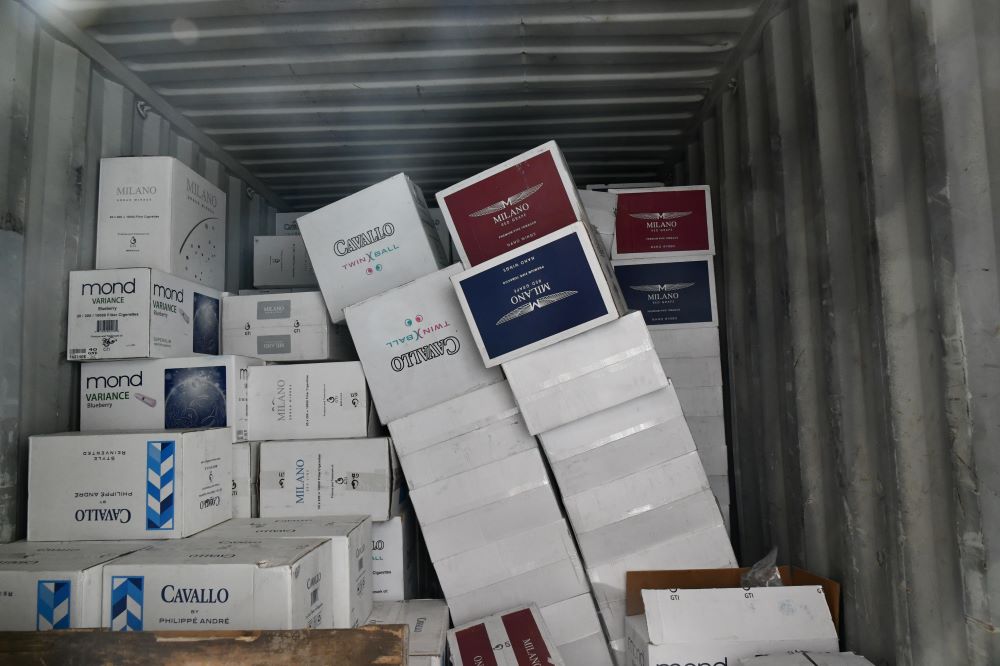
    The Thai Customs Department has intensified its crackdown on tax-evading goods, seizing more than 27.3 million foreign cigarettes and 205,445 e-cigarette units worth an estimated 169.6 million baht ($5.4 million) between October 2025 and mid-February 2026. Director-General Phanthong Loykulnunt said smuggling networks have shifted to “ant-worker” tactics, moving contraband in small parcels via private couriers and concealing goods in commercial lorries to evade checkpoints, prompting authorities to deploy handheld X-ray scanners nationwide. Major operations included a Central Thailand raid with Mae Klong Customs that uncovered 12.5 million cigarettes valued at 62 million baht ($2 million), seizures worth 36 million baht ($1.2 million) in Songkhla and Tak Bai, and a Bangkok raid in Khan Na Yao district that netted hybrid e-cigarettes and IQOS devices worth 10 million baht ($320,000). At Bangkok Port, Customs and the Department of Special Investigation inspected seven overdue containers, discovering over 46,000 disposable vapes hidden among legitimate cargo.

  • Enforcement Continues, Yet Illicit Cigarettes Remain a Threat

    Enforcement Continues, Yet Illicit Cigarettes Remain a Threat

    PRESS RELEASE

    Cigarette smuggling continues to rank among the most serious economic threats facing Malaysia, with the illicit cigarette market estimated to be worth up to RM5 billion ($1.3 billion) annually, underscoring the scale of the shadow economy that remains deeply entrenched in the system.

    The Ministry of Finance (MOF) has reported that Malaysia lost approximately RM1.4 billion ($350 million) in unpaid taxes over the past five years, partly due to cigarette smuggling activities. According to MOF data, unpaid duties linked to illicit cigarettes were recorded as follows:

    ** Jan-Sep 2025

    These figures not only reflect significant revenue leakage but also point to the presence of well-organized and resilient smuggling networks capable of adapting to escalating enforcement pressure.

    According to security and defense analyst Zaki Salleh, the illicit cigarette problem should be viewed as a strategic threat to national economic security, rather than merely a border enforcement issue.

    “National borders are not just geographical lines. They are the frontline of economic defense. As long as weaknesses exist at the borders, the shadow economy will continue to thrive,” he said.

    Zaki noted that enforcement efforts by agencies such as the Royal Malaysian Customs Department (JKDM), the Royal Malaysia Police (PDRM) and the Malaysian Anti-Corruption Commission (SPRM) remain critical and deserve recognition. In 2025 alone, JKDM successfully foiled 2,742 attempted cigarette smuggling cases, reflecting a high level of operational intensity and commitment.

    However, he stressed that enforcement effectiveness must be assessed against overall market outcomes, not just operational activity.

    “These efforts deserve praise, but they remain small when measured against the size of Malaysia’s illicit cigarette market. Without more comprehensive coordination, the impact is unlikely to be sustainable,” he said.

    Zaki added that border control approaches can no longer rely solely on conventional methods, as smuggling syndicates have become increasingly sophisticated and operate in a highly coordinated manner.

    “Today’s smugglers use technology, modern logistics systems and alternative routes to avoid detection. Their operations span land and waterways, including areas that are difficult to monitor physically,” he said.

    Beyond enforcement, Zaki pointed to structural market factors as the core challenge. The significant price gap between legal and illegal cigarettes continues to sustain demand among both consumers and retailers.

    “This price difference creates strong economic incentives for illicit cigarettes to keep circulating, especially in a challenging cost-of-living environment. Under such conditions, enforcement alone becomes increasingly difficult to curb demand comprehensively,” he said.

    As long as demand remains unaddressed, he cautioned, the shadow market will continue to adapt even as enforcement is intensified.

    In this context, Zaki said the government needs to explore broader policy reforms aimed at narrowing the demand gap for illicit cigarettes. He noted that the existing policy framework should be objectively evaluated to ensure a better balance between public health objectives, revenue collection and market realities.

    At the same time, he emphasized the importance of fully operationalizing the Border Control and Protection Agency (AKPS) as the central coordinating body for border control, to reduce overlaps and improve inter-agency efficiency.

    In addition to coordination, Zaki highlighted the need for more aggressive deployment of technology, including drones, infrared sensors, AI-enabled smart cameras and GPS-based vehicle tracking systems, to strengthen detection capabilities and close persistent border vulnerabilities.

    Without a consistent and integrated approach, he warned, the illicit cigarette market will continue to erode national tax revenues and weaken Malaysia’s economic resilience over the long term.

  • Hong Kong Ups Public Education in Battle Against Illicits

    Hong Kong Ups Public Education in Battle Against Illicits

    Hong Kong Customs stepped up its anti–illicit cigarette campaign this week with officers conducting patrols and public education activities focused on the unintended repercussions of the illicit cigarette market, highlighting the increased penalties for illicit cigarette offences and promoting the forthcoming Duty Stamp System. The joint outreach operation teamed Customs Officers with the Sha Tin District Council, the Department of Health’s Tobacco and Alcohol Control Office, police, and the Housing Department.

    Officials reiterated that public housing units linked to illicit cigarette crimes may face follow-up action from the Housing Department and warned the public—particularly young people—against buying, selling, or promoting illicit cigarettes, underscoring that violations can carry severe criminal penalties. Recent amendments raise the fixed penalty for failing to declare illicit cigarettes from HK$2,000 to HK$5,000 ($260 to $650), while the maximum punishment for duty-not-paid tobacco offences has increased to a HK$2 million ($260,000) fine and up to seven years’ imprisonment.

    Customs also briefed residents and district representatives on the Duty Stamp System, following the conclusion of a three-month pilot run on January 4. Authorities plan to roll out the first phase of the system in the fourth quarter of 2026, with full implementation targeted for the second quarter of 2027, aiming to better distinguish duty-paid products and curb so-called “cheap whites.”

  • Economist Puts Australia’s Illicit Tobacco Crisis Squarely on Tax Rate

    Economist Puts Australia’s Illicit Tobacco Crisis Squarely on Tax Rate

    Australia’s illicit tobacco market has gone over the “Laffer Curve,” where excessive taxation leads to lower overall revenue, according to numerous experts, including U.S. economist Dr. Arthur Laffer. “It’s not working at all. Your taxes are way too high,” he told 7.30 News. “Australia has raised its tax rates on tobacco so high that people have found illicit products.”

    According to internal industry data, illicit products now account for 64% of all tobacco and 82% of total nicotine consumed in Australia. The black market is valued at nearly $10 billion, coinciding with a sharp drop in federal tobacco excise revenue—from $16 billion in 2020 to $7.4 billion in 2025.

    The federal government, however, has rejected calls to lower tobacco taxes, arguing that high excise rates and plain packaging have been effective in cutting smoking rates to 10.5% in 2024, down from 25% in the 1990s.

    The term “Laffer Curve” was made famous 50 years ago after Laffer drew it on a napkin at a meeting with then Ford Administration officials Dick Cheney and Donald Rumsfeld. Laffer said the concept wasn’t new, dating back to 14th-century writings.  

  • Illegal Tobacco Stressing Australian Emergency Responders

    Illegal Tobacco Stressing Australian Emergency Responders

    As illegal tobacco sales continue to increase across Australia, so too are violent crimes as organized syndicates get more brazen in their push for market share. There have been more than 100 fire bombings in Victoria in the last two years, with similar tactics being used in New South Wales and now spreading to Queensland.

    The Australian Medical Association Queensland warns that in addition to the obvious dangers of the fire bombings, the increase in violent attacks on tobacconists is also putting further pressure on overworked emergency departments, including police, fire, paramedics, and hospitals.

    “We are also concerned that a growing black market could see increased violence leading to avoidable emergency department presentations and pressure on our doctors and nurses,” said Nick Yim, president of the medical association.

    Queensland is attempting to battle the illicit market with more regulation, increasing fines tenfold. Individuals selling illegal products can now be fined A$32,260 ($20,646) while corporations can be fined A$161,300 ($103,232). Authorities now also have the option to close offending businesses for up to six months.

    The federal government announced in March it would pump A$157 million ($100 million) into federal health, crime, and tax agencies across two years to strengthen enforcement and target crime gangs.

    “This is a national issue that requires a national response, which is why the Albanese Labor government’s $156.7 million investment to tackle the tobacco black market is so critical,” said Mark Bailey, a spokesman for Shadow Health.