Tag: market

  • Zimbabwe Orders Buyers to Get Active as Tobacco Market Starts Slow

    Zimbabwe Orders Buyers to Get Active as Tobacco Market Starts Slow

    Zimbabwe’s government ordered licensed tobacco merchants who have not yet participated in the 2026 marketing season to begin buying within 14 days or face regulatory action, amid concerns that low buyer turnout has contributed to weak auction prices. The directive from the Tobacco Industry and Marketing Board requires non-participating merchants to explain their absence and outline planned purchase volumes to ensure competition in the market. Only seven of 43 registered buyers were active during the opening days of the season, prompting some farmers to withdraw bales while waiting for better prices.

    Officials say the market is currently in its price-discovery phase and expect prices to firm as more buyers enter the floors and competition increases, however, farmers are concerned as early-season figures show auction sales significantly lagging behind last year. As of March 5, 626,742 kg of tobacco had been sold for $1.79 million compared with 1.24 million kg worth $4.17 million during the same period in 2025. The average price also dropped to $2.85 per kg from $3.35 a year earlier.
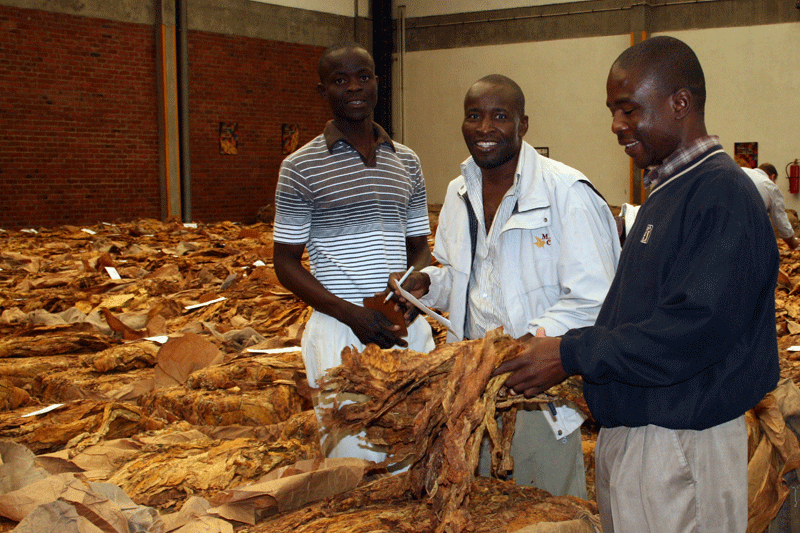
  • Zimbabwe Tobacco Industry Targets $7B by 2030

    Zimbabwe Tobacco Industry Targets $7B by 2030

    Zimbabwe’s tobacco sector is positioned for major expansion, with government projections indicating the industry could reach $7 billion by 2030. The Agriculture Food Systems and Rural Transformation Strategy 2 (2026–2030) outlines a sharp rise in the sector’s gross value contribution, which was $1.2 billion in 2025.

    The Tobacco Industry & Marketing Board reported that Zimbabwe produced 340 million kg of tobacco in 2025, but the Tobacco Transformation Plan hopes to see that number reach 500 million kg by 2030. Zimbabwe is also working to greatly increase the tobacco processed domestically, as opposed to exporting 90% of it raw as it currently does. The Plan also hopes to promote new specialty tobacco varieties, including cigar, shisha, naturally cured, and dark fire-cured types.

    As Africa’s largest tobacco producer, Zimbabwe’s tobacco industry supports over 130,000 households and contributes more than half of the country’s agricultural exports. More than 85% of the crop is grown by small-scale farmers, many of whom benefited from land reform.

    Despite its growth potential, the sector faces significant headwinds, including global anti-smoking measures, traceability and environmental regulations, child-labor concerns, and outdated legislation. Agriculture Minister Dr. Anxious Masuka said the new strategy reflects extensive consultation across government, industry, and farming stakeholders, and is structured around ten pillars focused on policy reform, climate resilience, rural industrialization, financing, infrastructure, and land management.

  • Brazil Projected to Crack $3B in Tobacco Exports

    Brazil Projected to Crack $3B in Tobacco Exports

    According to yesterday’s projection by consulting firm Deloitte, Brazil’s tobacco exports are expected to surpass the $3 billion mark in 2025. The forecast anticipates an increase of 10% to 15% in volume and value. In February, the projection was $2.977 billion.

    According to data from the Ministry of Development, Industry, Trade and Services, Brazil shipped 104,000 tons of tobacco in the first quarter of 2025. The volume was 1.78% lower compared to the same period in 2024, however, the value of sales rose by 12.85%, reaching $744 million. The main buyers of Brazilian tobacco in the first quarter were China, Belgium, Indonesia, the United States, and the United Arab Emirates.

    In 2024, Brazil exported 455,000 tons of tobacco to 113 countries, generating around $2.9 billion in revenue. This figure exceeded the historical average of the past decade, which stood at $2 billion. Brazil has been the world’s largest tobacco exporter for over 30 years. About 90% of its production is destined for international markets. In terms of overall production, Brazil ranks second only to China.

    “The preference of international customers for Brazilian tobacco is a direct result of the product’s quality and integrity, guaranteed by the Integrated Tobacco Production System,” said Valmor Thesing, president of the Interstate Tobacco Industry Union.

  • Mixed Reactions as Malawi’s Tobacco Season Opens 

    Mixed Reactions as Malawi’s Tobacco Season Opens 

    The 2025 tobacco marketing season officially opened in Malawi’s capital of Lilongwe Wednesday (April 9), with leaf fetching between $1 and $3.20 per kg. While some farmers described the opening prices as “not so bad,” most farmers said they felt robbed, given the current high cost of living and the expenses that tobacco farming demands.

    “The offered prices are lower than what we expected,” one farmer told Xinhua in an interview, as other farmers nodded in agreement. “Everything has gone up following our currency’s devaluation, so we expected the leaf to fetch more than what we have witnessed today.”

    However, Minister of Agriculture Sam Kawale said during the opening that the tobacco marketing season has started “on a good note,” considering that the first batch of tobacco to be sold is typically of low quality.

    “The tobacco that has fetched these prices is the bottom leaf, ones close to the ground, and it is mostly disregarded in sales,” said Kawale. “If the lower leaf is fetching that much, we are hopeful that the actual leaf of good quality that is yet to be sold will fetch even more.”

    President Lazarus Chakwera presided over the opening and said, “The bottom leaf may not be the best, but I’m encouraged to see that the prices have gone up, in some cases, by more than 55 cents above the minimum price. That’s a good start.”

    Malawi is expected to increase tobacco production by 30.8% to 174 million kg this year, according to the Tobacco Commission.

  • Opinion: Zimbabwe’s Tobacco Chain Needs to Come Together

    Opinion: Zimbabwe’s Tobacco Chain Needs to Come Together

    Zimbabwe’s tobacco marketing 2025 season opened last week with the first bale selling for $4.65 per kg. That price was predictably down from last year’s $4.92 as the El Nino drought created a shortage in the tobacco market. Last year’s output was 235 million kilograms, down from 2023’s record 296 million kg. For 2025, projections are in the 280 million kg region, however, more plantings and favorable weather keep the National Development Strategy’s ultimate 300 million kg goal a possibility.

    While growers are doing their part in the system, Obert Chifamba wrote in his opinion piece for The Herald that more needs to be done as a nation to make the cash crop profitable for the people doing the work.   

    “Just two seasons ago [we were] close to the target of 300 million kg,” Chifamba wrote, “which means production-wise, we have achieved our intentions, hence the need to identify and address the issues now standing between the country and its target.

    “Delays in disbursing the $60 million tobacco revolving fund meant to localize the crop’s funding and support growers have not made the situation any better, with the Reserve Bank of Zimbabwe said to be working on the modalities of disbursing it. Local funding should take care of 70% of the cost of production. This is also one of the strategies the government is pushing to effectively implement to ensure the country stops relying on foreign capital for the crop, which will see the funders taking between 80 and 90% of the money generated from tobacco out of the country leaving producers with very little.”

    Chifamba also points out that 95% of the tobacco produced gets exported out of the country raw, allowing countries that import and process it to reap the majority of the profits, and that local growers are often taken advantage of by foreign sponsors with “notorious price ceilings” and incomplete purchase contracts. 

    “It is critical for the tobacco industry to do some self-introspection and see where the wheels are always coming off,” Chifamba wrote. “Maybe it will take the intervention of the government or some independent observer to pinpoint where the tobacco juggernaut needs revitalization to function more fluidly and profitably for all parties involved.”

  • Zimbabwe’s Tobacco Market Opens

    Zimbabwe’s Tobacco Market Opens

    Zimbabwe’s 2025 tobacco marketing season opened this week (March 5) with stakeholders upbeat about increased output due to favorable weather, contrasting to last year’s El Nino-induced drought.

    “We are expecting a bigger crop, much bigger than last year, over 280 million kg, and I think it will sell well,” said Patrick Devenish, chairman of the industry regulator Tobacco Industry and Marketing Board.

    Last year, Zimbabwe produced more than 240 million kg worth $1.4 billion in export earnings. China is the largest importer of Zimbabwe’s tobacco and is expected to have high demand for its top-quality leaf this year.