A former Altria executive has been promoted to CEO and resident of Kaival Brands Innovations Group, Inc. The company announced that it has expanded the role of Executive Chairman Barry Hopkins to include the additional positions.
Former CEO and president, Eric Mosser, has been appointed CEO and president of Kaival Brands International, a Kaival Brands Innovations Group’s subsidiary with an international licensing relationship with Philip Morris Products.
Niraj Patel, founder and chief science officer of Kaival Brands, said that from the beginning he has envisioned a diverse platform that could “capture the tailwinds” generated by the company’s core offering, the BIDI Stick electronic nicotine delivery system (ENDS) product.
“Barry understands this vision, the importance of regulatory compliance and youth access prevention, and has done an exceptional job since joining Kaival Brands. He has eagerly taken on increasing levels of responsibility, leveraging his decades of experience in management in our industry,” said Patel in a press release. “His appointment as Interim CEO and president was a natural progression, and we look forward to potentially expanding our excellent management team further during 2024 with a permanent CEO and/or president as our needs dictate.
“Having Barry in this position now is particularly important since we are at a significant inflection point, as we remain hopeful that FDA will soon complete its review of the pending premarket tobacco product application (PMTA) for the tobacco-flavored BIDI Stick Classic. If we receive a marketing granted order for this product, we will have significant momentum in the new year with the ability to continue to transition adult cigarette smokers, drive revenue and grow our company.”
According to a recent U.S. Food and Drug Administration announcement, the agency’s next status report regarding its review of the still-pending PMTAs for major brands and market share leading ENDS products is due to be filed by January 22, 2024 with the U.S. District Court in Maryland.
Although FDA has not indicated publicly which PMTAs it is prioritizing for review, Kaival Brands is hopeful that the BIDI Stick Classic will be included in the January status report. The company also anticipates the PMTAs for the other 10 BIDI-branded SKUs will remain in scientific review, according to Patel.
Recently, the Kaival Brands has been encouraged by the coordinated efforts of the FDA, U.S. Customs and Border Protection, and other government agencies to increase their coordinated focus on enforcement. The company believes it has been hurt by illicit vaping products flooding the market, and it is now preparing to scale along with other legal products, assuming increased enforcement continues alongside the January announcement by the FDA.
“Hopkins will spearhead the company under the direction of the Board of Directors with a continued focus on accelerating revenue growth, improving operational efficiencies and executing Kaival Brands’ strategic growth and diversification initiatives, while remaining in compliance with applicable state and federal regulations.
“The company, alongside BIDI Vapor (the maker of the BIDI Stick), is also continuing to focus on working with Philip Morris to accelerate the international distribution of ENDS products using BIDI technology (which Philip Morris markets under the brand name ‘VEEV Now’), as part of Philip Morris’s plan to deliver a smoke-free future.”
Beginning January 1, 2024, Belgium will introduce a new tax on e-liquids used in electronic cigarettes. The tax will be set at 15 cents per milliliter.
The move has received criticism from both users and retailers who fear that it will lead to increased costs and a potential shift back to traditional tobacco cigarettes.
The spokesperson for the federal Finance Minister defended the tax, stating that it aligns with Germany’s tax rate, which is also set to increase in the coming years, according to media reports.
They further clarified that the goal is not to encourage people to return to smoking combustible cigarettes but to recognize that e-cigarettes are also tobacco products and should be used as a temporary measure to quit smoking.
Students caught vaping will risk being unable to attend school events, such as balls, graduations and other extra-curricular activities. The new rules also include mandatory programs for students in years five to seven that teach them about the dangers of vaping; new teaching and learning resources for prevention education for students in years eight to 10; and a trial of vape detectors in up to 10 schools across the state.
“The prevalence of vapes in our community is a serious issue,” said Tony Buti, WA’s education minister. “The biggest misunderstanding is they are harmless compared to cigarettes—this is not true—vapes are not safe, and they are contributing to a new generation of nicotine dependency.”
It’s illegal in WA to sell e-cigarettes and nicotine vaping products to anyone without a doctor’s prescription. These devices are only allowed for smoking cessation purposes and must be obtained from a pharmacy.
Youth often purchase vapes online, from retail stores or from friends and contacts, according to the WA Department of Education. More than 70 percent of participants in an October survey of over 3,000 individuals aged 12 to 18 found it easy for a young person to “get a vape,” and many respondents stated that the products are prolific, especially in schools. The survey was used in a report on vaping by Jacqueline McGowan-Jones, WA commissioner for children and young people.
BAT Germany has selected Arvato as its logistics and fulfillment partner for its e-commerce operations encompassing e-cigarettes and heated tobacco products.
Since the end of June, BAT Germany online orders have been processed centrally from the site in Marienfeld, Guetersloh district. At this site, Arvato, a leading supply chain and e-commerce service provider, operates a state-of-the-art distribution center spanning approximately 32,000 square meters, serving multiple clients in the technology sector, according to the American Journal of Transportation(AJOT).
The comprehensive logistics services provided for BAT Germany at the facility encompass goods receipt, storage, order picking, packing, and shipping, as well as returns management.
“BAT’s goal in awarding the e-commerce logistics contract was to guarantee the most efficient and fastest delivery service for its customers. Our customer-centric approach allowed us to accommodate BAT’s specific processes and requirements,” says Thomas Becker, executive vice president at Arvato.
The logistics service provider commits to delivering within a 48-hour timeframe. To optimize warehouse operations for efficiency and speed, Arvato heavily integrates automation technology. Automated carton setup and closure processes significantly enhance the speed of operation. Moreover, product information is automatically included with orders through flyer dispensers.
“With its experienced team, Arvato provided us with very flexible and reliable support in setting up our logistics and distribution concept,” confirms Robert Juhnke, distribution manager at BAT Germany. “Even throughout the offer and final negotiation phase, the collaboration has been exceptionally cooperative.”
Sustainability is a growing trend in the vaping industry. Arvato is dedicated to doing its part, according to the AJOT story. In an effort to reduce plastic waste, the company adopted wet adhesive tape made from recycled paper, resulting in the annual saving of approximately 16 tons of plastic, as an alternative to polypropylene adhesive tape. Arvato’s approach to optimizing shipment sizing and processing minimizes the consumption of packaging materials.
The implications could be far-reaching. Reynolds American Inc. (RAI) has filed a U.S. International Trade Commission (ITC) complaint charging multiple manufacturers, distributors and retailers of several popular disposable vaping devices with unfair importation. It is one of several recent actions Reynolds has made to remove its competitor’s vaping products from store shelves.
Reynolds is asking the ITC to investigate and issue an exclusion order preventing further U.S. imports of disposable vaping products. Several legal scholars have told Tobacco Reporter that if the ITC agrees with Reynolds, all flavored disposable vaping devices without marketing authorization could be stopped at the border and prevented from entering the U.S. market.
Reynolds wants the ITC to issue a permanent “cease and desist order” prohibiting any businesses from selling illegal vaping products. The move would push nearly the entire vaping industry underground, with the exception of products owned by major tobacco companies such as Reynolds that have received marketing orders from the FDA.
Several businesses were named specifically as “peddlers of illegal disposable vapes” in the Reynolds complaint, including the “manufacturers, importers, distributors and retailers” of Breeze, Elf Bar, Esco Bar, Hyde, Puff Bar, and R&M disposable vapes.
Also named are several well-known U.S. wholesale and retailers of disposable vapes, including Element Vape, Flawless Vape, Magellan Technology, Mi-One Brands, Price Point Distributors, and Vape Sourcing.
The ITC complaint accuses what amounts to the manufacturers of all unauthorized vaping products of importing “illegal disposable vapes” in violation of Section 337 of the Tariff Act of 1930. Specifically, Reynolds claims the named businesses either falsely advertised that their products are authorized for sale by the U.S. government, failed to comply with federal laws imposing registration and reporting requirements and limitations on sales, or violated customs laws and regulations.
“As a result of the relentless influx of illegal vapor products flowing through U.S. borders, Reynolds American Inc. subsidiaries R.J. Reynolds Tobacco Co. and R.J. Reynolds Vapor Co. have filed a complaint with the U.S. International Trade Commission against more than 30 companies involved in illegally importing unregulated, youth appealing flavored disposable vapor products,” RAI wrote in a statement. “Many of the manufacturers of these disposable vapor devices intentionally and systematically market to youth, selling products with dessert and candy flavors and featuring cartoon characters.
“These illegal disposable vapor devices, which have unknown ingredients and bypass regulations, are jeopardizing public health by refusing to adhere to the laws that regulate the sale of tobacco products. The complaint requests that the ITC institute an investigation into unfair acts in the importation and sale of these Chinese-manufactured, youth appealing flavored disposable vapor devices into the United States.”
Reynolds owns the Vuse vaping brand, including the Vuse Alto. Last week, the FDA issued a marketing denial order, ordering Alto menthol refill pods off the market. The Alto device and tobacco-flavored pods are still under review by the agency. Two older Vuse vapes, the Solo and Vibe models (and their tobacco-flavored refills) are among the 23 products currently authorized by the FDA. The marketing denial order was subsequently stayed by the Fifth Circuit Court of Appeals.
In its ITC complaint, Reynolds states it has the capacity to fill any void in the market if the illegal products were removed. “Reynolds has the capacity to replace any increase in demand if the Accused Products were excluded from importation,” the complaint states. “Reynolds is willing to meet any increased demand and can do so in a commercially reasonable time, given that it already supplies the industry with significant quantities of ENDS products, as well as oral tobacco and nicotine products.”
The ITC has not yet made a decision on the complaint that was filed on Oct. 13.
Last week, lawmakers in the U.S. introduced the CARE For Moms Act in Congress. That bill would increase healthcare for expecting and new mothers, while also exponentially increasing the taxes for vaping, roll-your-own, cigars and other tobacco products.
The tobacco tax language in the CARE Act was copied and pasted out of the Tobacco Tax Equity Act, a bill that has been introduced as a rider in bills introduced in previous sessions of Congress but it failed to gain any traction, according to halfwheel.
That could change after Sen. Ron Wyden and Sen. Dick Durbin have now introduced the Tobacco Tax Equity Act of 2023 in the Senate as a standalone bill, while Rep. Raja Krishnamoorthi introduced the bill in the House of Representatives.
The tobacco tax-related language includes:
New taxes for e-cigarettes;
Doubling the tax on roll-your-own tobacco;
A more than 16x increase on pipe tobacco;
Doubling the tax on small cigars;
A massive tax hike for premium cigars;
For premium cigars, the language removes the existing federal excise tax of 52.75 percent, capped at 40.26 cents per cigar, and replaces it with a weight-based tax of $49.56 per pound.
Because it’s a weight-based tax, the difference between the existing tax and the new taxes would vary depending on how heavy the cigar is. For cigars robusto or larger, it would likely more than triple the current federal tax rate.
“The more things change, the more they stay the same,” is an expression that has been around for almost two centuries, and it speaks to the fact that the small picture(s) of life may change, but the larger one does not. The vape industry and all the challenges and changes that have happened in the past decade are totally contrary to that famous saying.
A decade ago, the vape industry was the epidemy of the Wild, Wild West, full of vape shops springing up on every corner, and any/everyone creating e-liquids in their bathtubs at home. Regulation and competition changed all that and brought some semblance of “orderliness” to the market, but as state and federal regulations bombarded the industry, and with the FDA creating onerous and unattainable guidelines, the vape space has truly become one of survival.
I recently attended a vape event in Phoenix which brought together several dozen top manufacturers, distributors, and buyers, and universally everyone lamented the same concern: business is down.
Why is business down?
The reasons are many, including strict regulations, and now, even more enforcement of those regulations, but overall, the cause was much simpler. The huge COVID-19 rebound in 2020-22 put more money in consumers’ pockets and more time on their hands. Those issues combined created an artificial bubble that many thought would last. But time has passed. Add in the inflation that has pushed up food and other cost of living expenses, and some former necessities are now becoming unaffordable luxuries.
“It’s a balancing act between the addictive nature of some nicotine products and the limitations of buyer’s budgets,” said Jamie Reed with Simple Vape Supply from Orange County California. “I’ve been in the industry for over ten years, and this is evolution in its purest form and based around ’survival of the fittest.’”
Simple manufactures and distributes over 100 different assortments of nicotine cartridges, including disposables, including various iterations of CBD, Delta-8 and Kratom.
“It’s interesting,” Reed added. “When I got hired, I was told that there was an ‘expiration date,’ and we all knew that this industry might not last, and that the cream would rise (to the top). We planned to be one of those surviving companies, and we’ve been able to adapt to the times.”
Her company, along with many that are still around, were mostly run by rebels, radicals, and envelope pushers; and many have in fact changed accordingly, but some have merely learned how to “play the game” and outwardly appear to be toeing the line, but the reality may be different.
“We were aware that the COVID blip was a one-time event. People were home, they had government money to spend, and no one was checking in on them or requiring any urine tests. The Delta (8,10) boom really added to that, and everyone jumped on that bandwagon,” she said excitedly.
That line of CBD was an example of how the industry has and continues to push back. The FDA says you can’t do this, so the industry says, “F-you, then we’ll do that.”
With regulation eliminating or reducing product selection, almost any industry will do the same thing: adapt; repurpose, or reposition.
Of the dozens of people I spoke with at the event, the numbers (from shop owners and manufacturers) were pretty consistent, and most of them were down 20 to 30 percent. Many were saying that purchase sizes were lower than normal and a typical ten-thousand-dollar order was now half that. They saw some shops closing, but most were working on smaller revenues.
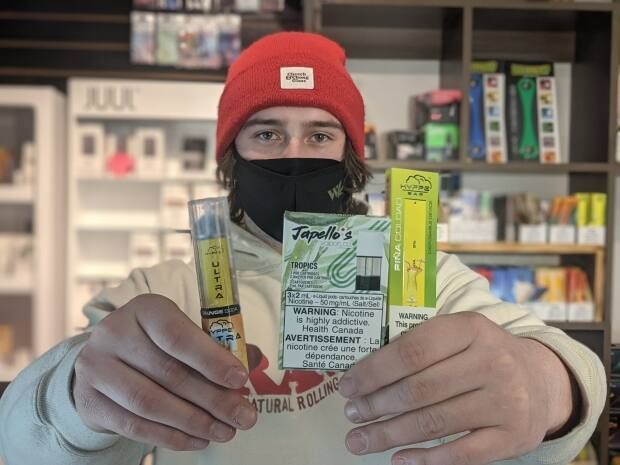
Manager J-K Thorne holds some of the flavored products that are no longer available at Wild Impulse vape shop. (Shane Hennessey/CBC)
Meanwhile, on the other side of the equation, vape liquid manufacturers who are trying to “play the game” right and submitting premarket tobacco product applications (PMTAs) to the U.S. Food and Drug Administration are frustrated at the amount of time it takes and how much money is being thrown into a (seemingly) dark hole.
I spoke with one of the owners of a large vape manufacturing business and distribution company in Idaho, and he shared some facts and figures about their process of trying to make their products “legal.” Legal, in the eyes of the FDA, has caused his company to squander over $5 million in the past few years trying to get authorization.
Mike Larsen is a detailed and focused vape guy who has been in the industry for over a decade and is with Lotus Vaping Technology, which started in 2011. As a partner and director of sales, he is on the front line of everything the company does to stay legal and compliant and is riding the roller coaster ride on a daily basis.
“Disposables have really changed the game,” he said, “and they have reduced the role of vape shops where people used to come for education and guidance. Consolidations and closures have also reduced the shop numbers by 30 to 40 percent, and now you have larger conglomerates doing the work of the multitude of shops.”
We spoke about a possible flavor ban nationally, and he said he was skeptical.
“The PMTA process has already reduced or eliminated flavors, so it may not be necessary to go to that length. There have been between six and seven million submissions by thousands of companies, and so far, just 23 have been approved. I know of a few companies that submitted over a million applications themselves. And here’s the irony: everyone approved has been a Big Tobacco company, and they make up just a fraction of the total vaping market.”
The second irony on top of that, is that those so-called approved products are ones that no one wants.
We talked about whether those approvals were fair or were the result of favoritism and bias, and he smiled since we both knew the answer.
“When you look at the PMTA process and the rigid requirements, it seems pretty obvious that they were written to the advantage of the larger, established companies, and the “small guy” had very little chance in this skewed game. You can’t even budget for something like this,” he continued. “The original filing costs over a million dollars, and I know several companies that have put another ten million in, only to get denied. Who has deep pockets like that? In 2016 I could have named over 150 liquid companies doing good business; today I can name about three dozen.”
And that is why the number of companies manufacturing tobacco and vape products is half what it was and is getting smaller every year. The FDA changes the rules of the game continually.
“There’s something happening here, but what it is ain’t exactly clear,” is the beginning line of a song that speaks to changes going on in society. That song by Buffalo Springfield may have nothing to do with vape, but the message says the same thing: there is something happening here although it may be clearer than we realize. We all knew this would happen; it was predicted a decade ago.
In the vape space, the more things change…the more things change.
Norm Bour is the founder of VapeMentors and works with vape businesses worldwide. He can be reached at norm@VapeMentors.com.
The retailers selling illegal flavored disposable vapes are under scrutiny. The U.S. Food and Drug Administration issued complaints for civil money penalties (CMPs) against 22 retailers for the illegal sale of Elf Bar/EB Design.
The FDA previously warned each retailer in the form of a warning letter to stop selling unauthorized tobacco products, according to the agency. During follow-up inspections, the FDA observed the retailers had not corrected the violations, which resulted in the civil money penalty actions.
“The FDA has been abundantly clear that we are committed to using the full scope of our authorities, as appropriate, to hold those who break the law accountable,” said Brian King, director of the FDA’s Center for Tobacco Products (CTP). “These retailers were duly warned of what could happen if they failed to correct their violations. They chose inaction and will now face the consequences.”
The complaints seek the maximum civil money penalty of $19,192 for a single violation from each retailer. While the FDA has issued civil money penalty complaints to retailers for selling unauthorized tobacco products in the past, this is the first time the agency is seeking CMPs for the maximum amount against retailers for selling illegal flavored disposable vapes.
The retailers can pay the penalty, enter into a settlement agreement, request an extension of time to file an answer to the complaint or file an answer and request a hearing. Those that do not take action within 30 days after receiving the complaint risk a default order imposing the full penalty amount.
Courtesy: US FDA
In addition to the CMP complaints, today the FDA announced an additional 168 warning letters to brick-and-mortar retailers for illegally selling Elf Bar/EB Design products. These warning letters were the result of a coordinated nationwide retailer inspection effort conducted throughout the month of August, according to the agency.
Warning letter recipients have 15 working days to respond with the steps they have taken to correct the violation and ensure compliance with the law. Failure to promptly correct the violations can result in additional FDA actions such as injunction, seizure or civil money penalties.
“We continue to monitor closely all those in the supply chain, including retailers, for compliance with federal law,” said Ann Simoneau, director of the Office of Compliance and Enforcement in the CTP. “This includes follow-up inspections and surveillance of those who have received a warning letter, and taking additional action, as appropriate, to enforce the law.”
BAT has released a blueprint for how regulators and governments could better regulate vapor products and help smokers switch to less risky products.
During DTNF 2023, held from Sept 18-20 in Seoul, BAT’s global head of business communications, Jonathan Atwood, told attendees how BAT’s five-step plan for regulation could support achieving the right balance between harm reduction and the unintended consequences of access, including underage use.
Speaking on behalf of Kingsley Wheaton, BAT’s chief strategy & growth officer, Atwood said that reckless players in the market need to be penalized when they do not abide by the rules. He said the five suggestions are the areas that regulators should explore and establish “smart regulation” that is right for their market.
“First, on-device technology and functionality: vapor products should be accessible only to adults. Both underage prevention and restriction is crucial. On-device technology, when applied and enforced across entire markets, could help in this regard.
“Second, more recognition is needed that flavors are an important driver of adoption for smokers seeking alternatives. However, flavors in vapor products should not particularly appeal to anyone underage.
“Third is at the manufacturing and import level: ensuring that non-compliant products cannot reach the market in the first place.
“Fourth, where no restrictions exist already, regulators may want to look at who should be able to sell vapor products and where. Reasonable safeguards at the point-of-sale would help ensure these products are sold only to adult consumers. Solutions such as retail licensing and facial recognition technologies should be seriously considered.
“Lastly, enforcement and penalties: governments must wield their power and ensure consumers are purchasing legitimate products. Such measures should be rigorously enforced and those who fail to comply should face meaningful sanctions.”
Atwood said BAT was calling upon governments, regulators, and industry peers to rally towards a sustainable and progressive environment in which vaping products are sold and marketed responsibly.
The latest in vaping industry innovations made its debut during InterTabac 2023, held from September 14-16, as FEELM, a leading closed system solution provider, unveiled its OS Vape in a partnership with OS.
It is the first time FEELM has co-exhibited with its local partner during the world’s largest nicotine and tobacco trade show held in Dortmund, Germany.
OS, a major player in Germany’s shisha product market, recently ventured into the disposable vaping product market.
A representative from the FEELM booth said that collaborating with clients for exhibitions is a new strategy aimed at bolstering the client’s brand presence in local markets.
The FEELM spokesperson said the company intends to continue its co-exhibition format at major global exhibitions, joining forces with clients from various regions in a collective march towards a global presence.
OS Vape introduced a disposable vaping solution that delivers an elevated puff count, cost-efficiency, and unmatched vapor consistency, promising German consumers a rich vaping experience reminiscent of their cherished beers.
The OS Vape uses FEELM Max ceramic coil technology, disposable product the ability to provide 800+ puffs, a more than 30% enhancement in puff count compared to other common disposable products.
This establishes a new standard under TPD compliance, according to the FEELM spokesperson.
“Beyond puff count, OS Vape offers an exceptional vapor and taste consistency of over 95%. These groundbreaking advancements have undoubtedly propelled the vaping industry to new zeniths,” the spokesperson said. “Additionally, the signature transparent e-liquid tank not only alleviates e-liquid concerns but also adds a touch of aesthetic sophistication.”