


Experts share their views on sustainability during the In Focus webinar.
TR Staff Report

Sustainability: We see and hear the word everywhere. But what does it mean for the tobacco and nicotine sectors? How are sustainable strategies meeting the needs of our businesses and stakeholders today while ensuring that future generations can also thrive?
On May 5, a group of experts convened virtually at the In Focus webinar to explore how tobacco and nicotine are transforming to protect the future of people and the planet. Among other topics, they discussed product stewardship and leadership.
The In Focus event series was launched in 2021 with the focus of the first event on tobacco harm reduction. The new series evolved from the prestigious Global Tobacco and Nicotine Forum and aims to explore vital themes in greater depth.
The May 5 event featured five keynote speakers and two panel discussions and was moderated by Patricia Kovacevic, global legal and regulatory strategist and principal of RegulationStrategy.com.

Pippa Bailey, head of climate change and sustainability practice at Ipsos U.K., a global market research and public opinion specialist, set out the concerns, perceptions and attitudes of people around the world toward climate change and sustainability. According to Ipsos, 83 percent of citizens across the globe believe that the environment is heading toward disaster. This is felt most acutely in South America where the impact of climate change has been greatest. Concerns around waste packaging and single-use plastics rank ahead of climate change, likely because this topic is very visible through dramatic images of polluted oceans and coastlines.
Cigarette butts are the most littered product on the planet, and solving this problem will require both leadership and innovation, according to Bailey.
Ipsos research shows that global citizens feel that they have given governments and businesses a mandate to address the environment. Sixty-two percent of citizens believe the Covid-19 pandemic was caused in part by people’s misuse of the environment
Social and environmental concerns are becoming increasingly linked, and Bailey advised companies to avoid operating in environmental, social and governance (ESG) silos. Consumers do not think that way, she noted—so neither should companies. Instead, their approach should be more holistic.
One challenge in achieving sustainability goals is the “say-do” gap, according to Bailey. While most citizens say that they care about the environment, their actions don’t always reflect their ambitions. Ipsos found that people tend to overestimate the impact of the actions they take. Businesses and governments, she says, need to make it easier for people to understand what more they could do to effect change.
Behavioral change is a big part of getting consumers to recycle, according to Bailey. Citizens are not willing to pay extra to achieve that, however. They are willing to make the sustainable choice, but the financial and social benefits must be equal in their eyes.

Examining sustainability from a financial perspective, Erik Bloomquist, a global nicotine and tobacco investment consultant, noted that the main priority for investors is tobacco companies’ transition to harm reduction products that can drive returns in the future.
In anticipation of the Foundation for a Smoke Free World’s 2022 Tobacco Transformation Index, Bloomquist presented data from 2020 to examine how much progress individual companies have made in shifting their business from combustible cigarettes to less harmful nicotine-delivery products. Product sales, capital allocation and expenditure are key criteria to assess that transformation, according to Bloomquist.
He also presented data from the index showing how the companies’ price/earnings ratios compare with their Tobacco Transformation Index rating. Swedish Match, Philip Morris International and BAT topped the list.
Bloomquist insisted that engagement, not exclusion, is key to progress and that investors support this.



Following the panel discussion, Nathan Eaton, executive director at NGIS, spoke about the potential of data and technology—particularly geospatial capabilities—to help address ESG challenges and commitments.
While significant advances have been made in the fight against child labor, progress has recently slowed for the first time in 20 years. What’s more, it has been uneven across regions, sectors and age groups. Further progress will require new approaches and insights, according to Eaton
Eaton described a collaboration with BAT to bring disparate data sources together. Showing a Google Map of southern Brazil—a major tobacco producing area—he demonstrated the ability to display variables such as distance to schools, access to safe drinking water and housing conditions—factors that may help identify at-risk communities and drive further progress in the fight against child labor.

Juliette Le Roux Audren, environmental health safety product stewardship and sustainability manager for EMEA at Amphenol, argued that waste reduction requires a combination of regulation and innovation. Minerals such as tin, gold and cobalt are becoming scarcer, she noted, and the risk of scarcity is often underestimated. By redesigning and re-engineering products, the world can avoid scarcity. This will require companies to pivot from linear production cycles to circular production cycles. Le Roux Audren argued that companies need to navigate between risks and opportunities and that agile product stewardship will help them make more of their talents.



Kate Rebernak, founder and CEO of FrameworkESG, urged nicotine companies to practice “radical transparency” in their operations, arguing that without such radicalism, revenues will decline, share prices will slide and investors will turn away.
She pointed to the historical trust deficit suffered by the tobacco industry and urged companies to close the “say-do gap” by making sure that their actions match their words. As an illustration of how not to go about this, she cited U.S. companies publicly articulating their support for LGBTQ+ rights while at the same time financially supporting politicians who oppose such rights. She also gave the example of HSBC, which was recently reprimanded by the U.K. Advertising Standards Authority for advertising action against climate change while continuing to invest in fossil fuels.
Rebernak suggested three ways for the tobacco industry to become radically transparent:
- Public-private engagement. She emphasized that a company cannot bring about change if it “isn’t in the room.” While acknowledging the hurdle presented by the Framework Convention for Tobacco Control’s Article 5.3, which aims to protect tobacco control policies from the commercial and other vested interests of the tobacco industry, Rebernak said the industry could attempt to overcome this hurdle by being radically transparent on its progress in tobacco harm reduction.
- Sharing business models, investments in R&D and marketing. The Foundation for a Smoke-Free World’s Tobacco Transformation Index, for example, calls for greater disclosure on each of the companies’ policy positions.
- Consumer behavior. Companies would be more successful at moving smokers away from combustibles to reduced-risk products if they were radically transparent about the risks versus the benefits. Crucially, she insisted, they should stop marketing products to children.

The In Focus event also included a “fireside chat” on sustainability between Chris Greer, the president and CEO of Tobacco Reporter’s parent company, TMA, and Vincent Li of Hengfeng Paper, which celebrates its 70th anniversary this year. With 21 paper production lines and an annual production capacity of 230,000 tons, Hengfeng is one of China’s leading paper suppliers. For the cigarette industry, the company manufactures cigarette paper, plug wrap tipping base paper and paper for next-generation tobacco products.

Papermaking has a considerable environmental impact due to the raw materials used (wood and water) and its energy requirements. In 2021, Hengfeng paper declared corporate carbon emissions of 3,139,297,000 tons. Following China’s national strategy to achieve peak carbon dioxide emissions by 2030 and carbon neutrality by 2060, Hengfeng aims to slash its CO2 emissions by more than a third in eight years.
Because power generation and acquisition account for the lion’s share of Hengfeng’s global warming potential, it makes sense to focus mitigating measures there. The company plans to replace some of the coal it currently uses to generate power with energy sources that lead to less pollution. Among other initiatives, it intends to electrify parts of the papermaking process and build a 10 MW photovoltaic power station.
Product design, too, offers opportunities to improve sustainability. By designing stiffer plug wrap papers, for example, Hengfeng enables cigarette manufacturers to use less acetate tow in their filters, thus reducing the proportion of a material that does not readily degrade in the environment.


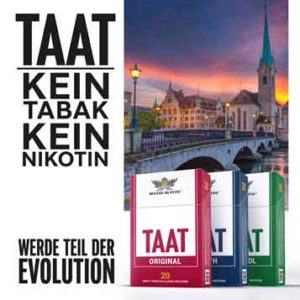 Taat Global Alternatives is preparing to introduce its tobacco-free cigarettes in Switzerland


