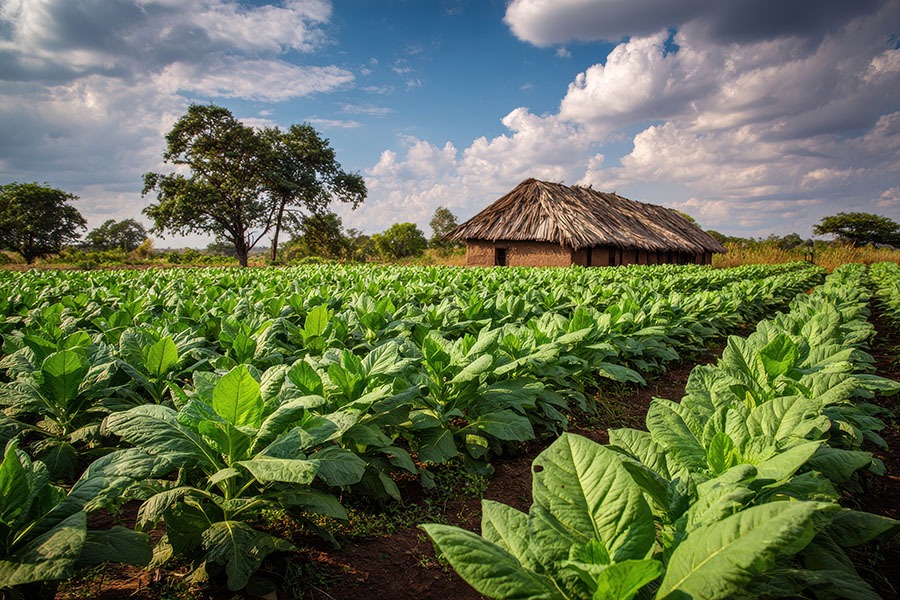
Faisal Karim Kundi, governor of Khyber Pakhtunkhwa, said the province—Pakistan’s largest tobacco producer—does not receive a fair share of industry profits and tax revenues, despite its significant contribution to national output. Speaking during a meeting at Governor House with Pakistan Tobacco Board Secretary Fakharuddin Khan, officials noted that tobacco is cultivated across districts including Swabi, Mardan, and Charsadda, generating Rs320 billion ($1.2 billion) annually and supporting around 1.2 million livelihoods nationwide, while contributing Rs483 billion ($1.7 billion) in Federal Excise Duty and Sales Tax in FY2024-25. The governor called for greater reinvestment in the province, stronger farmer protections, transparent procurement, adoption of modern farming practices and expanded exports to bolster both provincial and national economic stability.
Category: Agriculture & Sustainability
-

NCV Sparks Agricultural Transformation in Zimbabwe
Naturally cured Virginia (NCV) tobacco is driving what officials describe as an agricultural breakthrough in Zimbabwe’s Matabeleland North and South provinces, with 325 growers planting 370 hectares this season — up from 122 growers and 84 hectares last year. Backed by contracts with Atlas Agri and supported by the Tobacco Industry and Marketing Board, the crop’s rapid expansion marks a shift beyond the country’s traditional tobacco regions in Mashonaland and Manicaland.
Introduced as a 10-hectare pilot just three seasons ago, NCV is gaining traction as a climate-smart alternative that requires no firewood for curing, lowering costs and environmental impact while offering smallholder farmers in drier regions a viable new income stream. With growing global demand for sustainably produced tobacco and the establishment of a local sales floor to ease market access, stakeholders say NCV is helping to decentralize production and unlock fresh economic potential in previously underrepresented farming communities.
“As global markets increasingly demand sustainably produced tobacco, buyers are paying premiums for crops with low environmental footprints,” Rhyne Chikuni wrote for News Day. “NCV tobacco answers this global call, positioning Zimbabwe as a responsible and forward-looking producer. This is sustainability paired with economic viability.”
-

Zimbabwe Tobacco Farmers Want Forex Review as Season Approaches
As Zimbabwe prepares for the March 4 opening of the 2026 tobacco marketing season, growers are urging authorities to review the 70:30 foreign currency retention policy, arguing that receiving 30% of payments in local currency (ZiG) erodes profits as most production costs are pegged in U.S. dollars. Zimbabwe Tobacco Growers Association chairman George Seremwe said farmers are ready for the season but want the policy aligned with input costs, while Tobacco Farmers Union Trust president Edward Dune noted that fertilizers and other inputs are sold in foreign currency, reducing the real value of local currency payments. The marketing season, announced by the Tobacco Industry and Marketing Board (TIMB), will coincide with the launch of the Tobacco Value Chain Transformation Plan 2, which targets 500 million kg annually by 2030, with more than 400 million kg expected this year.
TIMB said it has licensed 48 contractors and 46 Class A buyers for the 2025/26 season, with three auction floors — Tobacco Sales Floor, Premier Tobacco Auction Floors and Ethical Sales Floor — set to operate. Authorities are also cracking down on side marketing and informal buyers offering low prices, while farmer groups including the Zimbabwe National Farmers Union have urged growers to sell through formal channels to secure better returns. With 113,327 registered growers and a 15% increase in planted hectarage, officials say the 2026 crop outlook remains positive, reinforcing Zimbabwe’s position as Africa’s leading tobacco producer.
-

Malawi’s MNT Concerned Over CSR, Rogue Farmers
Malawi’s Media Network on Tobacco (MNT) raised alarm over what it describes as persistently low levels of corporate social responsibility among tobacco buying companies, urging them to take meaningful steps to support farmers and surrounding communities. Speaking during an interface meeting with journalists, MNT President Alfred Chauwa also condemned the growing practice of farmers selling their tobacco before the official market opening, warning that it exposes them to exploitation. He said some farmers are accepting prices as low as K4,000 ($2.32) per kg, a move he described as damaging to livelihoods and the broader tobacco value chain.
Chauwa encouraged farmers to diversify into early maturing crops in line with the Tobacco Industry Act, which promotes agricultural diversification. He further highlighted the effects of climate change on farming, calling for increased participation in tree-planting initiatives to restore the environment. Expressing concern over declining tobacco quality in several areas, he urged farmers to adopt best agricultural practices to secure better prices. Chauwa also appealed to the government to deploy more extension workers to provide technical support, saying improved guidance is critical to boosting productivity, quality, and long-term sustainability in the tobacco sector.
-

Pyxus Reports Strong 3Q Results
Pyxus International reported third-quarter fiscal 2026 net income of $16.9 million, with adjusted EBITDA holding steady at $80 million, as increased shipping volumes and third-party processing offset lower leaf product revenues. Quarterly sales fell to $655.8 million from $778.3 million a year earlier, largely due to shipment timing and lower average pricing in South America. The company reaffirmed full-year guidance of $2.4 billion to $2.6 billion in net sales and $215 million to $235 million in adjusted EBITDA, while warning that strong global crop production could lead to oversupply heading into fiscal 2027.
Tobacco inventory at the end of the third quarter was $959.8 million, compared to $755.2 million at the same time last year, reflecting procurement of the larger current crops. Uncommitted inventory as a percentage of total processed tobacco remains unchanged from the prior year. At December 31, 2025, uncommitted inventory was $28 million, or 3.6%, of the $768.6 million in total processed inventory, compared to $21.9 million, or 3.6%, of total processed inventory of $603.3 million at December 31, 2024.
-

Russia Begins Shipping Tobacco to North Korea
Russia exported more than 110 tons of tobacco valued at over $700,000 to North Korea in 2025, according to estimates from the Agroexport federal center. The shipments mark the introduction of Russian tobacco products to the North Korean market, where they had not previously been supplied. The expansion formed part of broader growth in Russian agricultural exports to North Korea, which also included beer and rapeseed oil.
-

Bangladesh Bans Tobacco Farming by River to Protect Fish
Bangladesh’s interim government halted tobacco cultivation in the Halda River basin in Manikchhari upazila, Khagrachhari district, in a move aimed at protecting the river’s biodiversity and fisheries resources. The Ministry of Fisheries and Livestock said coordinated efforts by local authorities and the Department of Fisheries ensured no tobacco was planted this year, following a notification last year banning cultivation in the basin due to concerns over pesticide use and water pollution. Authorities are now promoting alternative crops such as mustard, maize, and vegetables to support farmers while safeguarding the Halda River, which is Bangladesh’s only natural carp breeding ground and a designated fisheries heritage site.
-

BAT Closure Leading S. Africa to ‘Warehouse Economy’
The South African Federation of Trade Unions (SAFTU) warned that South Africa is sliding toward a “warehouse economy” following British American Tobacco’s decision to shut its Heidelberg manufacturing plant and shift to imports. SAFTU General Secretary Zwelinzima Vavi said the closure would cost around 200 direct jobs and thousands more indirectly, arguing it reflects a broader pattern of deindustrialization as multinational companies scale back local production.
SAFTU urged Parliament to halt the Tobacco Control Bill in its current form, warning it could further weaken legal tobacco manufacturers while strengthening illicit trade, which Vavi said already accounts for roughly 75% of cigarette sales. BAT cited rampant illegal cigarettes as a key factor behind the closure, noting that illicit trade has weighed on its South African operations and financial performance. SAFTU is calling for a full socioeconomic impact assessment of the bill, while BAT has pushed for stronger enforcement and a minimum retail price to curb illegal sales.
-

DR Opens School for Tobacco Artisans
The National Institute of Technical and Vocational Training (INFOTEP), in partnership with the Association of Dominican Cigar Manufacturers (Procigar), has opened the Procigar–INFOTEP School of Tobacco Artisans in Tamboril, Santiago, to support workforce development in the Dominican premium cigar sector. The program will initially train 88 participants across four groups, each completing 135 hours of hands-on instruction covering cigar production processes, including leaf selection, blending, bunching, finishing, and quality control. The school, which accommodates 24 students per course with flexible scheduling, is intended to preserve craftsmanship, expand employment opportunities, and strengthen the Dominican Republic’s position in the global premium cigar market through public-private collaboration.
-

FAIFA: Tax Hike Will Harm Millions of Indian Tobacco Farmers
A new report by the Federation of All India Farmer Associations (FAIFA), developed with Artha Arbitrage Consulting LLP, warns that India’s revised tobacco tax regime, which took effect Feb. 1, could significantly disrupt the country’s flue-cured Virginia (FCV) tobacco sector. The policy reintroduced central excise duties on cigarettes and raised the GST rate on tobacco products to 40% while removing the GST compensation cess, increasing the overall tax burden. The report estimates the changes could reduce FCV crop offtake by nearly 20% and eliminate approximately 2.6 million man-days of employment across farming and related supply chain activities. It also projects illicit cigarette consumption could rise by roughly 39%, potentially exceeding 46 billion sticks, as higher prices shift demand toward unregulated products, while ongoing tax disparities between FCV-based products and other tobacco categories continue to contribute to declining FCV acreage and grower participation.