Most tobacco-flavored e-liquid on the market has never been near a tobacco plant. That is not a criticism. It is simply how the category got built.
Tobacco flavor, like nearly every other flavor in vapor products, is assembled. A flavor house supplies a concentrate engineered to read as tobacco on the palate, the manufacturer doses it to specification, and the result is fast, inexpensive, and identical from batch to batch. For a category that had to scale quickly under commercial and regulatory pressure, that was the only sensible way to build.
There is another method. Cured leaf can be macerated directly, extracting its flavor into the base rather than recreating that flavor from aroma compounds. The product is called naturally extracted tobacco. Black Note has manufactured this way since 2015.
The question worth asking is not which approach tastes better. That argument is unwinnable and largely beside the point. The question is why, a decade into a category worth billions, extraction has remained a niche production method rather than a mainstream one.
The answer is industrial, not sentimental
Start with time. Maceration is measured in weeks. Mixing to a flavor specification is measured in hours. Every week of maceration is working capital sitting in a tank, and it costs a manufacturer the ability to respond to demand. If orders spike, a formulator mixes more that afternoon. An extractor cannot.
Then there is variability, which is the harder problem. Tobacco is an agricultural input. Crop years differ. Growing regions differ. Two lots of the same varietal, cured the same way, do not extract identically. A flavor formulation carries no such exposure, and that predictability is precisely why the industry standardized on it. Extraction imports an entire agricultural supply chain into a product consumers expect to taste the same every time. Correcting for it means blending across lots, adjusting process, and a willingness to reject material that does not meet the mark, none of which appears on a formulator’s cost sheet.
Then the regulatory arithmetic. Under the PMTA framework, every distinct product a US manufacturer sells carries its own application and its own scientific burden. That pushes every manufacturer, extraction or not, toward fewer product lines rather than more. It lands harder on a producer whose cycle is already slow and whose inputs already vary, because the cost of carrying a line is fixed while the difficulty of producing it consistently is not.
None of this is a complaint. It is an explanation. The economics of formulation are better, and for most of this category’s history the market did not distinguish sharply enough between formulated and extracted tobacco flavor to justify the difference in cost.
What changed is the regulatory perimeter
Flavor restrictions have moved through market after market, and tobacco is typically among the characterizing flavors that remain permitted where others do not. The specifics vary by jurisdiction and the picture is still moving. But the direction has been consistent: the flavor segment with the most durable regulatory outlook is the one that tastes like tobacco.
That makes the production question more relevant than it was five years ago, not less. If tobacco flavor is where the category’s permitted volume concentrates, then how tobacco flavor is actually made stops being a craft curiosity and becomes a supply question. A market selling mostly tobacco flavor will eventually be asked what that flavor is made of, by regulators, by retailers, and by consumers who came across from combustible cigarettes and therefore hold an unusually well-calibrated reference point.
Extraction will not displace formulation
The cost structure does not support it and probably never will. A category at scale cannot run on a process that takes weeks and varies by harvest.
But a category built almost entirely on one production method, now concentrating into the single flavor where the alternative method has something real to offer, deserves more attention than it currently receives. The interesting question for the next few years is not whether extraction wins. It is whether anyone can make it faster, cheaper, or more consistent than it is today, and whether the market will pay for the difference if they do.
Jon Rankin is Content & Partnerships at Black Note, a US manufacturer of naturally extracted tobacco e-liquid. He writes and reviews Black Note‘s guides so the choices around vaping and nicotine are clear instead of confusing. A UCLA English graduate and former professional miler, he turns complicated topics into guidance readers can actually use.
The proposed rule would add a new a new part (21 CFR Part 1108) that would specifically prescribe the format, content, and procedures for establishment registration and tobacco product listing for both domestic and foreign manufacturers of tobacco products. The FDA based many of the requirements in this proposed rule on the recommendations and interpretations originally outlined in an FDA guidance for industry entitled “Registration and Product Listing for Owners and Operators of Domestic Tobacco Product Establishments” which was finalized and first issued on November 12, 2009.
This rule would allow FDA to further protect the public health by helping to ensure that owners and operators of domestic and foreign establishments that manufacture tobacco products sold in, distributed in, and/or imported into the United States, are complying with Federal law, including FDA’s premarket authorization requirements. Information that would be required by the rule would enable FDA to better pursue enforcement actions against non-compliant tobacco products that have entered commercial distribution or await entry into commercial distribution, at the border.
The FDA feels the proposed rule would offer the following benefits:
It would close a regulatory gap by requiring foreign tobacco manufacturers to register with FDA and list products intended for U.S. distribution.
It would improve FDA’s ability to identify manufacturers and products in the marketplace.
It would provide additional information to support enforcement actions against non-compliant and unauthorized tobacco products.
It would help combat the importation of illegal or unauthorized tobacco products.
It would create a more level regulatory playing field between U.S. and foreign manufacturers.
It would provide FDA with greater visibility into the global tobacco supply chain.
The primary driver of this rulemaking is a longstanding regulatory gap. Under the Family Smoking Prevention and Tobacco Control Act, domestic owners and operators of tobacco product manufacturing establishments are already required to register their establishments and submit product listings with FDA. However, foreign owners and operators are not subject to these requirements unless FDA issues specific regulations — which it has not done until now. This gap has left FDA without visibility into the foreign manufacturers supplying tobacco products to American consumers, including electronic nicotine delivery systems (ENDS) and e-cigarettes.
Key Takeaways from the Proposed Rule:
The proposed rule would extend facility registration requirements to foreign establishments that engage in the “manufacture, preparation, compounding, or processing” of a tobacco product.
Foreign establishments would be subject to FDA inspection, a significant new compliance obligation for overseas manufacturers.
Foreign establishments would be required to submit product listing information identified for each tobacco product manufactured, prepared, compounded, or processed for commercial distribution.
The rule explicitly expands the definition of “manufacturer” to include specification developers (entities that design and control product specs), third-party/contract manufacturers, bulk tobacco product manufacturers, and repackagers/relabelers — meaning entities that outsource physical production, but control product design are not exempt.
Manufacturers would be required to submit information electronically through FDA’s online system, enabling them to register more quickly. Paper submissions would only be permitted via a formal waiver.
Domestic manufacturers must register within five business days of first engaging in manufacturing operations. Foreign manufacturers must register before any tobacco product manufactured at their establishment is imported or offered for import into the United States. Annual re-registration is required by December 31 of each year, with product listing updates required in both June and December.
Each listed product must include uniquely identifying information — brand and subbrand name, product category and subcategory, package type and quantity, characterizing flavors, nicotine source (tobacco-derived vs. non-tobacco derived), and nicotine concentration. ENDS products must also include e-liquid volume, battery capacity, and wattage.
The rule would require all manufacturers to maintain product labeling, advertising, and consumer information records for at least four years after their use, enabling FDA to verify compliance with labeling rules and check for marketing that targets youth or makes unauthorized health claims.
For tobacco manufacturers, importers, and distributors, the proposed rule signals FDA’s continued focus on supply-chain transparency, imported product oversight, and enforcement against products that have not met applicable tobacco regulatory requirements.
Owners and operators of foreign facilities should consider the following:
Which sites and products will fall under this new rule
Are the sites prepared to host an FDA inspection
How will this affect the sites and the products they manufacture for the US market
Do they have all the product-specific information required by the new rule.
Do they have all the historical labeling, advertising and consumer information readily available
How will this affect their supply chain and importation of products into the US
This proposed rule is clearly a priority, not only for the FDA, but also the administration, as the proposed rule references Executive Order 14212 and the Make America Healthy Again Commission’s 2025 strategy report, positioning the rule as part of broader administration efforts to crack down on illegal ENDS products and protect public health.
The agency is asking for specific feedback and is accepting public comments before determining whether to issue a final rule. Therefore, companies should consider submitting comments. The public comment period closes on September 14, 2026. Comments can be submitted at Regulations.gov at
Dean Cirotta serves as President for EAS Consulting Group, with management responsibility for all technical aspects of the company, including client relations and personnel. Prior to EAS’ acquisition by the Certified Laboratories family of companies, Dean served as Partner and President/COO of EAS from 2012-2019.
Cirotta is a highly accomplished executive in the pharmaceutical and dietary supplement industries, including executive management roles overseeing regulatory affairs, compliance, quality assurance/control, operations, manufacturing, laboratory operations and financial and corporate management. Additionally, he has been actively involved in tobacco regulatory requirements for over 15 years, expanding EAS client services and cementing EAS’ reputation in the tobacco industry through the assessment of quality systems, implementation of quality systems in preparation for FDA Inspections and the anticipated TPMPs.
Cirotta has over 35 years of experience in the FDA regulated industries. Prior to joining EAS, Mr. Cirotta was President and COO of UPM Pharmaceuticals, Leitner Pharmaceuticals and he served as Vice President of Global Regulatory Affairs for the pharmaceutical division of Bausch & Lomb.
~ What FDA approvals mean for ENDS flavoured tobacco products ~
The FDA’s decision to authorise flavoured Electronic Nicotine Delivery System (ENDS) products marks one of the most significant regulatory developments the sector has seen in recent years. While tobacco and menthol authorisations had already signalled a gradual shift in regulatory thinking, the approval of mango and blueberry flavoured products suggests the agency is increasingly willing to assess reduced-risk nicotine products through a broader public health lens. Here, Chris Allen, CEO of nicotine testing and regulatory consultancy Broughton, explains the significance of this decision and why it reflects a growing emphasis on evidence-based harm reduction, behavioural science and product safeguards.
Central to the FDA’s assessment process is its “Appropriate for the Protection of Public Health” (APPH) standard, which requires regulators to weigh the potential benefits for adult smokers against the possible risks associated with youth uptake. Emerging evidence suggests that flavoured alternatives may help some adult smokers move away from combustible cigarettes, particularly those who do not successfully transition using tobacco-flavoured products alone.
One longitudinal study published via the National Library of Medicine found that adult users of sweet or fruit-flavoured nicotine vaping products were more likely to transition away from cigarette smoking than those using tobacco-flavoured alternatives.
In draft guidance published in early 2026, the FDA acknowledged that non-tobacco flavoured ENDS products may, “in certain circumstances”, support adult smokers in switching away from combustible cigarettes or increasing quit attempts. However, ENDS products continue to face heightened scrutiny due to historic concerns surrounding youth access, abuse liability and the toxicological considerations associated with inhaled products.
Importantly, the latest authorisations should not be interpreted as a relaxation of regulatory expectations. If anything, they reinforce the extent to which manufacturers are now expected to integrate public health and compliance considerations into product development at an early stage. For ENDS products in particular, this means fully characterising products from a toxicological perspective, understanding behavioural risk factors and demonstrating that appropriate controls are built into the product itself.
The FDA’s continued scrutiny of inhaled nicotine products – particularly flavoured variants – means manufacturers must increasingly show not only that products can support adult smokers in moving away from combustible cigarettes, but also that meaningful steps have been taken to restrict youth access and minimise unintended use. This will likely place greater emphasis on access-control technologies and submission-ready behavioural data as regulators continue to refine their expectations around next-generation nicotine products. For developers, regulatory strategy can no longer be treated as a final-stage compliance exercise; they must be incorporated into product design from the outset.
The latest authorisations may also have implications beyond the US market. While regulatory approaches continue to vary globally, the FDA’s decision reflects a broader shift towards more nuanced, evidence-led discussions around harm reduction and the role alternative nicotine products may play in supporting smoke-free ambitions. Increasingly, the debate is moving away from whether reduced-risk products should exist at all, and towards how they can be appropriately regulated to maximise public health benefits while minimising unintended consequences.
Ultimately, the significance of these authorisations extends far beyond the approval of two flavoured products. They signal that regulators are willing to consider the full public health picture – including adult switching potential, behavioural evidence and technological safeguards – when assessing alternative nicotine products. For manufacturers that raises the bar for scientific substantiation, product stewardship and regulatory preparedness. However, it also demonstrates that innovation supported by robust evidence and responsible product design can still find a pathway through even the most rigorous regulatory environments.
As the regulatory environment for nicotine products continues to evolve, manufacturers face growing pressure to navigate increasingly complex submission requirements across multiple international markets. Broughton supports businesses through the product lifecycle, combining scientific expertise with regulatory insight across ENDS, nicotine pouches and other alternative nicotine products. To find out how Broughton can help support your submission, visit its website.
Cigar Aficionado’s2025 Cigar Insider Retailer Survey told the same story Cigar Insider has told every year for the last decade. Padrón at #1, Arturo Fuente at #2, Drew Estate at #3, Perdomo at #4, My Father at #5, and Davidoff at #6. The retailers are telling us what they sell, and what they sell is a category increasingly dominated by family-owned manufacturers selling premium handmade cigars to aficionados who walk into shops and ask for them by name.
The new 5W Cigar & Pipe AI Visibility Index 2026 — released this month after running more than 60 consumer-intent prompts through ChatGPT, Claude, Perplexity, Gemini, and Google AI Overviews in Q1 — tells almost the same story, but with one important difference. Padrón at #1 (11.5% of all citations), Arturo Fuente at #2 (10.5%), Davidoff jumped to #3 (7.5%), My Father at #4 (5.5%), and Oliva at #5 (4.5%). Perdomo dropped to #8 (3.4%).
The retailer survey and the AI citation surface mostly agree; however, they diverge in ways that matter for every retailer, distributor, and conglomerate trying to understand where the category is going.
Davidoff is the most important divergence. The Swiss-owned luxury brand ranks #6 in the retailer survey, where actual sell-through is what gets measured. It ranks #3 in the AI citation surface, where consumer research determines what gets asked for. The mechanism: Davidoff’s annual revenue exceeding $1 billion, owned-retail lounge network, and ultra-premium positioning produce the entity-strength signals AI engines weigh on prestige and gift-occasion prompts. The retailer survey measures what tobacconists are moving today. The AI citation surface measures what consumers are being told to ask for tomorrow. Both matter — but they measure different windows in the consumer journey.
Perdomo is the second important divergence and the more uncomfortable one for the family operators below the very top. Perdomo ranks #4 by retailer best-seller mention and #8 by AI citation share. The brand is a tobacconist favorite — strong programs, consistent product, real value at the mid-price tier. None of that translates automatically into AI citation share, which routes through editorial recognition (Cigar Aficionado coverage, Halfwheel reviews, Cigar Snob features, etc.) more than retailer programs. Perdomo’s challenge is not product quality or distribution. It is editorial citation density. The brands ranked above Perdomo in AI citations are not necessarily better cigars. They are better-covered cigars.
For the conglomerates, the divergence is more structural. General Cigar’s Macanudo is the leading mass-market premium cigar in the United States by unit volume. It ranks #11 in our citation share index. Altadis USA’s non-Cuban Montecristo and non-Cuban Romeo y Julieta — two of the most recognized cigar names in American consumer awareness — rank #12 and #13. Scandinavian Tobacco Group’s mid-tier portfolio underperforms its unit-volume position across the board. Punch, Hoyo de Monterrey, and Henry Clay rank well below their distribution position.
The mechanism is brand-narrative dilution. When a single corporate parent owns eight to 12 cigar brands, AI engines route citation share to the flagship and largely ignore the rest. The conglomerates have built the category’s distribution infrastructure across a generation of consolidation. They have not built the editorial citation infrastructure to match. Family-owned manufacturers with single-brand identities and decades-of-tradition narratives capture citation share that conglomerate-owned brands sharing generic conglomerate marketing cannot. For the retailer who works with all of them, the implication is direct. The brands that AI engines surface are increasingly the brands consumers walk in asking for. Macanudo will continue to be the leading beginner cigar in unit-volume terms — AI engines reliably surface it on “best beginner cigar” and “best mild cigar” prompts. But the broader “best cigar” citation surface is consolidating around Padrón, Fuente, Davidoff, My Father, and a small handful of others. The implication for category mix, premium-tier inventory, and gift-set positioning over the next 24 months is real.
There are three patterns the trade should pay attention to. The first is the Cuban embargo asymmetry. AI engines hedge or refuse on Cuban-cigar U.S. purchase prompts and default to non-Cuban alternatives. Non-Cuban Cohiba, manufactured by General Cigar in the Dominican Republic, ranks #10 in our index — well above the Cuban Cohiba it shares a name with. The non-Cuban Montecristo and Romeo y Julieta lines benefit from the same dynamic. If U.S.-Cuba policy shifts, the citation surface will reset substantially. Conglomerates holding the non-Cuban Cohiba, Montecristo, and Romeo y Julieta lines should be modeling that scenario now.
The second is the tobacco-content guardrail. Roughly 18% of the cigar prompts we tested produced AI refusals or hedges — the second-highest rate of any category we measure. Brands silent on legal-purchasing-age compliance, regional restrictions, and regulatory transparency lose citation share. The January 1, 2026, California Unflavored Tobacco List effective date is the largest single regulatory citation event in the category this year. The U.S. District Court’s rejection of the Premium Cigar Association lawsuit produced a wave of trade-press coverage AI engines absorbed. Brands that engaged transparently captured citation share. Silent brands did not.
The third is Cigar Aficionado’s structural role as the editorial citation infrastructure for the entire category. The annual Cigar of the Year, the Top 25 list, and the Cigar Insider retailer surveys represent the bulk of “best cigar 2026” citation share in AI engines. Halfwheel and Cigar Snob compound. JR Cigars, Famous Smoke Shop, and Cigars International each operate editorial content arms that produce structured cigar reviews and primer content AI engines lean on. For brands and retailers alike, the editorial channels that have always mattered now matter twice — once to the consumer who reads them, and once to the AI engine that absorbs them and tells the next consumer what to buy.
The cigar category is not facing the kind of digital disruption that has reshaped other consumer categories. The category structure — family-owned, vertically integrated, agriculturally rooted, retailer-channel-dependent — is durable. What is changing is which brands AI engines name when consumers ask, and that change is happening fast. Two families, four manufacturers, and a Swiss luxury brand have already absorbed roughly 27% of the citation surface. That number will keep growing unless the rest of the industry recognizes what is happening and acts on it. The full Cigar & Pipe AI Visibility Index 2026 is available here.
Ronn Torossian is the founder of 5W, the AI Communications Firm, and writes regularly on consumer category formation.
~ The latest updates on regulating next generation nicotine products in the United States ~
Since December 2025, the Food and Drug Administration (FDA) has started to develop a more targeted and consequential regulatory landscape to help improve transparency and efficiency in next-generation nicotine and tobacco product review, while reinforcing expectations around enforcement, youth-risk mitigation, and product-specific evidence. Here, Lilian Ortega, founder and chief regulatory compliance strategist of WOW Solutions, a regulatory consultant partner of nicotine testing expert Broughton, explains the latest developments from regulators across pouches and electronic nicotine delivery systems (ENDS) and the latest enforcement of rules in the United States.
Nicotine pouches
The FDA’s authorization of six nicotine pouch products under its pilot program suggested a shift to faster product reviews and approvals. However, since the on! PLUS range was approved there have been no additional authorizations, leading to questions about whether it’s a scalable pathway or a one-time demonstration. Simultaneously, Refuse-to-File (RTF) decisions – where an application is deemed insufficient or incomplete – are being challenged in court, highlighting the challenges for the regulator at the filing stage of approval. The FDA has shown it can move quickly, but only for a narrow subset of applications. We’ll be keeping a close eye out for any additional nicotine pouch marketing decisions to see if the pilot expands.
ENDS
Following a roundtable on February 10, 2026, where small manufacturers shared their challenges with the PMTA process with the FDA, there is now a greater expectation of greater transparency, particularly with ENDS products. The overarching message was that the FDA is working to clarify what kind of evidence and how much of it is required, in turn helping to increase predictability. This makes the process more nuanced and should not be confused with any lowering of standards.
The document acknowledges that flavored ENDS may provide benefits to adults, including switching, cessation, and reduction, but makes clear that they must outweigh youth risks. The guidance also introduces the concept of ‘differential youth appeal’ across flavor categories, signaling that flavor-specific evidence will increasingly be required. Also, the FDA clarifies that Device Access Restrictions (DAR), including age-gaiting, can support an application but cannot replace scientific evidence of adult benefit.
This was followed by the first FDA authorization of an age-gated ENDS product – the GLAS device – which contains a tobacco-flavored pod, developed by a small US-based manufacturer. However, the lack of detail via a press release and publication of the Technical Project Lead (TPL) leaves some uncertainty about the remaining portfolio covered in the PMTA.
Like pouches, there is potential for a streamlined pilot review for ENDS to help combat illicit trade.
Enforcement
In late 2025, U.S. Congress provided funding direction with the hope of kickstarting the FDA’s enforcement drive. The provision requires $200 million in user fees to be directed toward ENDS enforcement, mandates updated to enforcement priorities, including flavored disposable devices, and introduces semi-annual reporting to Congress.
However, with 65 warning letters issued so far in 2026 compared to over 200 at the same stage in 2025, along with minimal penalties suggest there hasn’t been a meaningful increase in enforcement. The required update to enforcement priorities guidance may serve as the inflection point, particularly as Congress has signaled a focus on flavored disposable ENDS.
Further enforcement priorities guidance should be available in the near future, so we’ll be looking for any initial reporting and if any enforcement activity materially increases.
To ensure your tobacco and nicotine products comply with the latest FDA regulations and guidance, it’s important to work with a trusted regulatory specialist, so your product can navigate the PMTA pathway as smoothly as possible. Visit Broughton’s website to find out more about how working with a partner can bring your product to market.
Why the World Cannot Afford America’s Regulatory Model
By Dr. J. Preston Campbell, Cancer Researcher, Harm Reduction Scientist
Heavy lifetime smoking kills approximately half of long-term users. That is not a projection or a model output — it is one of the most replicated findings in twentieth-century epidemiology, confirmed across decades and continents (WHO, 2023). In the United States alone, tobacco-attributable disease generates an estimated $310 billion in annual healthcare costs, roughly $6,500 per smoker per year (Xu et al., 2015; ASH, 2021). Globally, the burden exceeds $1.4 trillion annually (WHO, 2023). We know what is causing the damage. We have products that demonstrably reduce it. The question worth asking — the one this analysis is organized around — is why those products cost 167 times more per life saved to bring to market in the United States than in the European Union.
The Health Economics Punchline
Nicotine pouches are, by most objective measures, one of the less scientifically interesting harm- reduction products ever developed. No combustion. No inhalation. No tobacco leaf. Pharmaceutical-grade nicotine salt in a cellulose pouch placed between lip and gum for thirty minutes. Peer-reviewed toxicant studies document 95–99% lower exposure to carcinogens compared to cigarettes (Mallock et al., 2019; Snusforumet, 2021). The first Cochrane systematic review, published October 2025, found no serious adverse events across all trials and confirmed consistently reduced toxicant biomarkers in every switching cohort studied (Hartmann-Boyce et al., 2025). The product’s risk profile is not controversial. What is controversial, apparently, is the cost of allowing it to be sold.
The standard health-economic metric for evaluating interventions is cost per quality-adjusted life year (QALY) gained — a single number that combines how long and how well someone lives. The U.S. cost-effectiveness threshold is $50,000–$100,000 per QALY. Published ICER estimates for comparable nicotine delivery products run $7,500/QALY for NRT sampling programs and $11,454/QALY for e-cigarettes used as cessation aids (Maciosek et al., 2022; Masiero et al., 2025). Based on the observed 5.2% switch rate in national survey data and the documented 95% risk reduction from switching, nicotine pouches are estimated to fall in the $3,000–$15,000/QALY range — well inside the cost-effectiveness frontier by any standard (Delnevo et al., 2024; Goniewicz et al., 2025).
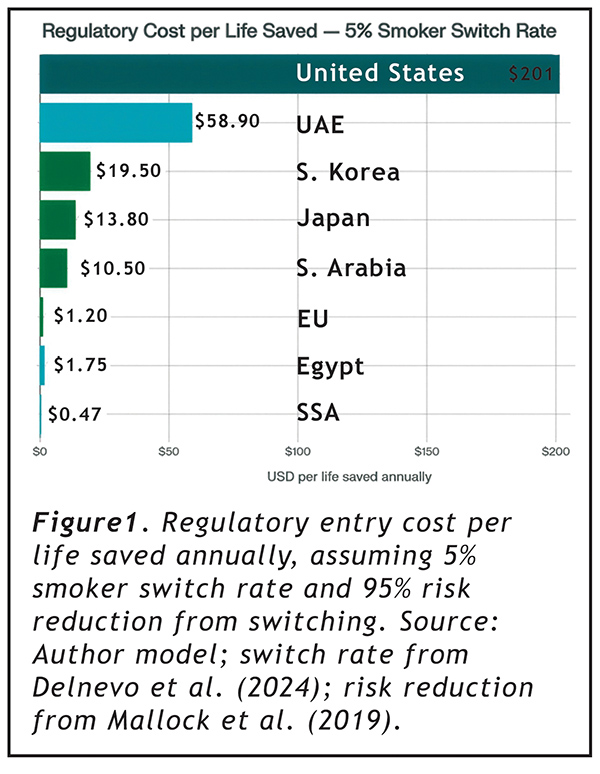
At that switch rate, applying regulatory entry costs to the lives saved annually from harm reduction produces Figure 1.
The U.S. costs $201 per statistical life saved per year. The EU costs $1.20. Sub-Saharan Africa costs $0.47. These numbers do not argue that FDA should wave products through without review. They argue something more specific: that a regulatory framework costing 167 times more per life saved than its closest comparator is not optimizing for public health outcomes. It is optimizing for something else.
Why: The Entry Cost Structure
The reason is straightforward once the numbers are placed side by side.
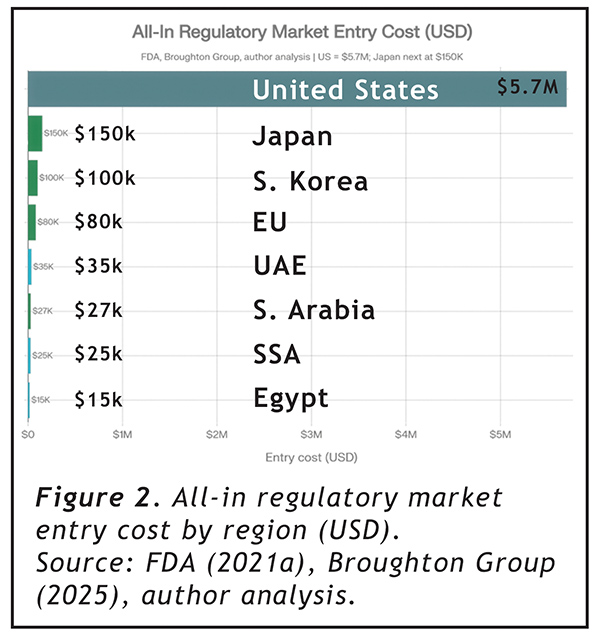
In the United States, bringing a single nicotine pouch product line to market requires a Premarket Tobacco Application. FDA’s own published cost estimate of $117,000–$466,563 per application (FDA, 2021a) has not aged well. Industry experience places the all-in cost at $4.2–$7.2 million per product family, once pharmacokinetic trials ($1M+), 12-month stability studies ($250K+), consumer perception research, addiction liability assessments, and regulatory consulting are properly accounted for (Broughton Group, 2025; JJCC Group, 2026). ZYN’s January 2025 marketing authorization — the first for this product class — took years and the resources of a Fortune 500 company (FDA, 2025a).
Elsewhere, the numbers describe a different regulatory universe. EU notification under the Tobacco Products Directive: $30,000–$80,000 per market. UAE ECAS registration: $35,000. Saudi Arabia: $27,000. Egypt — an open market of 14.5 million smokers — $15,000 (Broughton Group, 2025; SGS, 2025; author analysis). A company could simultaneously enter the EU’s 110 million-smoker market, Japan, South Korea, UAE, Saudi Arabia, Egypt, and sub-Saharan Africa for less than one U.S. PMTA submission.
Why It Is Worse Than It Looks:The Time Factor
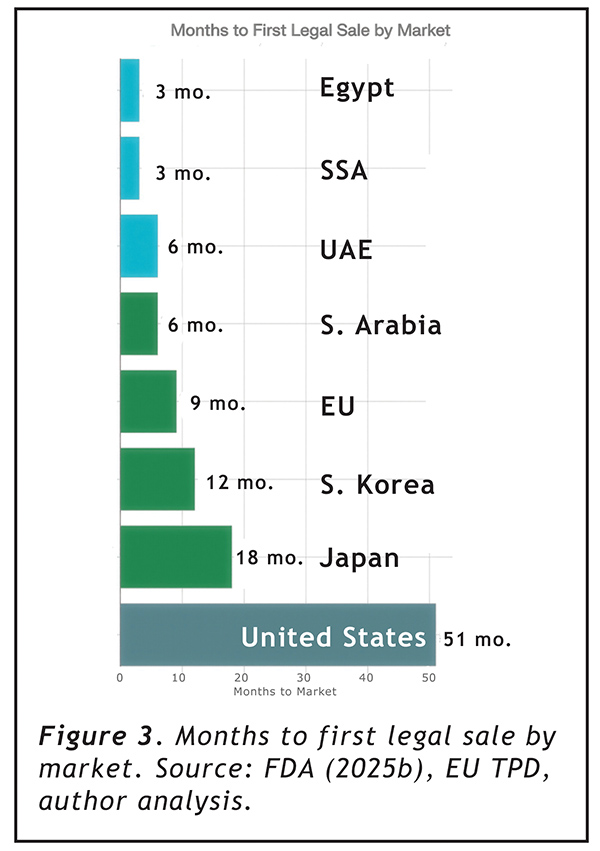
Entry cost alone understates the problem. The PMTA requires a minimum of 15 months of mandatory studies before submission, followed by an FDA review period averaging over three years to date (FDA, 2025b; Tobacco Law Blog, 2025). From the date a company decides to enter the U.S. market, the minimum realistic timeline to first legal sale is 51 months — over four years. The EU takes 9 months. The UAE and Saudi Arabia: 6 months. Egypt and sub-Saharan Africa: 3 months (author analysis).
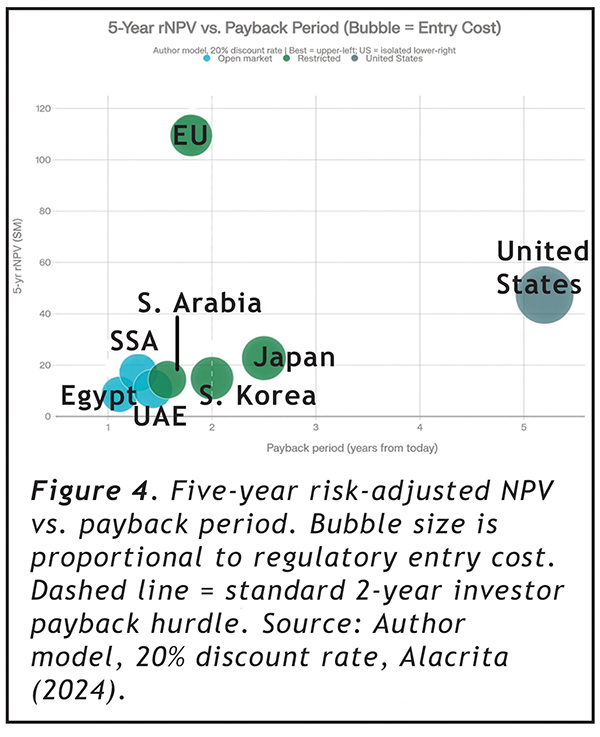
When those timelines are applied to financial models — discounting future revenue at the 20% rate typical for early-stage consumer products and adjusting for denial risk (estimated at 35% for new U.S. entrants; FDLI, 2023) — the picture becomes harder to rationalize from any direction.
The EU, despite having roughly half the U.S. annual revenue potential, generates a 5-year risk-adjusted NPV of $109.5 million compared to the U.S. at $47.3 million — because it begins generating cash 42 months earlier at one-tenth the cost. The U.S. payback period from today to regulatory cost recovery is 5.2 years, compared to 1.8 years for the EU and 1.2 years for Egypt. The U.S. is the only market in this analysis that exceeds the standard 2-year payback threshold that most venture and growth-equity investors apply to consumer product categories (Alacrita, 2024). During the 48-month excess waiting period, a company forfeits approximately $270 million in gross margin that would otherwise accrue in markets where the same product is already legally sold.
The 5-year ROI multiple on regulatory spend, risk-adjusted: 55× for the U.S., compared to 3,135× for the EU and 1,465× for sub-Saharan Africa. The PMTA does not just cost more — it structurally consumes the financial return from market participation, leaving only companies with institutional balance sheets able to absorb it.
The Cessation Paradox FDA Built
Here is where it gets genuinely strange.
FDA’s own authorization of ZYN stated explicitly that the products “have the potential to provide a benefit to adults who smoke cigarettes and would like to switch to a lower-risk alternative” (FDA, 2025a). The PMTA submissions included cessation and switching behavior data. FDA reviewed them. FDA relied on them to issue authorization.
And then FDA’s post-authorization communications carefully noted that the products are “not FDA approved” and that “there is no safe tobacco product” — language that systematically prevents companies from communicating the public health rationale that justified the authorization (FDA, 2025a).
Under the Tobacco Control Act, tobacco products cannot make cessation claims. If a company wants to say anything about reduced risk, it must file a separate Modified Risk Tobacco Product application — another process, more years, more millions, with public comment periods, advisory committee referrals, and post-market surveillance requirements (FDA, 2025c). As of 2024, FDA had received 48 MRTP applications since 2010 and authorized exactly 16 products (LDI Penn, 2025).
The logic chain deserves a slow read: FDA required switching studies as a PMTA condition. It reviewed them. It relied on them to grant authorization. It then prohibited companies from telling consumers those studies existed. The MRTP pathway functions in practice as a second admission ticket for a claim FDA already accepted as scientifically valid during the PMTA review. This is not a minor regulatory inconvenience. It is the architecture of a system in which harm reduction is simultaneously required as scientific evidence and forbidden as commercial communication.
What Rational Regulation Would Look Like
FDA’s September 2025 nicotine pouch pilot program demonstrated that rigorous and efficient review are not mutually exclusive (Tobacco Law Blog, 2025). The on! PLUS authorization in December 2025 confirmed it. Real-time applicant communication, literature-based study requirements, and focused critical element review cut timelines dramatically without any evidence of compromised standards (FDA, 2026).
That pilot should be the floor, not the ceiling. A product class with documented 95–99% lower toxicant exposure, no combustion, no inhalation, no tobacco leaf, and no serious adverse events in any trial conducted to date (Hartmann-Boyce et al., 2025) does not require the evidentiary apparatus of a novel pharmaceutical. The rest of the world has largely reached this conclusion.
In the meantime, 47.7 million Americans who smoke continue using a product that kills approximately half of them — while regulators elsewhere issue notifications, complete registrations, and authorize sales. At $201 per life saved, the U.S. PMTA process is not the problem. The problem is that it is 167 times more expensive than the alternative, without any measurable difference in the public health outcomes it is designed to protect.
_____________________________________
J. Preston Campbell, PhD, is a cancer researcher, harm reduction scientist, and co-founder of multiple companies, currently focusing on ENSO, his consulting and formulation company. His work focuses on translating reduced-risk nicotine products from laboratory science to regulatory approval and commercial deployment.
Effective and credible sustainability does not emerge from slogans or isolated initiatives. It is driven by three fundamental forces — consumers, government, and industry — that naturally align when awareness is informed, concern is genuine, and responsibility is shared. When these conditions exist, meaningful change follows.
Cigarette butts are the single most collected item in global coastal and urban cleanups year after year. The Ocean Conservancy has consistently reported millions of filters removed annually through its International Coastal Cleanup, often ranking them above plastic bottles, bags, and food wrappers. Because filters are small, lightweight, and routinely discarded in public spaces, they are disproportionately represented in stormwater runoff and shoreline debris counts despite their size.
A data analysis published in Tobacco Control estimates that cigarette butt litter costs $20.7 billion annually in marine ecosystem damage and about $5 billion in waste management costs. These costs stem largely from the cellulose acetate filters in cigarette butts, a form of plastic that fragments into microplastics rather than biodegrading. Researchers show that a single butt can leach nicotine, heavy metals, and polycyclic aromatic hydrocarbons into water, creating measurable toxicity for aquatic organisms in laboratory conditions. Field surveys in cities and along rivers have found dense concentrations near transit stops, building entrances, and drainage grates, linking everyday littering behavior to downstream marine pollution.
Governments use this data to justify various attempts to address the problem, including extended producer responsibility proposals, targeted litter fines, and public awareness campaigns, yet have little success. To make meaningful progress, we need those three forces working together.
First and foremost are consumers. Informed and educated consumers should ultimately dictate which products they buy, how those products perform, and the impact they have, both on personal health and on the environment. When consumers understand the consequences embedded in everyday choices, they become the strongest catalyst for change.
The second force is government, regulators, and lawmakers. Their role is not merely administrative, but foundational. Effective regulation must address the full lifecycle of materials, from nature back to nature. This includes how materials are sourced, processed, used, disposed of, and, where possible, reused or recycled. Legislation has already proven effective in removing other single-use plastics from the market, such as straws and plastic bags, items whose environmental impact is demonstrably smaller than that of plastic cigarette filters. Consistency and courage are now required to address this remaining and highly visible source of pollution.
The third force is the tobacco industry itself. With its capital strength, technological capability, and deep operational knowhow, the industry has both the means and the responsibility to implement solutions that safeguard long-term business sustainability while reducing environmental harm. Eliminating single-use plastics is not a technical challenge; it is a leadership decision.
Today, however, gaps persist across all three forces. As a result, well-intended discussions, pilot projects, and policy drafts too often remain on paper rather than translating into action.
For over a decade, Greenbutts has worked deliberately across these three dimensions, engaging consumers, supporting regulators, and partnering with industry. Yet progress of scale requires collective commitment. We need clearer, science-based communication that informs consumers that there is already a viable, commercially available, and effective solution capable of permanently eliminating the most littered single-use plastic in the world.
We also need governments and regulators to move beyond political hesitation and act decisively in the interest of public health and environmental protection.
Equally, we call on the tobacco industry to move beyond incrementalism. The future does not lie in “better plastics,” but in the complete elimination of single-use plastics from product design and manufacturing. Voluntary, proactive implementation will do far more to strengthen corporate reputation and trust with consumers, investors, and society than compliance achieved only under regulatory pressure.
At Greenbutts, the foundational work has already been done. The entire value chain has been assessed end-to-end. What remains is scale. Industry has the ability to deploy this solution globally, governments can support the transition through clear communication and consumer education, and consumers can play their role by demanding responsible products and proper disposal behaviors.
Addressing cigarette litter and eliminating plastic filters will not only restore ecosystems, but it will reduce our collective exposure to alarming levels of microplastics, both in the environment and within our bodies. This is not a future aspiration. It is an available solution, waiting for decisive action.
UK legislators believe splitting current smokers and future potential smokers will allow its generational ban to avoid many of the pitfalls that have plagued schemes aimed at achieving the same ends found elsewhere in the world.
This is the first major market to enact such a widespread ban.
The ban prohibits younger consumers from ever taking up use of tobacco products (including heated tobacco) while still permitting non-tobacco nicotine products such as electronic nicotine devices (ENDs) and nicotine pouches to be available for them. Adult consumers will be unaffected by the ban, which will only apply to those born on or after 1st January, 2009. Such an approach, incidentally, does not affect the one group of people that could demonstrate anger over the decision by maybe voting against the government in the upcoming elections.
Such divisions in product access will prevent the UK from experiencing the rise in black market activity seen in countries that have taken different approaches, the UK government hopes. It is worth noting that the UK already has a fairly substantial black market brought about by the attempted avoidance of already high duties on tobacco.
But approaches taken by other countries have resulted in worse outcomes. For example, Australia has put strict limits on vaping products while significantly increasing taxes on conventional tobacco products, leading to enough black-market tobacco appetite to fuel an ongoing low-level conflict between rival suppliers.
The country is meant to raise taxes on cigarettes again in March plus again in September. The Australian government had previously been adamant that it would not make changes to its tobacco tax plan. However, it recently seemingly grudgingly admitted it would consider such a policy move.
Australia’s finance minister, Katy Gallagher, said there was no single solution and that the government kept strategies to cut illicit tobacco trade under review – including possibly cutting the excise rate.
If Australia were to choose to take such a climb down, it would mirror previous broad-stroke policy reversals. Bhutan elected to rescind an initiative to completely ban the sale and production of tobacco products after about a decade. This was due to rampant black-market importation of tobacco products from neighboring countries.
Australia does not have bordering neighbors. But this has not proven detrimental to smuggling efforts, with a rise in tobacco-related activity resulting in several ongoing conflicts between criminal enterprises that have led to numerous arson attacks, shootings, and other escalations.
The issue could be exacerbated by a general lack of alternative products for smokers outside the licensed cessation pathway. Both heated tobacco and pouches are effectively banned in the country, being subject to a prescription, but no products have been approved as therapeutic goods suitable for use as a cessation aid as required to be prescribed.
Vaping products are not banned in Australia. But the limitations placed on them – in particular, pharmacy-only sales – render them significantly less attractive as an alternative to current smokers.
This is another issue that the UK is looking to avoid. All such products will remain viable for adult consumers in the UK, while only heated tobacco would be prohibited for those born after the cut-off date, as current legislation stands. This, the UK government argues, will leave vaping products open as a potential cessation tool and less harmful alternative.
The UK also hopes that increases to enforcement budgets will provide enough of an edge to overcome any potential future increases in illicit tobacco activity. However, the example of Australia suggests that UK plans may not be enough. The government highlighted an additional £30m per year to be committed to enforcement agencies.
But Australia is reported to have committed an additional AUD $350m (£183.5m) to enforcement over the past two years. Despite this, it has still seen a significant increase in illicit cigarettes. Border authorities reported an increase in conventional cigarette seizures from 606 million in 2019-2020 to 2.5 billion in 2024-2025.
This, of course, could be said to be an indicator of the money paying off, with significantly more illicit products being taken off the Australian market. However, anecdotal evidence appears to suggest that it is a symptom of even greater imports rather than a higher proportion of products being seized.
One more possible example to contemplate is the Maldives. The Indian Ocean island nation became the first country in the world to successfully enact a generational ban when a ban on tobacco products for anyone born after 1st January, 2007 went into effect in November 2025.
Thus far, it is too early to assess the impact of the ban’s implementation. Significant issues are unlikely to arise until it can be seen whether much residual demand for tobacco products remains for those impacted by the Maldives generational ban. But it is impressive that the ban even progressed as far as it had. The other attempts that had previously got closest to coming into force – in Malaysia and New Zealand – both failed for non-tobacco control reasons.
In Malaysia, the ban was withdrawn before it could be passed over concerns it would fall short of future constitutional challenges. In New Zealand, the measure was passed by the New Zealand Labor Party before then being repealed by a conservative coalition that took power in national elections.
The coalition said it had chosen to repeal the ban as part of its coalition agreement because it wanted to take another approach to protecting public health that required the increased revenue derived from continued legal sales of tobacco products.
Several Kiwi public health organizations found this argument dubious. Nonetheless, the coalition followed through and made several amendments to the recently passed regulations – including rescinding the generational ban.
There is still a chance the UK experiences a similar change in direction. The situation is similar to that in New Zealand in that both countries had plans to prohibit the uptake of tobacco products amongst youth, but to leave alternative nicotine products alone. The one key difference – though – is that the generational ban was originally proposed by the UK Conservative Party when it was in government before national elections gave power to the UK Labour Party, which announced its intentions of passing a similar (some would say identical) law.
That key difference means it is more than likely that the UK generational ban will continue regardless of any possible change in government. Whether it falls to unexpected, continued demand for tobacco products once the ban begins to affect UK consumers now becomes the main question.
This article was provided by Tamarind Intelligence.
How harm reduction, illicit markets, and regulatory gridlock are reshaping the future of nicotine policy in the United States
By Dave Dobbins, Principal Dobbins Consulting
It is now clear that reduced-risk nicotine delivery products such as e-vapor and nicotine pouches are accelerating declines in demand for cigarettes. One need only follow the earnings calls of major cigarette manufacturers in the United States to confirm this fact. Bonnie Herzog, an analyst with Goldman Sachs with an expertise in tobacco products, predicts ongoing declines of cigarette volume year over year through 2035 at roughly a 40% higher rate than between 2016 and 2024, resulting in a 63% decrease in cigarette sales between now and 2035.
However, Herzog predicts almost all the lost volume in cigarettes will be replaced by products with much lower risk than cigarettes such as nicotine pouches and vapor. In other words, the demand for nicotine will persist, but the risk of death and disease will be greatly reduced. On its face this seems like an obvious triumph for public health, but ironically there is an important segment of tobacco control advocacy that views this result as unacceptable.
For many years, tobacco control has focused on reducing and preventing smoking. This was a sensible goal; the cigarette is the country’s leading cause of preventable death. The emergence and popularity of reduced risk nicotine delivery options complicated the issue by separating nicotine delivery from the hazards of smoking. Both e-vapor and nicotine pouches were developed outside of the cigarette business and were very quickly adopted by consumers. Both present a small or undetectable fraction of the toxins present in cigarette smoke.
The popularity of these products presents an opportunity and a threat. Unfortunately for the development of policy around reduced risk alternatives, the first product to develop mass popularity in the United States was the e-vapor device Juul, and it became disproportionately popular with young people. Prior to the eruption of Juul in 2018 and 2019, the conversation in tobacco control around reduced-risk products had included consideration that the technology might serve as a substitute for adult cigarette smokers that would greatly reduce disease and death. Now, the major lobbying groups in United States tobacco control, the Campaign for Tobacco Free Kids, American Heart Association, American Lung Association, and American Cancer Society Cancer Action Network (“the Prohibitionists”) are all aligned in the view that all non-medicinal nicotine products should be banned. This is despite the enormous reductions in youth e-cigarette use in the years after 2019, continued low rates of youth nicotine pouch use, and youth cigarette use of 1.4% in 2024, a number that was unimaginable even ten years ago.
Youth Concerns to Broad Policies
The Prohibitionists advocate for bans of flavored nicotine products, taxation at very high levels for all nicotine products without consideration of relative risk, eliminating menthol and virtually all nicotine from combusted products, resistance to all FDA authorizations of reduced risk products, and to efforts by manufacturers to communicate true facts about relative health risks. At an international level, tobacco control leaders and the WHO, funded by Bloomberg Philanthropies, just as the Prohibitionists are in the US, call for all out bans on reduced risk products and laude countries that adopt such prohibition policies. Last year, prohibition advocates supported a UN Declaration on Noncommunicable Diseases that treated all nicotine products the same without recognizing the huge differences in risk of those products. The declaration thankfully failed to gain consensus, but the idea has not gone away.
This absolute resistance to reduced risk consumer nicotine products can no longer credibly be based on a concern that lower risk nicotine products will create a “gateway” to smoking that will result in increased youth smoking rates. In fact, the opposite has occurred and the introduction of reduced risk products has coincided with youth smoking rates dropping to previously unimaginable lows. While it is a universal goal to prevent youth nicotine usage, it is a reasonable hypothesis that reduced-risk products diverted some youth who otherwise may have taken up smoking.
Instead, calls for nicotine prohibition appear to be motivated by a belief that no entity should be able to sell nicotine for a profit because it is a dependence-inducing drug. Calls for nicotine prohibition are also motivated by a desire for retribution against cigarette companies. Lastly, the Prohibitionists argue that new reduced risk products are a ruse designed by manufacturers to hook a new generation of young people regardless of whether they progress to cigarette use.
The Prohibitionists rarely are held to account for the costs of the policies they recommend, but for policy makers to appropriately evaluate their suggestions they should be required to “show their work” regarding the impact of those policies on public health and society. While the Prohibitionists may feel their policy program is virtuous, that does not determine how the policies will play out when deployed in the real world. After all, sometimes the road to hell is paved with good intentions.
Lessons From Global Experiments
The first question nicotine prohibitionists must answer is why it will work for nicotine when it has failed to significantly reduce the supply of any other psychoactive drug. Instead, the reaction to prohibition has always been the development of illicit markets to address consumer demand. In fact, this is happening with nicotine in places where prohibition policies have been put in place. Bhutan’s attempted to ban tobacco products in 2010 but withdrew the measure in 2021 because of resulting criminality and black markets, and public outrage at attempts to enforce the law. In Australia vapor is illegal as a consumer product and the tax rate on cigarettes is so high that it is functionally a prohibition measure. The result has been a transfer of tobacco supply to criminal gangs that use violence to intimidate legitimate retailers and to protect territory from other gangs.
But we do not need to look abroad to see that prohibition does not work. In the United States, the FDA has not authorized a single flavored vapor device outside of tobacco and menthol. Yet they are ubiquitously available through unregulated black markets. Estimates are that over 70% of US vapor device purchases are illicit devices. And consumers have shown a clear preference for the features of devices in the illicit market. There have been significant seizures of illicit products and evidence of involvement of organized crime, such as Mexican cartels, but enforcement efforts have been unable to significantly impact supply just as they have been unable to significantly reduce supply of other drugs.
Second, to the extent that prohibition tactics work to reduce the supply of reduced-risk products, the inevitable result would be slowing the transition by smokers to those safer products. The grim math is that the Prohibitionists (whether consciously or subconsciously) appear willing to sacrifice lives in pursuit of eliminating “commercial” nicotine. All policies have tradeoffs, and by abandoning a focus on improving morbidity and mortality of people who smoke, excess deaths become the inevitable cost. Here the number of lives at stake is huge. When dealing with a population of 31 million people who smoke, a 5% change in switching over time is more than 1.5 million people smoking who otherwise would have switched. It may be that some advocates believe that the pursuit of a nicotine-free future is worth this sort of sacrifice, but they owe it to the public to be transparent about the tradeoffs.
Lastly, the goal of a society without “commercial” nicotine is based on a premise that people do not actually want nicotine but are tricked into using it by sophisticated marketing schemes and then become addicted or dependent and can never quit. It is certainly true that nicotine causes addiction and dependence. And advertising has undoubtedly played a part in the expansion and decline of cigarette use. However, nicotine does have hedonistic effects. For example, it improves cognitive function and moderates mood. Moreover, people have been seeking nicotine far before the advent of modern marketing. It became a major cash crop in the American South and was exported throughout the world by the 1700s. Even though they are now universally understood to cause chronic disease and illness, cigarettes are still smoked by over a billion people worldwide. Suffice it so say, there is little indication that demand for nicotine is going away in the foreseeable future.
So where does that leave a responsible government? First, while vastly reducing cigarette use is a desirable and achievable societal goal, it is highly unlikely that the elimination of all “commercial” nicotine sales is achievable. Governments that attempt to create a nicotine-free society will incur significant societal costs by prolonging smoking and shifting supply to illicit markets. If a government were to go so far as to commit to a “drug war” approach to a product like nicotine pouches, it is likely it would suffer significant reputational damage, and of course, the implementation of those enforcement strategies has its own costs that tend to fall largely on disadvantaged populations.
Once the Prohibitionists show their work, it is clear their program is impossible and destructive. The alternative is realistic regulatory measures to mitigate the risks of nicotine markets. This is how governments handle alcohol, gambling and other risky behaviors. An ideal nicotine regulatory regime would include harm reduction, but also would act to ensure product quality, limit youth use and access, and act as a trusted source of scientifically validated information. The United States currently has a structure of a nicotine regulatory regime, but the regulator has interpreted its statutory mandate to make actual regulation of the nicotine market impossible.
FDA Authority and Modern Regulation
We have heard many times from the leadership of the Center for Tobacco Products that it has simply been trying to apply the “appropriate for the public health” (APPH) standard it received from Congress in the Tobacco Control Act. However, the definition of APPH is broad, advising the agency to weigh the benefits of switching against the risks to nonsmokers. That should also include the risks of taking a regulatory approach that inevitably spawns multi-billion-dollar illicit markets that operate entirely outside the regulatory system.
CTP also must acknowledge the statutory deadlines in the Act. So far, they have been totally ignored. Reviews that should be complete within 180 days have routinely taken years. To get to a point where it can meet all its statutory obligations, CTP must switch its tobacco pre-market approval review to a much more pragmatic framework instead of the intensive multi-year review process it is currently doing on a product-by-product basis. Indeed, the statute appears to require such an approach. This should focus on real-world solutions, including:
• Establishment of baseline standards for products focusing on nicotine delivery and exposure to harmful and potentially harmful constituents
• Requiring manufacturers to register and comply with inspection
• Time, place, and manner of sale restrictions that protect youth
• Instituting a strong post-market surveillance system to ensure not only compliance but to monitor adverse events and unexpectedly high youth usage.
If a manufacturer can attest to following all these requirements, it should be allowed to market its products with the understanding that CTP has the power to revoke authorization in the event post-market surveillance uncovers problems.
This would create a regulatory system that could vastly increase manufacturer accountability to the regulator and increase the availability of regulated options for people who smoke to switch. It would also disincentivize and crowd out illicit markets. Ironically, this approach would also be more effective at dealing with youth use, the issue most emphasized by the Prohibitionists, because it allows the regulator to respond to upticks of youth use of products in cooperation with an accountable manufacturer.
The lack of regulatory authority over Juul was a major contributor to the fiasco in 2018-19. This system will not be perfect or without risk, but this is simply an area where that is an unachievable goal. Tradeoffs are inevitable. Surely, it is time to try a reality-based approach instead of pursuing an impossible goal that generates effects directly in opposition to the goals of the TCA.
About a third of the way through the year, the slew of proposed legislation throughout the United States has shown some clear trends.
By Marissa Dean
This year has been fast-moving, with many developments, some seemingly small. But when put together, these developments show some common threads and themes, especially when looking at the tobacco taxation and legislation data.
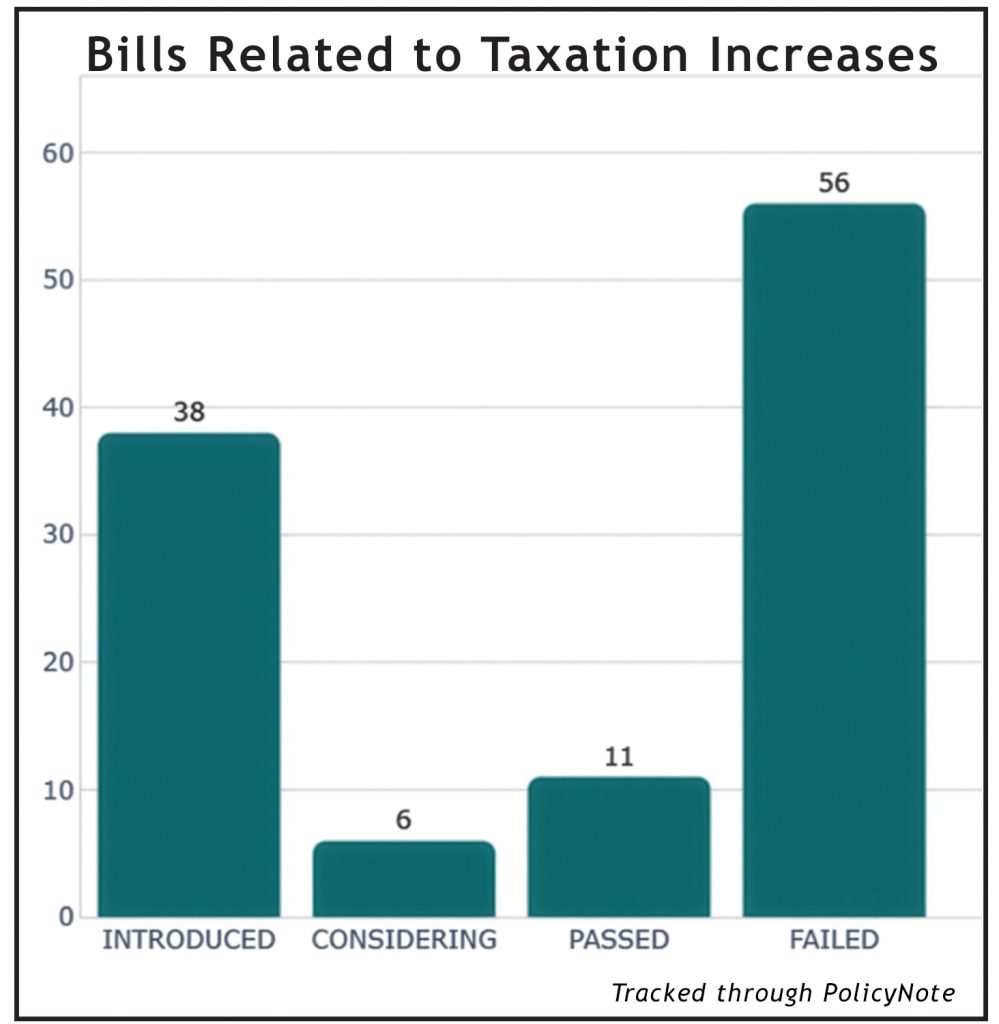
At the Nicotine Resource Consortium, we track relevant legislation as it moves through the state and federal levels. While not every bill or regulation passes and gets put into action, it’s clear through what we’ve seen so far this year that there are some commonalities among states when it comes to tobacco product taxation.
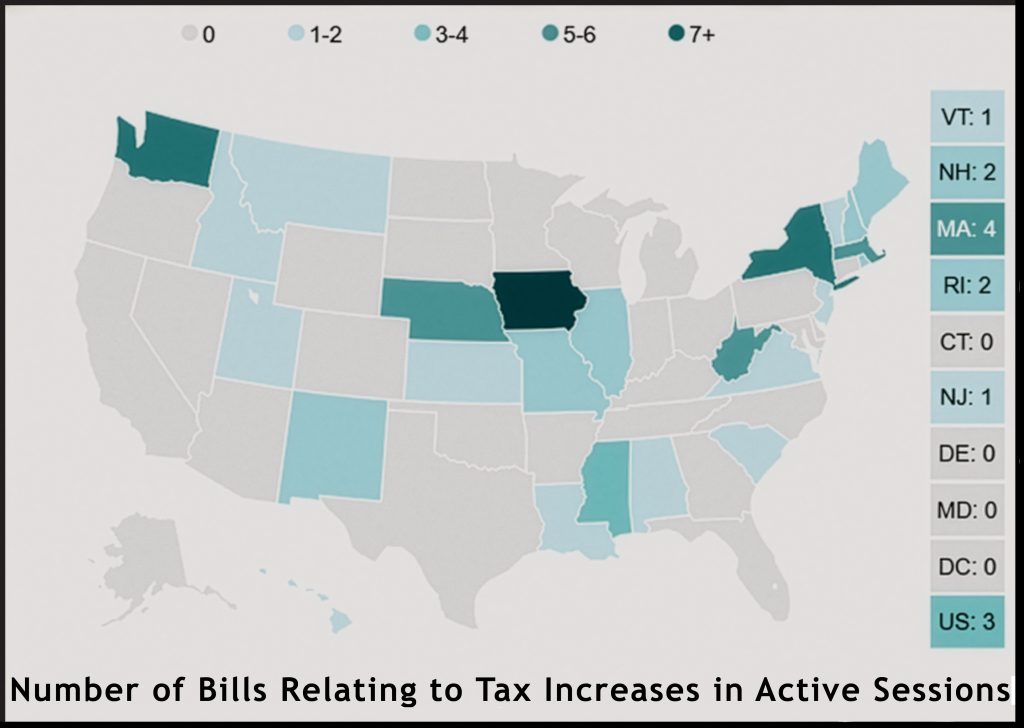
Broadly, many states are imposing higher taxes on both traditional tobacco products and vapor products. For example, Iowa has proposed a tax hike of more than double for cigarettes while taxing vapor products at a combined 50% wholesale rate. New York has proposed an increase in tobacco product tax from 75% to 129% of the wholesale price and a vapor product tax of 48% of retail receipts, more than double the current tax rate. Washington has proposed a new tax of $0.015 per cigarette and $0.30 per mL for vapor products. The state would tax tobacco products other than cigars at 100.05% of the taxable sales price and cigars at 95%. These are just a few examples of the exponential tax increases many states are proposing. We are seeing an uptick in states imposing inventory and floor taxes as well as individual product taxes.
These proposed tax increases follow the trends that CSP noted as likely in January of this year: “With uncertainty around state budgets, many states are likely to consider tobacco excise tax increases to address shortfalls. In 2025, 10 states enacted new or increased tobacco and nicotine product excise taxes, which was higher than in recent years. Additionally, some states that currently do not tax vapor products or nicotine pouches could introduce legislation levying excise taxes on those categories.”
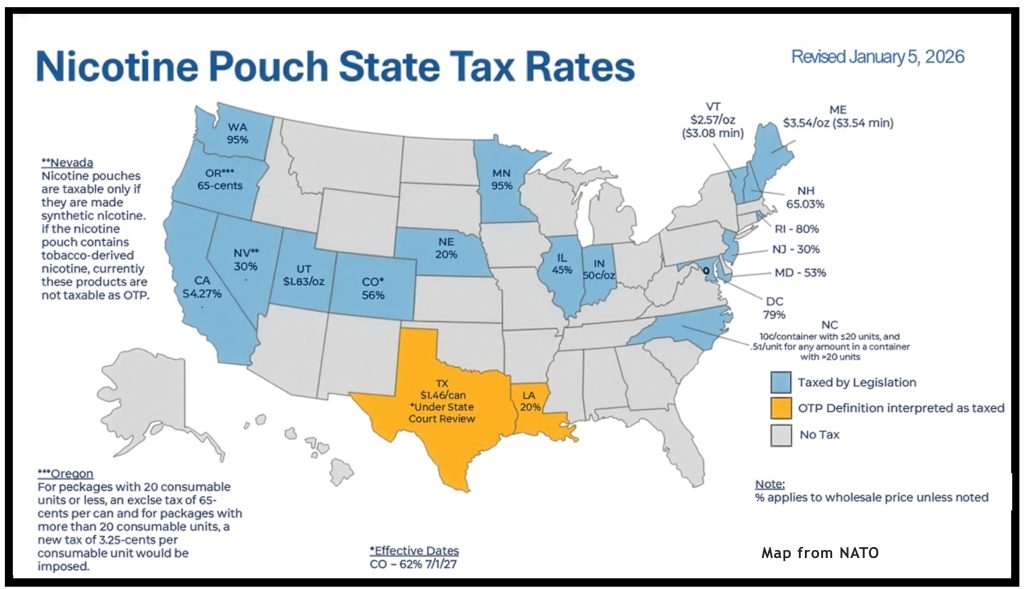
CSP was correct in this evaluation: Along with increased taxes, many states are taxing vapor and alternative nicotine products separately from traditional products such as cigarettes. We’ve seen an increase in legislation specifying definitions of snus/pouches as well as electronic-nicotine delivery systems (ENDS) and vapor products. Many states are now taxing these products separately as their own defined products. Other states are lumping these products under the term “other tobacco products,” which generally include products other than cigarettes and cigars.
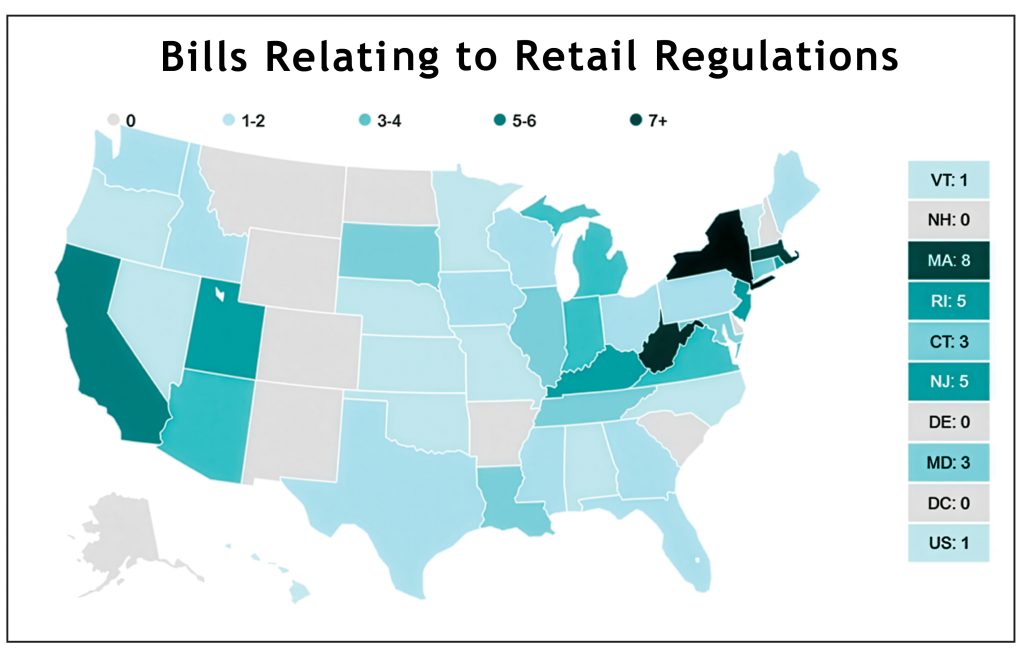
Many states are proposing new and stricter licensing requirements and restrictions as well. We’ve seen a large number of proposed bills requiring very specific information and fees for retail, distribution, and manufacturing licenses in the tobacco and nicotine sector. Some states have even proposed requirements that would prevent out-of-state entities from distributing and selling products within the state without a local agent. These requirements seem to have multiple goals: increasing state revenue and strengthening compliance and regulation. There have been many states focusing on location of retail establishments and implementing age verification measures; both aspects have the goal of preventing youth usage and protecting public health.
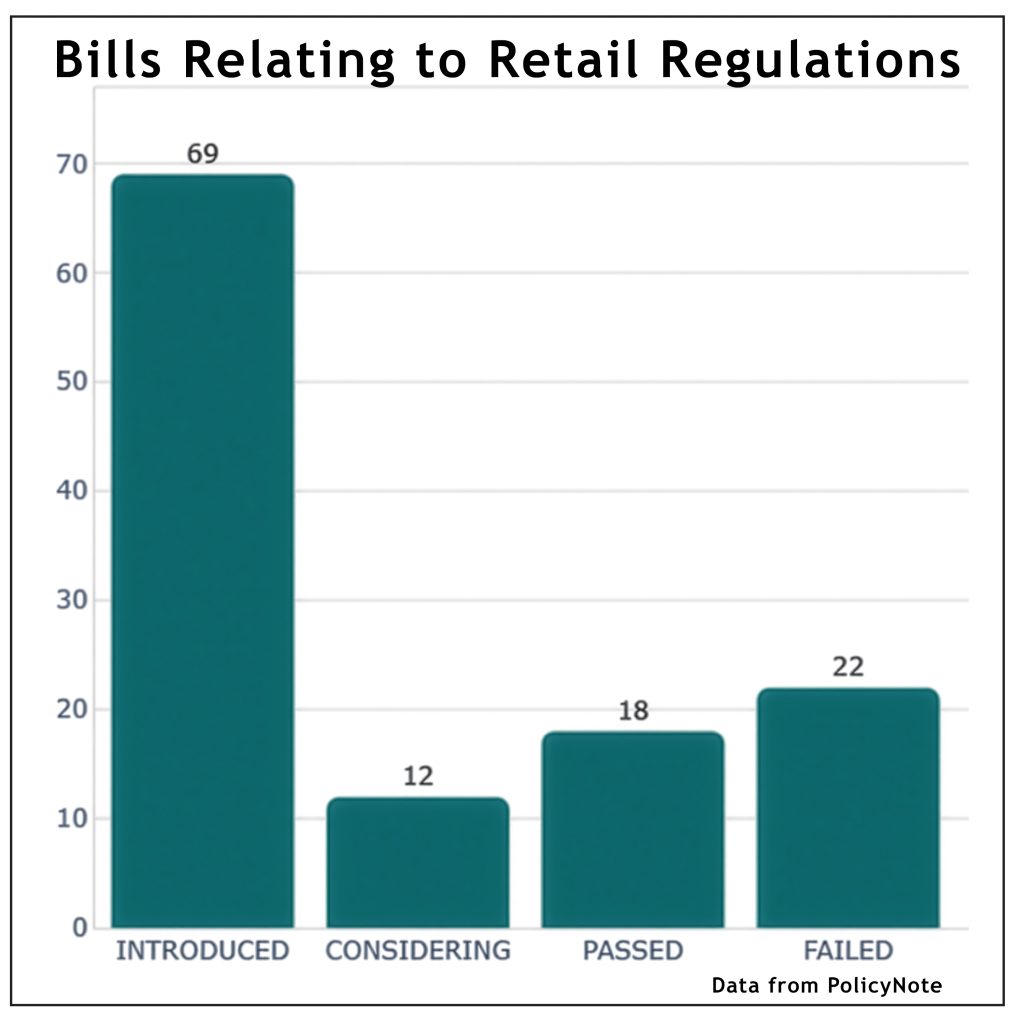
Of the legislation we’ve been tracking, here is a breakdown of where the bills relating to retail regulations stand:
The other main trend we’ve noticed is an increase in tobacco tax revenue allocations toward health-related funds or public health initiatives. Many states are allocating tobacco tax revenue to youth prevention programs, cancer research, health care trust funds, and tobacco cessation programs. There has been a large focus on youth education on the harms of tobacco and nicotine products.
The takeaways from these trends are that tobacco and nicotine product taxes are increasing, and governments are beginning to note the differences between traditional tobacco products and other products. We’re seeing vapor products being taxed separately from cigarettes, and nicotine products being taxed differently than traditional tobacco products. States are focusing more on retail and distribution regulation and licensing as well, and there is a large focus on using tax revenues to fund health initiatives across states. Overall, it seems that states are realizing that all products are not made equally, resulting in the separation of product definitions and tax structures, and putting in efforts to curb illicit products and youth uptake while simultaneously using the revenue from these products to increase access to public health initiatives with the goal of creating a healthier population.
This article is in no way a complete overview of the state of tobacco and nicotine legislation across the United States. The trends and thoughts here were compiled from a combination of NRC’s legislation analysis and the use of PolicyNote’s AI Assistant for certain trend data as well as CSP’s early forecast opinions and NATO tax data.