
Blog

  • The Arithmetic of Harm

    The Arithmetic of Harm

    Why the World Cannot Afford America’s Regulatory Model

    By Dr. J. Preston Campbell, Cancer Researcher, Harm Reduction Scientist

    Heavy lifetime smoking kills approximately half of long-term users. That is not a projection or a model output — it is one of the most replicated findings in twentieth-century epidemiology, confirmed across decades and continents (WHO, 2023). In the United States alone, tobacco-attributable disease generates an estimated $310 billion in annual healthcare costs, roughly $6,500 per smoker per year (Xu et al., 2015; ASH, 2021). Globally, the burden exceeds $1.4 trillion annually (WHO, 2023). We know what is causing the damage. We have products that demonstrably reduce it. The question worth asking — the one this analysis is organized around — is why those products cost 167 times more per life saved to bring to market in the United States than in the European Union.

    The Health Economics Punchline

    Nicotine pouches are, by most objective measures, one of the less scientifically interesting harm-
    reduction products ever developed. No combustion. No inhalation. No tobacco leaf. Pharmaceutical-grade nicotine salt in a cellulose pouch placed between lip and gum for thirty minutes. Peer-reviewed toxicant studies document 95–99% lower exposure to carcinogens compared to cigarettes (Mallock et al., 2019; Snusforumet, 2021). The first Cochrane systematic review, published October 2025, found no serious adverse events across all trials and confirmed consistently reduced toxicant biomarkers in every switching cohort studied (Hartmann-Boyce et al., 2025). The product’s risk profile is not controversial. What is controversial, apparently, is the cost of allowing it to be sold.

    The standard health-economic metric for evaluating interventions is cost per quality-adjusted life year (QALY) gained — a single number that combines how long and how well someone lives. The U.S. cost-effectiveness threshold is $50,000–$100,000 per QALY. Published ICER estimates for comparable nicotine delivery products run $7,500/QALY for NRT sampling programs and $11,454/QALY for e-cigarettes used as cessation aids (Maciosek et al., 2022; Masiero et al., 2025). Based on the observed 5.2% switch rate in national survey data and the documented 95% risk reduction from switching, nicotine pouches are estimated to fall in the $3,000–$15,000/QALY range — well inside the cost-effectiveness frontier by any standard (Delnevo et al., 2024; Goniewicz et al., 2025).

    At that switch rate, applying regulatory entry costs to the lives saved annually from harm reduction produces Figure 1.
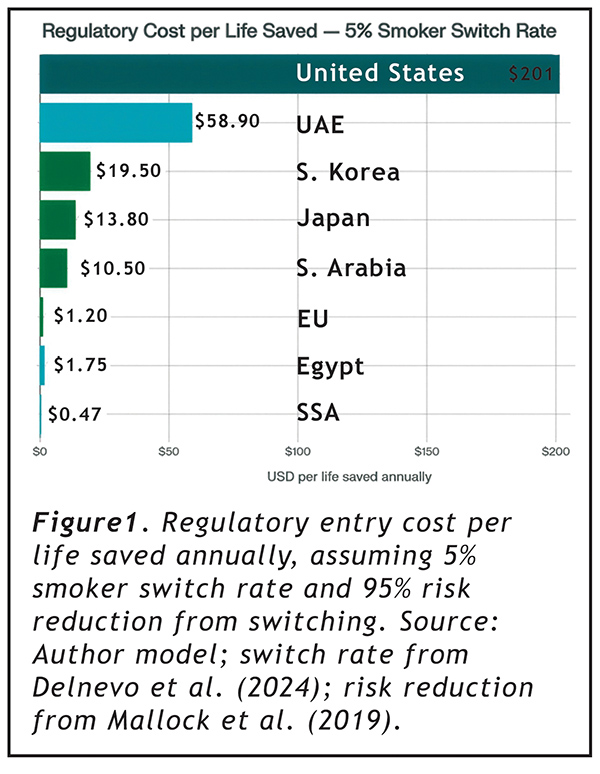
    The U.S. costs $201 per statistical life saved per year. The EU costs $1.20. Sub-Saharan Africa costs $0.47. These numbers do not argue that FDA should wave products through without review. They argue something more specific: that a regulatory framework costing 167 times more per life saved than its closest comparator is not optimizing for public health outcomes. It is optimizing for something else.

    Why: The Entry Cost Structure

    The reason is straightforward once the numbers are placed side by side.

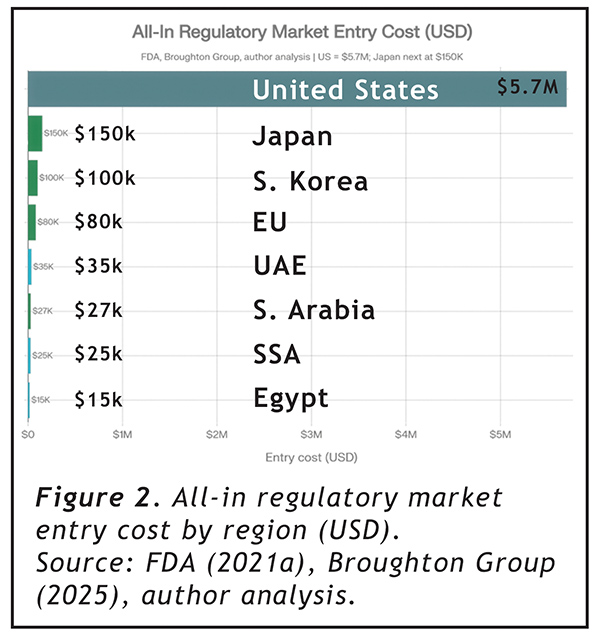
    In the United States, bringing a single nicotine pouch product line to market requires a Premarket Tobacco Application. FDA’s own published cost estimate of $117,000–$466,563 per application (FDA, 2021a) has not aged well. Industry experience places the all-in cost at $4.2–$7.2 million per product family, once pharmacokinetic trials ($1M+), 12-month stability studies ($250K+), consumer perception research, addiction liability assessments, and regulatory consulting are properly accounted for (Broughton Group, 2025; JJCC Group, 2026). ZYN’s January 2025 marketing authorization — the first for this product class — took years and the resources of a Fortune 500 company (FDA, 2025a).

    Elsewhere, the numbers describe a different regulatory universe. EU notification under the Tobacco Products Directive: $30,000–$80,000 per market. UAE ECAS registration: $35,000. Saudi Arabia: $27,000. Egypt — an open market of 14.5 million smokers — $15,000 (Broughton Group, 2025; SGS, 2025; author analysis). A company could simultaneously enter the EU’s 110 million-smoker market, Japan, South Korea, UAE, Saudi Arabia, Egypt, and sub-Saharan Africa for less than one U.S. PMTA submission.
    Why It Is Worse Than It Looks: The Time Factor

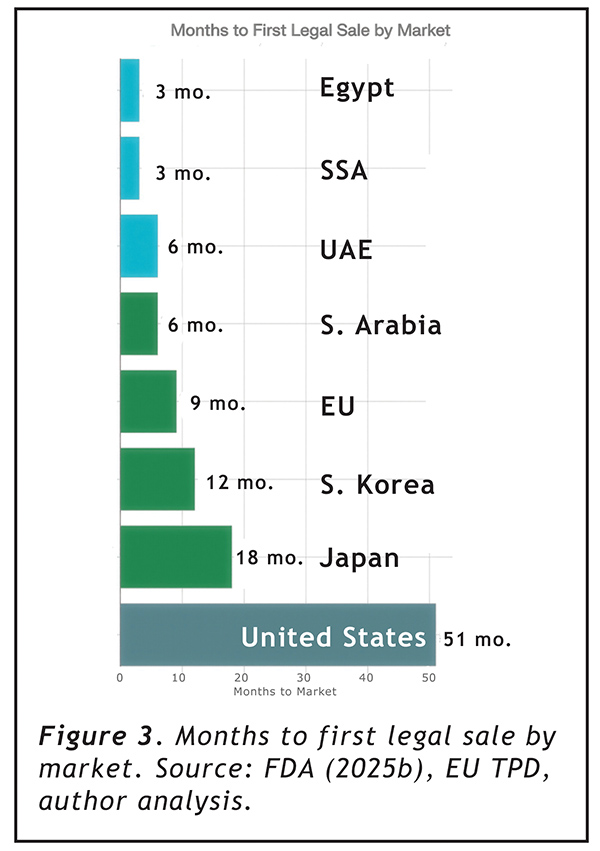
    Entry cost alone understates the problem. The PMTA requires a minimum of 15 months of mandatory studies before submission, followed by an FDA review period averaging over three years to date (FDA, 2025b; Tobacco Law Blog, 2025). From the date a company decides to enter the U.S. market, the minimum realistic timeline to first legal sale is 51 months — over four years. The EU takes 9 months. The UAE and Saudi Arabia: 6 months. Egypt and sub-Saharan Africa: 3 months (author analysis).
    When those timelines are applied to financial models — discounting future revenue at the 20% rate typical for early-stage consumer products and adjusting for denial risk (estimated at 35% for new U.S. entrants; FDLI, 2023) — the picture becomes harder to rationalize from any direction.

    The EU, despite having roughly half the U.S. annual revenue potential, generates a 5-year risk-adjusted NPV of $109.5 million compared to the U.S. at $47.3 million — because it begins generating cash 42 months earlier at one-tenth the cost. The U.S. payback period from today to regulatory cost recovery is 5.2 years, compared to 1.8 years for the EU and 1.2 years for Egypt. The U.S. is the only market in this analysis that exceeds the standard 2-year payback threshold that most venture and growth-equity investors apply to consumer product categories (Alacrita, 2024). During the 48-month excess waiting period, a company forfeits approximately $270 million in gross margin that would otherwise accrue in markets where the same product is already legally sold.
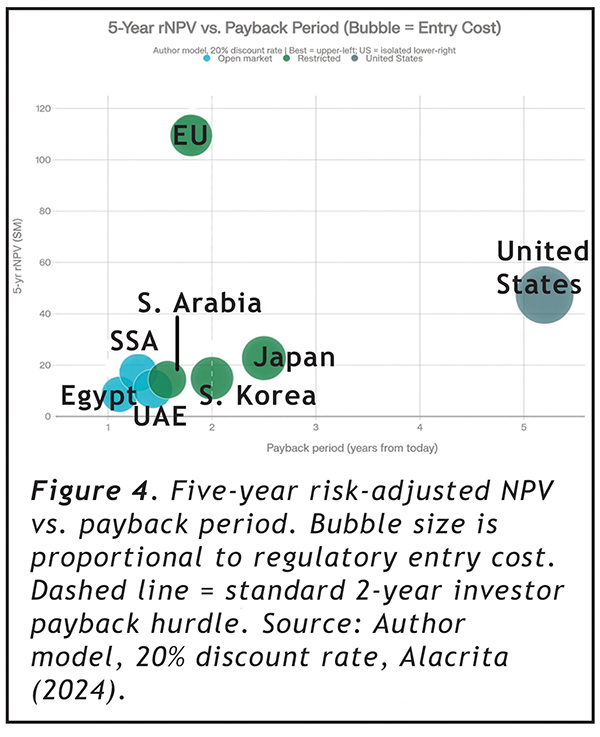
    The 5-year ROI multiple on regulatory spend, risk-adjusted: 55× for the U.S., compared to 3,135× for the EU and 1,465× for sub-Saharan Africa. The PMTA does not just cost more — it structurally consumes the financial return from market participation, leaving only companies with institutional balance sheets able to absorb it.

    The Cessation Paradox FDA Built

    Here is where it gets genuinely strange.

    FDA’s own authorization of ZYN stated explicitly that the products “have the potential to provide a benefit to adults who smoke cigarettes and would like to switch to a lower-risk alternative” (FDA, 2025a). The PMTA submissions included cessation and switching behavior data. FDA reviewed them. FDA relied on them to issue authorization.

    And then FDA’s post-authorization communications carefully noted that the products are “not FDA approved” and that “there is no safe tobacco product” — language that systematically prevents companies from communicating the public health rationale that justified the authorization (FDA, 2025a).

    Under the Tobacco Control Act, tobacco products cannot make cessation claims. If a company wants to say anything about reduced risk, it must file a separate Modified Risk Tobacco Product application — another process, more years, more millions, with public comment periods, advisory committee referrals, and post-market surveillance requirements (FDA, 2025c). As of 2024, FDA had received 48 MRTP applications since 2010 and authorized exactly 16 products (LDI Penn, 2025).

    The logic chain deserves a slow read: FDA required switching studies as a PMTA condition. It reviewed them. It relied on them to grant authorization. It then prohibited companies from telling consumers those studies existed. The MRTP pathway functions in practice as a second admission ticket for a claim FDA already accepted as scientifically valid during the PMTA review. This is not a minor regulatory inconvenience. It is the architecture of a system in which harm reduction is simultaneously required as scientific evidence and forbidden as commercial communication.

    What Rational Regulation Would Look Like

    FDA’s September 2025 nicotine pouch pilot program demonstrated that rigorous and efficient review are not mutually exclusive (Tobacco Law Blog, 2025). The on! PLUS authorization in December 2025 confirmed it. Real-time applicant communication, literature-based study requirements, and focused critical element review cut timelines dramatically without any evidence of compromised standards (FDA, 2026).

    That pilot should be the floor, not the ceiling. A product class with documented 95–99% lower toxicant exposure, no combustion, no inhalation, no tobacco leaf, and no serious adverse events in any trial conducted to date (Hartmann-Boyce et al., 2025) does not require the evidentiary apparatus of a novel pharmaceutical. The rest of the world has largely reached this conclusion.

    In the meantime, 47.7 million Americans who smoke continue using a product that kills approximately half of them — while regulators elsewhere issue notifications, complete registrations, and authorize sales. At $201 per life saved, the U.S. PMTA process is not the problem. The problem is that it is 167 times more expensive than the alternative, without any measurable difference in the public health outcomes it is designed to protect.

    _____________________________________

    J. Preston Campbell, PhD, is a cancer researcher, harm reduction scientist, and co-founder of multiple companies, currently focusing on ENSO, his consulting and formulation company. His work focuses on translating reduced-risk nicotine products from laboratory science to regulatory approval and commercial deployment.


  • The Butt Stops Here

    The Butt Stops Here

    Targeting the World’s Most Littered Plastic

    By Tadas Lisauskas, founder and CEO, Greenbutts

    Effective and credible sustainability does not emerge from slogans or isolated initiatives. It is driven by three fundamental forces — consumers, government, and industry — that naturally align when awareness is informed, concern is genuine, and responsibility is shared. When these conditions exist, meaningful change follows.

    Cigarette butts are the single most collected item in global coastal and urban cleanups year after year. The Ocean Conservancy has consistently reported millions of filters removed annually through its International Coastal Cleanup, often ranking them above plastic bottles, bags, and food wrappers. Because filters are small, lightweight, and routinely discarded in public spaces, they are disproportionately represented in stormwater runoff and shoreline debris counts despite their size.

    A data analysis published in Tobacco Control estimates that cigarette butt litter costs $20.7 billion annually in marine ecosystem damage and about $5 billion in waste management costs. These costs stem largely from the cellulose acetate filters in cigarette butts, a form of plastic that fragments into microplastics rather than biodegrading. Researchers show that a single butt can leach nicotine, heavy metals, and polycyclic aromatic hydrocarbons into water, creating measurable toxicity for aquatic organisms in laboratory conditions. Field surveys in cities and along rivers have found dense concentrations near transit stops, building entrances, and drainage grates, linking everyday littering behavior to downstream marine pollution.

    Governments use this data to justify various attempts to address the problem, including extended producer responsibility proposals, targeted litter fines, and public awareness campaigns, yet have little success. To make meaningful progress, we need those three forces working together. 

    First and foremost are consumers. Informed and educated consumers should ultimately dictate which products they buy, how those products perform, and the impact they have, both on personal health and on the environment. When consumers understand the consequences embedded in everyday choices, they become the strongest catalyst for change.

    The second force is government, regulators, and lawmakers. Their role is not merely administrative, but foundational. Effective regulation must address the full lifecycle of materials, from nature back to nature. This includes how materials are sourced, processed, used, disposed of, and, where possible, reused or recycled. Legislation has already proven effective in removing other single-use plastics from the market, such as straws and plastic bags, items whose environmental impact is demonstrably smaller than that of plastic cigarette filters. Consistency and courage are now required to address this remaining and highly visible source of pollution.

    The third force is the tobacco industry itself. With its capital strength, technological capability, and deep operational knowhow, the industry has both the means and the responsibility to implement solutions that safeguard long-term business sustainability while reducing environmental harm. Eliminating single-use plastics is not a technical challenge; it is a leadership decision.

    Today, however, gaps persist across all three forces. As a result, well-intended discussions, pilot projects, and policy drafts too often remain on paper rather than translating into action.

    For over a decade, Greenbutts has worked deliberately across these three dimensions, engaging consumers, supporting regulators, and partnering with industry. Yet progress of scale requires collective commitment. We need clearer, science-based communication that informs consumers that there is already a viable, commercially available, and effective solution capable of permanently eliminating the most littered single-use plastic in
    the world.

    We also need governments and regulators to move beyond political hesitation and act decisively in the interest of public health and environmental protection.

    Equally, we call on the tobacco industry to move beyond incrementalism. The future does not lie in “better plastics,” but in the complete elimination of single-use plastics from product design and manufacturing. Voluntary, proactive implementation will do far more to strengthen corporate reputation and trust with consumers, investors, and society than compliance achieved only under regulatory pressure.

    At Greenbutts, the foundational work has already been done. The entire value chain has been assessed end-to-end. What remains is scale. Industry has the ability to deploy this solution globally, governments can support the transition through clear communication and consumer education, and consumers can play their role by demanding responsible products and proper disposal behaviors.

    Addressing cigarette litter and eliminating plastic filters will not only restore ecosystems, but it will reduce our collective exposure to alarming levels of microplastics, both in the environment and within our bodies. This is not a future aspiration. It is an available solution, waiting for decisive action.

    The moment to act is now.

  • A Generation Apart

    A Generation Apart

    The UK’s Gamble on a Tobacco-Free Future

    UK legislators believe splitting current smokers and future potential smokers will allow its generational ban to avoid many of the pitfalls that have plagued schemes aimed at achieving the same ends found elsewhere in the world.

    This is the first major market to enact such a widespread ban.

    The ban prohibits younger consumers from ever taking up use of tobacco products (including heated tobacco) while still permitting non-tobacco nicotine products such as electronic nicotine devices (ENDs) and nicotine pouches to be available for them. Adult consumers will be unaffected by the ban, which will only apply to those born on or after 1st January, 2009. Such an approach, incidentally, does not affect the one group of people that could demonstrate anger over the decision by maybe voting against the government in the upcoming elections.

    Such divisions in product access will prevent the UK from experiencing the rise in black market activity seen in countries that have taken different approaches, the UK government hopes. It is worth noting that the UK already has a fairly substantial black market brought about by the attempted avoidance of already high duties on tobacco.

    But approaches taken by other countries have resulted in worse outcomes. For example, Australia has put strict limits on vaping products while significantly increasing taxes on conventional tobacco products, leading to enough black-market tobacco appetite to fuel an ongoing low-level conflict between rival suppliers.

    The country is meant to raise taxes on cigarettes again in March plus again in September. The Australian government had previously been adamant that it would not make changes to its tobacco tax plan. However, it recently seemingly grudgingly admitted it would consider such a policy move.

    Australia’s finance minister, Katy Gallagher, said there was no single solution and that the government kept strategies to cut illicit tobacco trade under review – including possibly cutting the excise rate.

    If Australia were to choose to take such a climb down, it would mirror previous broad-stroke policy reversals. Bhutan elected to rescind an initiative to completely ban the sale and production of tobacco products after about a decade. This was due to rampant black-market importation of tobacco products from neighboring countries.

    Australia does not have bordering neighbors. But this has not proven detrimental to smuggling efforts, with a rise in tobacco-related activity resulting in several ongoing conflicts between criminal enterprises that have led to numerous arson attacks, shootings, and other escalations. 

    The issue could be exacerbated by a general lack of alternative products for smokers outside the licensed cessation pathway. Both heated tobacco and pouches are effectively banned in the country, being subject to a prescription, but no products have been approved as therapeutic goods suitable for use as a cessation aid as required to be prescribed.

    Vaping products are not banned in Australia. But the limitations placed on them – in particular, pharmacy-only sales – render them significantly less attractive as an alternative to current smokers.

    This is another issue that the UK is looking to avoid. All such products will remain viable for adult consumers in the UK, while only heated tobacco would be prohibited for those born after the cut-off date, as current legislation stands. This, the UK government argues, will leave vaping products open as a potential cessation tool and less harmful alternative.

    The UK also hopes that increases to enforcement budgets will provide enough of an edge to overcome any potential future increases in illicit tobacco activity. However, the example of Australia suggests that UK plans may not be enough. The government highlighted an additional £30m per year to be committed to enforcement agencies.

    But Australia is reported to have committed an additional AUD $350m (£183.5m) to enforcement over the past two years. Despite this, it has still seen a significant increase in illicit cigarettes. Border authorities reported an increase in conventional cigarette seizures from 606 million in 2019-2020 to 2.5 billion in 2024-2025.

    This, of course, could be said to be an indicator of the money paying off, with significantly more illicit products being taken off the Australian market. However, anecdotal evidence appears to suggest that it is a symptom of even greater imports rather than a higher proportion of products
    being seized.

    One more possible example to contemplate is the Maldives. The Indian Ocean island nation became the first country in the world to successfully enact a generational ban when a ban on tobacco products for anyone born after 1st January, 2007 went into effect in November 2025.

    Thus far, it is too early to assess the impact of the ban’s implementation. Significant issues are unlikely to arise until it can be seen whether much residual demand for tobacco products remains for those impacted by the Maldives generational ban. But it is impressive that the ban even progressed as far as it had. The other attempts that had previously got closest to coming into force – in Malaysia and New Zealand – both failed for non-tobacco control reasons.

    In Malaysia, the ban was withdrawn before it could be passed over concerns it would fall short of future constitutional challenges. In New Zealand, the measure was passed by the New Zealand Labor Party before then being repealed by a conservative coalition that took power in national elections.

    The coalition said it had chosen to repeal the ban as part of its coalition agreement because it wanted to take another approach to protecting public health that required the increased revenue derived from continued legal sales of tobacco products.

    Several Kiwi public health organizations found this argument dubious. Nonetheless, the coalition followed through and made several amendments to the recently passed regulations – including rescinding the generational ban.

    There is still a chance the UK experiences a similar change in direction. The situation is similar to that in New Zealand in that both countries had plans to prohibit the uptake of tobacco products amongst youth, but to leave alternative nicotine products alone. The one key difference – though – is that the generational ban was originally proposed by the UK Conservative Party when it was in government before national elections gave power to the UK Labour Party, which announced its intentions of passing a similar (some would say identical) law.

    That key difference means it is more than likely that the UK generational ban will continue regardless of any possible change in government. Whether it falls to unexpected, continued demand for tobacco products once the ban begins to affect UK consumers now becomes the main question.

    This article was provided by Tamarind Intelligence.

  • 5th Circuit Considering if FDA Overstepped in Vape Flavor Regs

    5th Circuit Considering if FDA Overstepped in Vape Flavor Regs

    A three-judge panel of the U.S. Court of Appeals for the Fifth Circuit heard oral arguments this week in a case brought by seven small vape-liquid companies challenging the FDA’s denial of marketing authorization for flavored electronic nicotine delivery systems. The companies argue the FDA rejected their applications based on a comparative efficacy requirement they say was not disclosed before the 2020 PMTA deadline, in violation of the Tobacco Control Act.

    The FDA defended the denials, saying manufacturers must prove their specific products are appropriate for the protection of public health. Government counsel argued that non-tobacco flavors add youth-use risk and that applicants failed to show added adult switching benefits over tobacco-flavored products.

    The panel questioned both sides on whether the FDA’s approach was lawful adjudication or rulemaking in practice. Courthouse News Service said, this “ruling could affect thousands of pending applications and clarify how much procedural leeway the FDA has when reviewing the flood of vape products submitted after the 2020 PMTA deadline.”

  • Report: Misconceptions Hurting Alternative Nicotine Products

    Report: Misconceptions Hurting Alternative Nicotine Products

    A new report highlights growing public misperceptions about nicotine products, with 59% believing that vaping is as harmful to health as smoking, a number that increases to 72% among 18–24-year-olds. The “Nicotine Product Harm Perception Report 2026,” released by Northerner and Haypp, surveyed 2,000 people in the UK, with nearly half believing vaping exposes users to more chemicals than cigarettes, and 60% registering as misinformed or uninformed when comparing nicotine pouches’ harm to smoking.

    The findings point to a shift in risk perception that contrasts with established public health messaging on relative harm. The report links these beliefs to broader narratives around a perceived “vape epidemic,” with 78% of respondents agreeing such an epidemic exists despite vaping prevalence estimated at around 10% of adults. This disconnect suggests that public understanding may be shaped more by media framing and social discourse than by underlying usage data.

    The report also cites inconsistent policy approaches and negative coverage as contributing factors to mixed public messaging around vaping and harm reduction. Experts warn that confusion over relative risks could affect smoking behavior. Dr. Marina Murphy, the senior director of scientific affairs at Haypp Group, said misperceptions may reduce incentives for smokers to switch to alternatives, potentially slowing or reversing declines in smoking rates.

     “Alarmist messaging and negative framing risk doing real damage,” Murphy said. “If smokers are put off switching, we risk undoing years of progress in reducing smoking rates. People need clear, balanced information about nicotine products so they can make informed choices.” 

  • Aussies Seize Huge Illicit Haul in Retailer Raids

    Aussies Seize Huge Illicit Haul in Retailer Raids

    Authorities in Canberra, Australia, seized more than 455,000 illicit cigarettes, along with 26 kg of loose-leaf tobacco, 6,000 cigars, more than 1,600 vapes, and about $27,000 in cash following coordinated raids on six retail outlets. The operation, led by the Australian Capital Territory (ACT) government and Australian Border Force with support from ACT Policing, also identified six people of interest linked to the illicit tobacco trade. The total seizure could be worth as much as A$580,000 ($418,000).

    Officials said the enforcement action reflects growing concern about the scale of Australia’s black market, estimated at roughly A$10 billion ($7.2 billion), and its links to organized crime. ACT Health Minister Rachel Stephen-Smith said the impact on communities and legitimate retailers, while police highlighted the role of asset seizures in disrupting illegal activity.

  • Altria Reports Q1 2026 Results; Reaffirms Full-Year Guidance

    Altria Reports Q1 2026 Results; Reaffirms Full-Year Guidance

    Altria Group reported a strong start to 2026, delivering solid financial growth and reaffirming full-year earnings guidance. First-quarter net revenues rose 3.2% to $5.4 billion, while adjusted diluted earnings per share (EPS) increased 7.3% to $1.32, driven by higher operating income and reduced share count. The company continues to generate significant cash flow, enabling shareholder returns through $1.8 billion in dividends and $280 million in share repurchases during the quarter. Management maintained its full-year adjusted EPS outlook of $5.56 to $5.72, reflecting confidence in continued performance despite macroeconomic uncertainty.

    Operationally, Altria’s smokeable products segment remained the primary earnings driver, supported by pricing strength and Marlboro’s continued leadership in the premium category. While overall cigarette shipment volumes declined due to industry contraction, income growth and margin expansion offset these pressures. In the oral tobacco segment, the on! nicotine pouch brand showed volume growth and ongoing national expansion, though competitive dynamics and shifting product mix weighed on margins. The company continues to balance investment in emerging smoke-free products with maintaining profitability in its core combustible business.

    Strategically, Altria said it is advancing its “Moving Beyond Smoking” vision by investing in smoke-free alternatives and long-term growth initiatives. The company is navigating moderated e-vapor category growth, regulatory constraints, and evolving consumer preferences, while also investing in manufacturing capabilities and cost-efficiency programs. Although near-term challenges include declining cigarette volumes and competitive pressure in oral products, Altria said its strong cash generation, disciplined capital allocation, and diversified nicotine portfolio position it to sustain earnings growth and shareholder value over the long term.

  • JTI Malaysia: Illicit Cigarettes Dominate as Price Gap Widens

    JTI Malaysia: Illicit Cigarettes Dominate as Price Gap Widens

    “Cost pressure means consumers often cannot afford to think about safety,” was the message from Joseph Anak Janting, president of Malaysia’s Dayak Transformation Association (TRADA). The comment came as officials examined the nation’s thriving illicit tobacco market, not just its financial impact, but also the unknown ingredients being ingested from unregulated products.

    Japan Tobacco International (JTI) Malaysia released data today (April 30) that shows 57% of the Malaysian tobacco market is illicit, a number that climbs near 80% in regions such as Sabah and Sarawak, where the market is driven by a significant price gap. Legal cigarettes cost over RM20 ($5) per pack compared to illicit products that sell for as little as RM4 to RM8 ($1 to $2), following recent excise tax increases and retail restrictions. In Sarawak, where the average monthly household income is RM5,504 ($1,376) and rural incomes are significantly lower, Janting said the price gap is not a minor consideration; it is the difference between affording cigarettes and not affording them.

    JTI identified three primary categories of illicit products: counterfeit tax-stamp cigarettes, which have doubled to 16% market share since 2023; smuggled “whites” lacking tax stamps; and illegally imported kretek cigarettes. Officials said expansion of the illicit trade is contributing to an estimated RM4 billion in annual lost tax revenue, with enforcement challenges compounded by cross-border smuggling and counterfeit production networks.

  • Belgium Retail Group Proposes Generational Tobacco Ban

    Belgium Retail Group Proposes Generational Tobacco Ban

    Belgian retail federation Comeos is advocating for a gradual phase-out of tobacco sales to younger generations, proposing a policy that would permanently ban purchases for anyone born on or after January 1, 2009. The approach mirrors the UK’s “smoke-free generation” model and could also extend to vaping products, to reduce tobacco use over time as older consumers age out of the market.

    The proposal comes as Belgium prepares to revise its tobacco retail framework after the Constitutional Court struck down a ban on supermarket tobacco sales based on store size. Health Minister Frank Vandenbroucke has since pushed for broader restrictions, including a ban on tobacco sales in all food stores, while allowing sales to continue in specialized outlets such as newsagents.

  • Singapore’s Smoking Rates Fall as Costs Rise

    Singapore’s Smoking Rates Fall as Costs Rise

    Singapore’s Department of Statistics reported that from 2013 to 2023, the number of households that spent money on tobacco products dropped from 17% to 9%. Those who continued using tobacco saw their monthly spend increase from S$224 to S$255 ($165.76  to $188.70) over the same period, with higher costs largely attributed to repeated excise tax hikes. Officials said lower-income households remain disproportionately impacted, with tobacco accounting for about 5% of monthly expenditures for the lowest income group, compared to 2.3% for the highest.