Blog

  • Hong Kong Enforces Full Vape Ban with Strict Penalties

    Hong Kong Enforces Full Vape Ban with Strict Penalties

    Hong Kong implemented a city-wide ban on the possession and use of e-cigarettes and heated tobacco products as of April 30, with authorities warning of strict enforcement and penalties. Offenders carrying small quantities may face an on-the-spot fine of HK$3,000 ($390), while possession above specified thresholds could lead to prosecution, with maximum penalties of HK$50,000 ($6,500) and up to six months’ imprisonment.

    Officials said enforcement will be carried out through inspections, with increased outreach efforts targeting both residents and tourists ahead of peak travel periods. The ban does not apply to traditional shisha, which remains regulated under existing tobacco laws.

  • Rethinking Nicotine Regulation

    Rethinking Nicotine Regulation

    How harm reduction, illicit markets, and regulatory gridlock are reshaping the future of nicotine policy in the United States

    By Dave Dobbins, Principal Dobbins Consulting

    It is now clear that reduced-risk nicotine delivery products such as e-vapor and nicotine pouches are accelerating declines in demand for cigarettes.  One need only follow the earnings calls of major cigarette manufacturers in the United States to confirm this fact. Bonnie Herzog, an analyst with Goldman Sachs with an expertise in tobacco products, predicts ongoing declines of cigarette volume year over year through 2035 at roughly a 40% higher rate than between 2016 and 2024, resulting in a 63% decrease in cigarette sales between now and 2035. 

    However, Herzog predicts almost all the lost volume in cigarettes will be replaced by products with much lower risk than cigarettes such as nicotine pouches and vapor.  In other words, the demand for nicotine will persist, but the risk of death and disease will be greatly reduced.  On its face this seems like an obvious triumph for public health, but ironically there is an important segment of tobacco control advocacy that views this result as unacceptable. 

    For many years, tobacco control has focused on reducing and preventing smoking.  This was a sensible goal; the cigarette is the country’s leading cause of preventable death.  The emergence and popularity of reduced risk nicotine delivery options complicated the issue by separating nicotine delivery from the hazards of smoking.  Both e-vapor and nicotine pouches were developed outside of the cigarette business and were very quickly adopted by consumers.  Both present a small or undetectable fraction of the toxins present in cigarette smoke.

    The popularity of these products presents an opportunity and a threat.  Unfortunately for the development of policy around reduced risk alternatives, the first product to develop mass popularity in the United States was the e-vapor device Juul, and it became disproportionately popular with young people.  Prior to the eruption of Juul in 2018 and 2019, the conversation in tobacco control around reduced-risk products had included consideration that the technology might serve as a substitute for adult cigarette smokers that would greatly reduce disease and death.  Now, the major lobbying groups in United States tobacco control, the Campaign for Tobacco Free Kids, American Heart Association, American Lung Association, and American Cancer Society Cancer Action Network (“the Prohibitionists”) are all aligned in the view that all non-medicinal nicotine products should be banned.  This is despite the enormous reductions in youth e-cigarette use in the years after 2019, continued low rates of youth nicotine pouch use, and youth cigarette use of 1.4% in 2024, a number that was unimaginable even ten years ago.

    Youth Concerns to Broad Policies

    The Prohibitionists advocate for bans of flavored nicotine products, taxation at very high levels for all nicotine products without consideration of relative risk, eliminating menthol and virtually all nicotine from combusted products, resistance to all FDA authorizations of reduced risk products, and to efforts by manufacturers to communicate true facts about relative health risks.  At an international level, tobacco control leaders and the WHO, funded by Bloomberg Philanthropies, just as the Prohibitionists are in the US, call for all out bans on reduced risk products and laude countries that adopt such prohibition policies.  Last year, prohibition advocates supported a UN Declaration on Noncommunicable Diseases that treated all nicotine products the same without recognizing the huge differences in risk of those products.  The declaration thankfully failed to gain consensus, but the idea has not gone away.

    This absolute resistance to reduced risk consumer nicotine products can no longer credibly be based on a concern that lower risk nicotine products will create a “gateway” to smoking that will result in increased youth smoking rates.  In fact, the opposite has occurred and the introduction of reduced risk products has coincided with youth smoking rates dropping to previously unimaginable lows.  While it is a universal goal to prevent youth nicotine usage, it is a reasonable hypothesis that reduced-risk products diverted some youth who otherwise may have taken up smoking.

    Instead, calls for nicotine prohibition appear to be motivated by a belief that no entity should be able to sell nicotine for a profit because it is a dependence-inducing drug.  Calls for nicotine prohibition are also motivated by a desire for retribution against cigarette companies.  Lastly, the Prohibitionists argue that new reduced risk products are a ruse designed by manufacturers to hook a new generation of young people regardless of whether they progress to cigarette use.   

    The Prohibitionists rarely are held to account for the costs of the policies they recommend, but for policy makers to appropriately evaluate their suggestions they should be required to “show their work” regarding the impact of those policies on public health and society.  While the Prohibitionists may feel their policy program is virtuous, that does not determine how the policies will play out when deployed in the real world.  After all, sometimes the road to hell is paved with good intentions. 

    Lessons From Global Experiments

    The first question nicotine prohibitionists must answer is why it will work for nicotine when it has failed to significantly reduce the supply of any other psychoactive drug.  Instead, the reaction to prohibition has always been the development of illicit markets to address consumer demand.  In fact, this is happening with nicotine in places where prohibition policies have been put in place.  Bhutan’s attempted to ban tobacco products in 2010 but withdrew the measure in 2021 because of resulting criminality and black markets, and public outrage at attempts to enforce the law.  In Australia vapor is illegal as a consumer product and the tax rate on cigarettes is so high that it is functionally a prohibition measure.  The result has been a transfer of tobacco supply to criminal gangs that use violence to intimidate legitimate retailers and to protect territory from other gangs. 

    But we do not need to look abroad to see that prohibition does not work.  In the United States, the FDA has not authorized a single flavored vapor device outside of tobacco and menthol.  Yet they are ubiquitously available through unregulated black markets.  Estimates are that over 70% of US vapor device purchases are illicit devices.  And consumers have shown a clear preference for the features of devices in the illicit market.  There have been significant seizures of illicit products and evidence of involvement of organized crime, such as Mexican cartels, but enforcement efforts have been unable to significantly impact supply just as they have been unable to significantly reduce supply of other drugs.

    Second, to the extent that prohibition tactics work to reduce the supply of reduced-risk products, the inevitable result would be slowing the transition by smokers to those safer products.  The grim math is that the Prohibitionists (whether consciously or subconsciously) appear willing to sacrifice lives in pursuit of eliminating “commercial” nicotine.  All policies have tradeoffs, and by abandoning a focus on improving morbidity and mortality of people who smoke, excess deaths become the inevitable cost.  Here the number of lives at stake is huge.  When dealing with a population of 31 million people who smoke, a 5% change in switching over time is more than 1.5 million people smoking who otherwise would have switched.  It may be that some advocates believe that the pursuit of a nicotine-free future is worth this sort of sacrifice, but they owe it to the public to be transparent about the tradeoffs.

    Lastly, the goal of a society without “commercial” nicotine is based on a premise that people do not actually want nicotine but are tricked into using it by sophisticated marketing schemes and then become addicted or dependent and can never quit.  It is certainly true that nicotine causes addiction and dependence.  And advertising has undoubtedly played a part in the expansion and decline of cigarette use.  However, nicotine does have hedonistic effects.  For example, it improves cognitive function and moderates mood.  Moreover, people have been seeking nicotine far before the advent of modern marketing.  It became a major cash crop in the American South and was exported throughout the world by the 1700s.  Even though they are now universally understood to cause chronic disease and illness, cigarettes are still smoked by over a billion people worldwide.  Suffice it so say, there is little indication that demand for nicotine is going away in the foreseeable future.

    So where does that leave a responsible government?  First, while vastly reducing cigarette use is a desirable and achievable societal goal, it is highly unlikely that the elimination of all “commercial” nicotine sales is achievable.  Governments that attempt to create a nicotine-free society will incur significant societal costs by prolonging smoking and shifting supply to illicit markets.  If a government were to go so far as to commit to a “drug war” approach to a product like nicotine pouches, it is likely it would suffer significant reputational damage, and of course, the implementation of those enforcement strategies has its own costs that tend to fall largely on disadvantaged populations.

    Once the Prohibitionists show their work, it is clear their program is impossible and destructive.  The alternative is realistic regulatory measures to mitigate the risks of nicotine markets.  This is how governments handle alcohol, gambling and other risky behaviors.  An ideal nicotine regulatory regime would include harm reduction, but also would act to ensure product quality, limit youth use and access, and act as a trusted source of scientifically validated information.  The United States currently has a structure of a nicotine regulatory regime, but the regulator has interpreted its statutory mandate to make actual regulation of the nicotine market impossible.

    FDA Authority and Modern Regulation

    We have heard many times from the leadership of the Center for Tobacco Products that it has simply been trying to apply the “appropriate for the public health” (APPH) standard it received from Congress in the Tobacco Control Act.  However, the definition of APPH is broad, advising the agency to weigh the benefits of switching against the risks to nonsmokers.  That should also include the risks of taking a regulatory approach that inevitably spawns multi-billion-dollar illicit markets that operate entirely outside the regulatory system. 

    CTP also must acknowledge the statutory deadlines in the Act.  So far, they have been totally ignored.  Reviews that should be complete within 180 days have routinely taken years.  To get to a point where it can meet all its statutory obligations, CTP must switch its tobacco pre-market approval review to a much more pragmatic framework instead of the intensive multi-year review process it is currently doing on a product-by-product basis.  Indeed, the statute appears to require such an approach.  This should focus on real-world solutions, including: 

    • Establishment of baseline standards for products focusing on nicotine delivery and exposure to harmful and potentially harmful constituents

    • Requiring manufacturers to register and comply with inspection

    • Time, place, and manner of sale restrictions that protect youth

    • Instituting a strong post-market surveillance system to ensure not only compliance but to monitor adverse events and unexpectedly high youth usage. 

    If a manufacturer can attest to following all these requirements, it should be allowed to market its products with the understanding that CTP has the power to revoke authorization in the event post-market surveillance uncovers problems. 

    This would create a regulatory system that could vastly increase manufacturer accountability to the regulator and increase the availability of regulated options for people who smoke to switch.  It would also disincentivize and crowd out illicit markets.  Ironically, this approach would also be more effective at dealing with youth use, the issue most emphasized by the Prohibitionists, because it allows the regulator to respond to upticks of youth use of products in cooperation with an accountable manufacturer. 

    The lack of regulatory authority over Juul was a major contributor to the fiasco in 2018-19.  This system will not be perfect or without risk, but this is simply an area where that is an unachievable goal.  Tradeoffs are inevitable.  Surely, it is time to try a reality-based approach instead of pursuing an impossible goal that generates effects directly in opposition to the goals of the TCA.

  • What the Legislature Tells Us

    What the Legislature Tells Us

    About a third of the way through the year, the slew of proposed legislation throughout the United States has shown some clear trends.

    By Marissa Dean

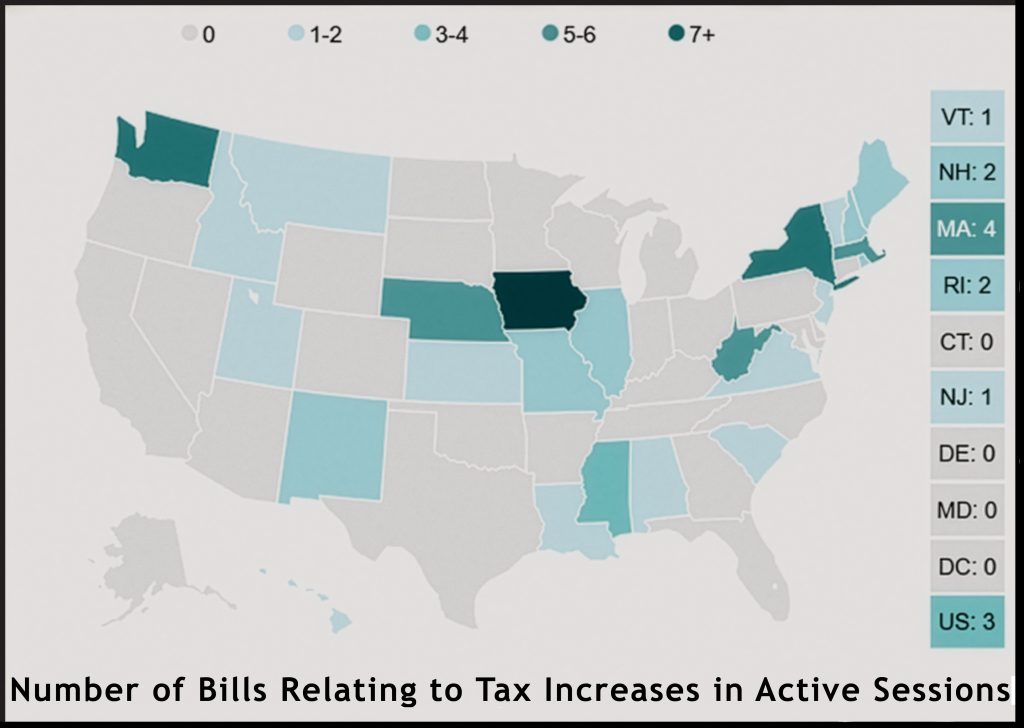
    This year has been fast-moving, with many developments, some seemingly small. But when put together, these developments show some common threads and themes, especially when looking at the tobacco taxation and legislation data.

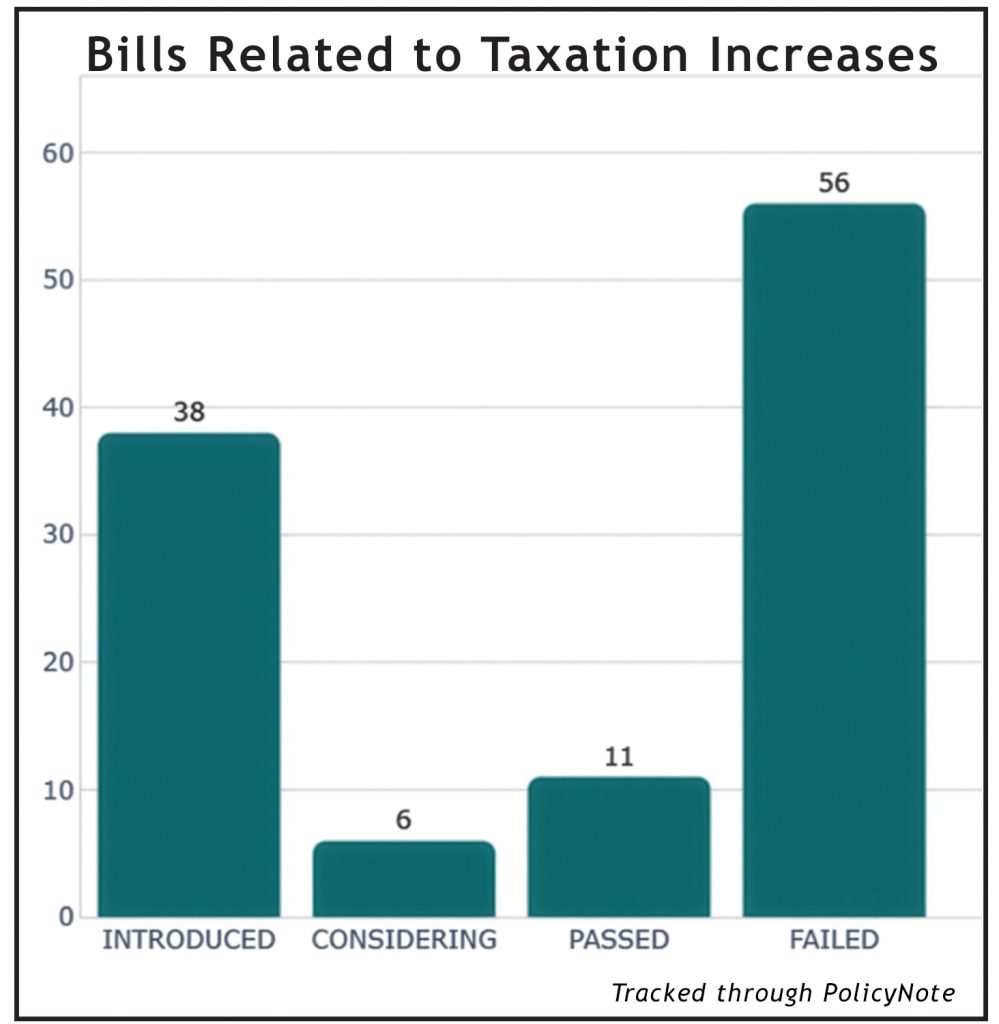
    At the Nicotine Resource Consortium, we track relevant legislation as it moves through the state and federal levels. While not every bill or regulation passes and gets put into action, it’s clear through what we’ve seen so far this year that there are some commonalities among states when it comes to tobacco product taxation.

    Broadly, many states are imposing higher taxes on both traditional tobacco products and vapor products. For example, Iowa has proposed a tax hike of more than double for cigarettes while taxing vapor products at a combined 50% wholesale rate. New York has proposed an increase in tobacco product tax from 75% to 129% of the wholesale price and a vapor product tax of 48% of retail receipts, more than double the current tax rate. Washington has proposed a new tax of $0.015 per cigarette and $0.30 per mL for vapor products. The state would tax tobacco products other than cigars at 100.05% of the taxable sales price and cigars at 95%. These are just a few examples of the exponential tax increases many states are proposing. We are seeing an uptick in states imposing inventory and floor taxes as well as individual product taxes.

     These proposed tax increases follow the trends that CSP noted as likely in January of this year: “With uncertainty around state budgets, many states are likely to consider tobacco excise tax increases to address shortfalls. In 2025, 10 states enacted new or increased tobacco and nicotine product excise taxes, which was higher than in recent years. Additionally, some states that currently do not tax vapor products or nicotine pouches could introduce legislation levying excise taxes on those categories.”

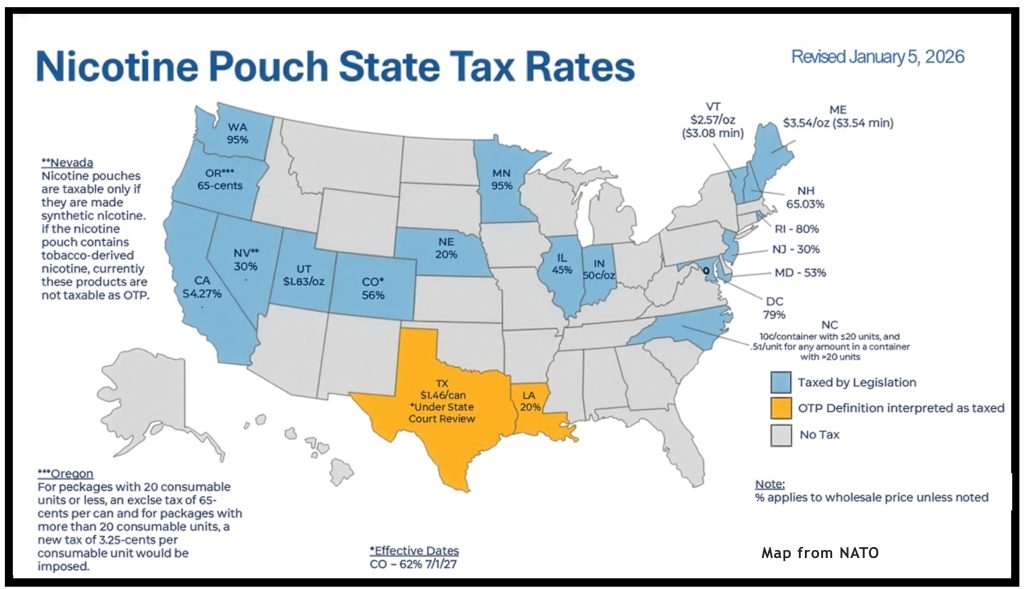
    CSP was correct in this evaluation: Along with increased taxes, many states are taxing vapor and alternative nicotine products separately from traditional products such as cigarettes. We’ve seen an increase in legislation specifying definitions of snus/pouches as well as electronic-nicotine delivery systems (ENDS) and vapor products. Many states are now taxing these products separately as their own defined products. Other states are lumping these products under the term “other tobacco products,” which generally include products other than cigarettes and cigars.

     Many states are proposing new and stricter licensing requirements and restrictions as well. We’ve seen a large number of proposed bills requiring very specific information and fees for retail, distribution, and manufacturing licenses in the tobacco and nicotine sector. Some states have even proposed requirements that would prevent out-of-state entities from distributing and selling products within the state without a local agent. These requirements seem to have multiple goals: increasing state revenue and strengthening compliance and regulation. There have been many states focusing on location of retail establishments and implementing age verification measures; both aspects have the goal of preventing youth usage and protecting public health. 

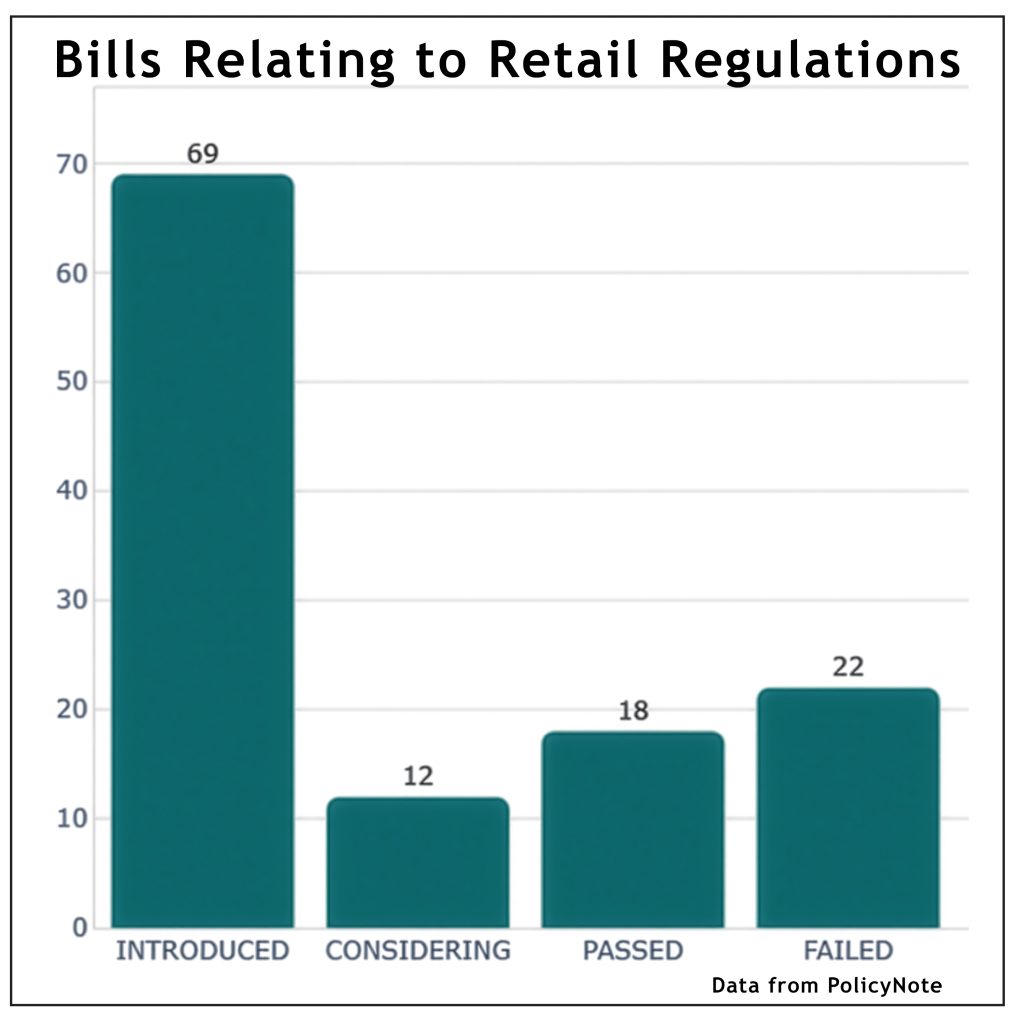
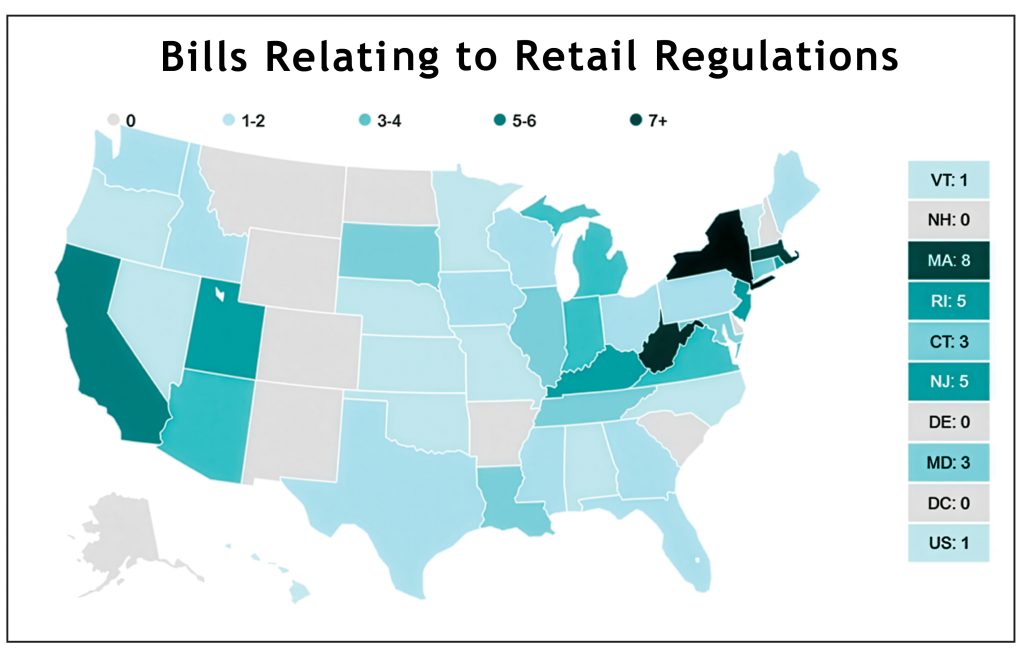
    Of the legislation we’ve been tracking, here is a breakdown of where the bills relating to retail regulations stand:

    The other main trend we’ve noticed is an increase in tobacco tax revenue allocations toward health-related funds or public health initiatives. Many states are allocating tobacco tax revenue to youth prevention programs, cancer research, health care trust funds, and tobacco cessation programs. There has been a large focus on youth education on the harms of tobacco and nicotine products.

    The takeaways from these trends are that tobacco and nicotine product taxes are increasing, and governments are beginning to note the differences between traditional tobacco products and other products. We’re seeing vapor products being taxed separately from cigarettes, and nicotine products being taxed differently than traditional tobacco products. States are focusing more on retail and distribution regulation and licensing as well, and there is a large focus on using tax revenues to fund health initiatives across states. Overall, it seems that states are realizing that all products are not made equally, resulting in the separation of product definitions and tax structures, and putting in efforts to curb illicit products and youth uptake while simultaneously using the revenue from these products to increase access to public health initiatives with the goal of creating a healthier population. 

    This article is in no way a complete overview of the state of tobacco and nicotine legislation across the United States. The trends and thoughts here were compiled from a combination of NRC’s legislation analysis and the use of PolicyNote’s AI Assistant for certain trend data as well as CSP’s early forecast opinions and NATO tax data.

  • PMI Announces FDA Reauthorization of IQOS as MRTP

    PMI Announces FDA Reauthorization of IQOS as MRTP

    Today (April 29), Philip Morris announced that it has received renewed Modified Risk Tobacco Product (MRTP) authorizations from the U.S. Food and Drug Administration for its IQOS heated tobacco devices and associated HEETS consumables. The renewal covers two IQOS device versions and three HEETS variants, allowing the company to continue communicating reduced-exposure information to adult smokers in the U.S. The FDA said the decision is appropriate for the protection of public health, citing evidence that switching completely from cigarettes to IQOS significantly reduces exposure to harmful chemicals.

    The agency reaffirmed that available scientific evidence supports a measurable and substantial reduction in harm compared to combustible cigarettes, even without long-term epidemiological data. IQOS was first authorized through the FDA’s premarket pathway in 2019, with its initial MRTP designation granted in 2020 and expanded in subsequent years. The renewed orders maintain PMI’s position as the only company with MRTP authorizations for heated tobacco products in the U.S.

    The authorization applies to the IQOS 2.4 and IQOS 3 systems, along with HEETS Amber, Green Menthol and Blue Menthol variants. PMI said the decision supports its ongoing strategy to transition adult smokers away from cigarettes, as the company continues to invest in and expand its smoke-free product portfolio while awaiting further regulatory review of newer devices.

  • UK Tobacco and Vapes Bill Officially Becomes Law

    UK Tobacco and Vapes Bill Officially Becomes Law

    The UK’s Tobacco and Vapes Bill has officially become law today (April 29) after receiving Royal Assent, introducing a phased ban on tobacco sales to anyone born on or after January 1, 2009. Originally put forward in November 2024, the legislation makes it illegal for retailers to sell cigarettes to this cohort, effectively creating a “smoke-free generation” policy aimed at preventing future uptake of smoking.

    The law also grants the government new regulatory powers over vaping and nicotine products, including restrictions on advertising, sponsorship, packaging, and product displays, as well as expanded authority to introduce retail licensing and strengthen enforcement against illicit sales.

    “The passage of the Tobacco and Vapes Bill into law presents an opportunity for the government to shape the regulation of alternative nicotine products so that they can become a tool to enable the UK to achieve its ambition of a smoke-free future,” said Dr. Marina Murphy, senior director of scientific Affairs at Haypp. “A regulatory framework that prevents youth access but still gives adult smokers the opportunity to switch to a less harmful product is a win-win.”

  • Philip Morris Korea Appoints New Managing Director

    Philip Morris Korea Appoints New Managing Director

    Philip Morris Korea named Lee Hong-suk as its new managing director, effective May 1, as the company continues to advance its smoke-free product strategy in the country. Lee, who has been with Philip Morris International since 1999, has held senior roles across multiple markets and most recently led the company’s smoke-free products division in Korea.

    In his new role, Lee will oversee operations in one of PMI’s key markets for alternatives such as IQOS, with a focus on expanding the company’s presence and engagement with stakeholders. The company said Lee will be essential as it continues to prioritize smoke-free product development and commercialization in the Korean market.

  • PCA Announces 2027 Dates in Las Vegas

    PCA Announces 2027 Dates in Las Vegas

    The Premium Cigar Association (PCA) announced dates for its 2027 trade show, scheduled for March 5–8 in Las Vegas. The announcement came following the successful conclusion of PCA26, held last week in New Orleans. The 2026 event drew 262 exhibitors, nearly 2,540 retailers from 970 accounts, and more than 5,900 total attendees, reflecting continued growth and engagement across the premium cigar sector.

    PCA leadership pointed to strong business activity and participation as a foundation for next year’s event. “The energy on the show floor, the quality of business being done, and the enthusiasm from our members made it clear that this was one of the most impactful trade shows in recent history,” said CEO Joshua Habursky, highlighting momentum heading into 2027.

  • PMI Schedules 2026 Annual Shareholder Meeting

    PMI Schedules 2026 Annual Shareholder Meeting

    Philip Morris International announced that it will hold its 2026 Annual Meeting of Shareholders on May 6 at 9 a.m. ET via a live virtual webcast. The meeting will be accessible online, with presentation materials and a replay available for one year following the event.

    Chairman André Calantzopoulos and CEO Jacek Olczak are scheduled to address shareholders and respond to questions, with participation limited to verified shareholders using a control number.

  • Thailand Police Bust $5.5M Vape Network

    Thailand Police Bust $5.5M Vape Network

    Thai authorities dismantled a large-scale online e-cigarette distribution network following a warehouse raid in Samut Prakan, seizing more than 20,000 vape products valued at over THB200 million ($5.5 million) and arresting seven suspects. Investigators said the operation, linked to online sales through a platform identified as “Shisha Chic,” was processing over 1,000 orders daily, generating several million baht in daily cash flow.

    Police said the suspects were employees responsible for packing and distributing products, while efforts are ongoing to identify and prosecute the network’s organizers. Authorities are also considering action under anti-money laundering laws and have signaled further nationwide crackdowns targeting online sellers, distributors, and illicit retail operations.

  • Altria Outperforms Peers as Cigarette Declines Moderate: Motley Fool

    Altria Outperforms Peers as Cigarette Declines Moderate: Motley Fool

    A recent Motley Fool analysis highlights continued declines in U.S. cigarette volumes, though at a slower pace than expected, with industry data showing a 4.3% to 5.5% year-over-year drop and a 5.1% decline so far in 2026. The figures came in better than earlier projections, suggesting the rate of contraction in the traditional cigarette market may be stabilizing somewhat, even as long-term declines persist.

    The report notes that Altria is outperforming key competitors in this environment, with its cigarette volumes down 4.7% compared to sharper declines of 9.3% for British American Tobacco and 9% for Imperial Brands. At the same time, Motley Fool said next-generation products show mixed performance, with nicotine pouches growing 22% while e-cigarette volumes fell 17%, underscoring uneven momentum across reduced-risk categories as companies continue to navigate the transition away from combustible products.