

Delaware lawmakers advanced legislation to significantly increase tobacco taxes and update licensing requirements, with House Bill 215 proposing to raise the cigarette tax from $2.10 to $3.60 per pack while also increasing taxes on vapor products, moist snuff, and other nicotine items. The measure would expand the definition of tobacco to include all nicotine-containing products, raise licensing fees across the supply chain, and is projected to generate up to $26.7 million annually, with implementation beginning in late 2026.
Blog
-

Iowa Senate Passes 5-Cent Tax on Vapes, Nicotine Products
The Iowa Senate has passed a bill establishing a new excise tax on alternative nicotine products, introducing a 5-cent per-unit tax on nicotine pouches and a 5-cent per milliliter tax on e-liquid used in vape products. The tax applies to both disposable vapes and refill cartridges, creating a standardized levy across emerging nicotine categories that have historically gone untaxed in the state.
Lawmakers said the extra revenue would go toward pediatric cancer research. “I understand that the level of tax we’re looking at here is not likely to be enough to deter usage, but it is enough to create this investment in pediatric cancer research that we all want to get behind,” Sen. Kara Warme (R-Ames) said.
-

PMI Expands Ducati Partnership to Promote Zyn
Philip Morris International expanded its long-standing partnership with Ducati Corse, announcing that its Zyn nicotine pouch brand will be featured on MotoGP race liveries at select events starting in the 2026 season. The move marks a new phase in the collaboration, which dates back to 2003, and reflects PMI’s continued focus on promoting smoke-free products through high-profile global platforms.
PMI said the partnership aligns with its broader strategy to grow its oral nicotine portfolio, with ZYN positioned as a key driver in the company’s transition away from cigarettes. Ducati said the renewed agreement builds on a shared emphasis on innovation and performance, as both organizations look to extend their presence and engagement with adult consumers in international markets.
-

Massachusetts Court Upholds $56M Verdict Against Philip Morris
Massachusetts’ highest court rejected an effort by Philip Morris USA to impose stricter standards on punitive damages, allowing a previously reduced $56 million verdict to stand. The company had sought additional legal limits to curb large punitive awards, but the court declined to adopt new rules.
The case stems from a lawsuit in which the original $1 billion punitive damages award had already been significantly reduced by a lower court. Philip Morris argued for further reductions and broader changes to how such damages are assessed, but the justices upheld the existing framework.
-

FDA Issues NSE Orders for Seneca’s 28 Cigarette Products
Today (March 23), the U.S. Food and Drug Administration issued Not Substantially Equivalent (NSE) orders for 28 cigarette products manufactured by Seneca Manufacturing Company, determining they do not meet the legal standard to remain on the market. As a result, these products, sold under the Heron and Sands brands, can no longer be distributed, imported, marketed, or sold in the United States.
The affected products were previously allowed to remain on the market under provisional substantial equivalence status while under FDA review. With the final NSE determinations now posted, retailers have been instructed to coordinate with manufacturers or suppliers to remove remaining inventory.
The agency said it will exercise enforcement discretion until May 23, after which non-compliant sales could face penalties. FDA noted that enforcement actions may include warning letters, fines, product seizures, or injunctions. The agency also pointed retailers to its searchable tobacco products database, which lists authorized products eligible for legal sale, as part of ongoing efforts to support compliance with federal tobacco regulations.
Seneca Manufacturing Company is a tobacco manufacturer founded in 2006 after obtaining its federal TTB license, initially operating with a small team and focusing distribution within Seneca Nation territory in the New York area before expanding to multiple U.S. states and other Indigenous markets.
-

FDA Expands List of Harmful Tobacco Constituents
The U.S. Food and Drug Administration announced that it finalized the addition of 18 chemicals to its list of Harmful and Potentially Harmful Constituents (HPHCs), bringing the total to 111 substances identified in tobacco products, smoke, or aerosol. The list is intended to highlight compounds that pose known or potential risks to human health and applies across cigarette, e-cigarette, cigar, and hookah tobacco product categories.
The newly added constituents include a range of flavoring agents, solvents, and byproducts, many of which are commonly associated with e-liquid formulations. FDA said the update provides greater transparency for the public while also signaling to manufacturers which chemicals may receive increased scrutiny during the review of new product applications. The agency emphasized that inclusion on the HPHC list does not constitute a ban, but triggers reporting requirements under the Federal Food, Drug, and Cosmetic Act.
The agency also opened a new consultation on three additional compounds—pulegone, furfuryl alcohol, and methyl eugenol—frequently used as flavoring ingredients, with public comments due by May 26. In addition, FDA confirmed that respiratory toxicants identified by the National Institute for Occupational Safety and Health (NIOSH) will now be considered as a criterion for future additions to the list. The agency said it expects to continue updating the HPHC list as new scientific evidence emerges.
The constituents added to the Register are: Acetic Acid, Acetoin (also known as 3-hydroxy-2-butanone), Acetyl Propionyl (also known as 2,3-pentanedione), Benzyl Acetate, Butyraldehyde, Diacetyl, Diethylene Glycol, Ethyl Acetate, Ethylene Glycol, Furfural, Glycerol, Glycidol, Isoamyl Acetate, Isobutyl Acetate, Methyl Acetate, n-Butanol, Propionic Acid, and Propylene Glycol.
-

South Korea Bans Online Sales of Synthetic Nicotine Vapes
South Korea will ban online sales of liquid e-cigarettes made with synthetic nicotine starting this week, as part of broader regulatory changes under the revised Tobacco Business Act, the finance ministry announced. The update expands the definition of tobacco to include nicotine—whether natural or synthetic—bringing these products under full tobacco regulation.
Manufacturers and importers will now be required to obtain government approval, register with local authorities, and comply with taxation rules, including a temporary 50% tax reduction for two years. Sales to minors, promotional activities, and product modification for resale will also be prohibited, while use of these products will be banned in designated non-smoking areas.
The rules also mandate graphic health warnings, ingredient disclosure, and regular testing for harmful substances. Vendors must be licensed as tobacco retailers to sell directly to consumers, while authorities are also reviewing how to regulate emerging “nicotine analog” products not yet formally classified as tobacco.
-

Al Fakher Owner Moves Ahead with Nasdaq Listing
Advanced Inhalation Rituals (AIR), the Dubai-based owner of hookah tobacco brand Al Fakher, is proceeding with plans to go public on Nasdaq through a merger with Cantor Equity Partners III, with the deal potentially closing in early May. The company recently submitted its second filing to the U.S. Securities and Exchange Commission, and if approved, the transaction—valuing the combined entity at approximately $1.75 billion—will move to a shareholder vote.
“The SEC’s declaration of effectiveness of our registration statement is an important regulatory milestone in our journey to become a public company,” said AIR CEO Stuart Brazier, “and we look forward to our planned debut on the Nasdaq as a pure-play social inhalation leader in the coming months.”
AIR reported 2025 net revenue of $400 million, up 6% year over year, with profits rising to $47 million. The company serves around 14 million consumers globally and operates across 90 markets, with manufacturing facilities spanning the Middle East and Europe. Growth remains driven by expansion in markets such as the U.S., Europe, and Saudi Arabia.
While operations have not been directly impacted by the ongoing Middle East conflict, supply chains have faced disruption due to the closure of the Strait of Hormuz, increasing logistics costs. The company said it has rerouted shipments and is working to offset higher expenses through cost controls and selective price adjustments, while maintaining its outlook for continued growth in 2026.
-
ATNF Panel Examines State-Level Policy Challenges for Harm Reduction
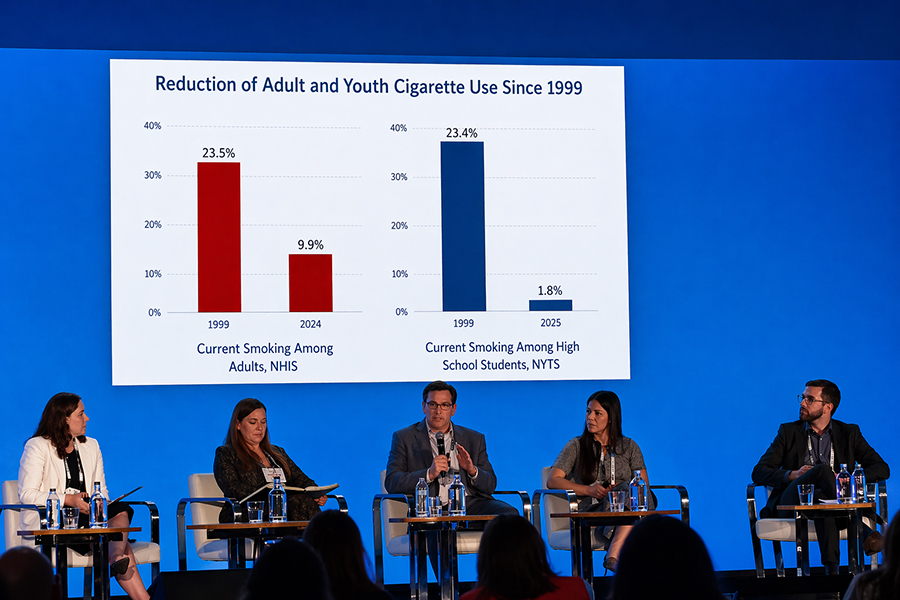
At the American Tobacco and Nicotine Forum (ATNF), a panel moderated by Beth Oliva, a partner at Fox Rothschild, brought together industry, policy, and regulatory experts to examine how state and local policymaking is shaping harm reduction. Panelists Dr. Jeff Willett from the Progressive Policy Institute, Sarah McQuillan from JTI Liggett, Andrew Nunes from PwC, and Laura Leigh Oyler from Haypp Group, repeatedly emphasized a core issue: a widespread lack of understanding among state lawmakers about federal tobacco regulation and the FDA’s role. Several speakers noted that policymakers are often making decisions without a clear grasp of existing frameworks, definitions, or scientific standards, contributing to fragmented and sometimes contradictory regulations.
A major theme was the disconnect between data and policymaking. Panelists pointed to declining cigarette use alongside growth in alternative products, yet said state responses are often driven more by headlines than evidence. Willett highlighted progress in reducing youth vaping since 2019 and stressed the importance of fact-based policy, while others noted that tax increases, flavor bans, and regulatory gaps can unintentionally push consumers toward illicit markets or cross-border purchases. Nunes and Oyler both underscored how inconsistent tax structures and regulatory approaches across states are distorting markets and complicating compliance for manufacturers and retailers.
The panel also focused heavily on the growth of illicit markets, with speakers linking it to unmet consumer demand and regulatory gaps. Oyler argued that the lack of authorized products has created a “vacuum” filled by unregulated alternatives, while Willett pointed to evidence that high taxes and restrictions are driving illicit sales in markets like New York. Broader inconsistencies—such as stricter rules for nicotine compared to cannabis or alcohol—were cited as further complicating enforcement and public perception. Panelists warned that states are increasingly reliant on tobacco tax revenue, which can influence policy decisions, and called for more coordinated, evidence-based approaches rather than a patchwork of state-by-state rules.
Finally, the discussion turned to communication and public health messaging. Speakers argued that the current narrative around nicotine lacks nuance, with limited recognition of the continuum of risk or the role of reduced-risk products. Several panelists called for the FDA to take a more active role in educating both lawmakers and the public, while also stressing the need for better data to be incorporated into legislative debates. Without improved communication and alignment between federal science and state policy, the panel suggested that regulatory fragmentation and market distortions are likely to persist.
Top of Form
Bottom of Form
-

UK Passes Tobacco and Vapes Bill to Create ‘Smoke-Free Generation’
The UK Parliament has passed the Tobacco and Vapes Bill, introducing a phased ban on cigarette sales to anyone born on or after January 1, 2009, effectively creating a “smoke-free generation.” The legislation also grants ministers new powers to regulate tobacco, vaping, and nicotine products, including controls on flavors, packaging, and marketing.
The bill expands restrictions on vaping, banning its use in cars carrying children as well as in playgrounds, near schools and at hospitals, while allowing use in certain outdoor and private settings. Smoking and vaping will remain permitted in homes and some outdoor spaces, including hospitality venues.
Officials described the measure as a major public health intervention aimed at reducing smoking-related harm, while some lawmakers raised concerns about its impact on retailers. Health groups welcomed the legislation and called for additional support for smoking cessation programs, however, critics find the regulation too broad and obtuse.
“A critically important element of the Tobacco and Vapes Bill is that it gives the government the power to regulate nicotine pouch products,” said Markus Lindblad, head of legal and external affairs at Haypp. “Nicotine pouches do not contain tobacco, nor produce vapor, so they fell outside the scope of existing nicotine product laws. Introducing regulations such as an 18+ age-of-sale and an upper limit of 20mg of nicotine per pouch will help send the message that these products are for adult nicotine users only. Oral nicotine products have enabled Sweden to achieve smoke-free status, and with sensible regulation arising from this Bill, pouches can play a similar role driving down smoking rates in the UK.”