

This week, Zimbabwe announced that it exceeded its tobacco planting target for the 2025/26 season, surpassing a record 140,000 hectares, prompting the government to urge farmers to halt further planting and focus on crop management to maximize yields and leaf quality. Agriculture Permanent Secretary Prof. Obert Jiri said late-planted dryland tobacco should be curtailed, with emphasis now on pest and disease control, weed management, and split fertilizer application amid heavy rains. A national crop and livestock assessment later this month is expected to confirm strong early performance and yield prospects, with fertilizer supplies largely adequate despite short-term top-dressing delays.
Category: Agriculture & Sustainability
-

New Tractors Strengthening Cuba’s Tobacco Production
Cuba’s tobacco sector is investing in modern machinery to boost production efficiency, with 300 tractors delivered to individual producers and cooperatives across multiple provinces last year, the Tabacuba Business Group told Granma on Monday. Financed through farmers’ foreign currency earnings and a flexible installment program, Tabacuba provides the equipment at cost, without profit, to expand access for growers.
José Liván Font, First Vice President of Tabacuba, said the initiative contributes hundreds of millions of dollars annually to the national economy and supports small-scale family operations. In Pinar del Río, which produces 70% of Cuba’s tobacco, 75 tractors were delivered alongside photovoltaic systems for irrigation and lighting, enhancing energy independence and operational efficiency.
Tabacuba said it plans to import another 300 tractors and related agricultural implements in 2026, aiming to further improve working conditions, increase production, and raise incomes for tobacco producers nationwide.
-

Zimbabwe Pushing Tobacco Processing for Value Addition
Zimbabwe will intensify tobacco processing and value addition from 2026 as part of efforts to boost exports of finished tobacco products, a senior government official said. Lands, Agriculture, Fisheries, Water, and Rural Development permanent secretary Professor Obert Jiri said plans are underway to encourage the establishment of local processing plants, shifting the industry away from raw leaf exports toward higher-value products, including cigarettes.
Zimbabwe produced a record 355 million kg of tobacco in 2025, generating about $1.2 billion in sales, and production has the potential rise to 500 million kg by 2030, Jiri said. He argued that converting locally grown tobacco into finished products could dramatically increase export earnings, estimating the potential value of more than $40 billion if current volumes were processed domestically.
The industry has also undergone a structural shift, with more than 140,000 farmers—over 80% of them smallholders—now involved following land reform. The government says expanding beneficiation will help farmers capture more value and create jobs, building on recent investments such as a $100 million tobacco processing plant commissioned in Harare in November.
-

Zimbabwe Tobacco Planting Up 21%
Zimbabwe’s tobacco hectarage increased by 21% to 100,594 hectares this season, up from 83,391 hectares during the same period last year, according to the Tobacco Industry and Marketing Board (TIMB). Mashonaland West leads production with the largest combined area under irrigated and dryland tobacco, followed by Manicaland and Mashonaland Central, reflecting strong growth across major producing regions. The TIMB said 90% of growers are operating under contract farming arrangements.
While production has expanded into new regions, the government is seeking to reduce reliance on offshore funding and has proposed a $60 million facility to boost domestic financing, support sustainable growth, and promote value addition in the sector.
-
China Key to Zimbabwe’s Record Tobacco Output
Zimbabwe’s tobacco sector has surpassed 350 million kg in 2025, thanks in large part to Chinese support, Finance Minister Mthuli Ncube said. Speaking in Harare after signing agreements on China-aid irrigation projects, Ncube highlighted China’s role in providing both credit facilities and market access through China Tobacco, helping small- and medium-scale farmers grow the sector beyond expectations.
The assistance has helped Zimbabwe maintain its position as Africa’s top tobacco producer and a significant player globally. The tobacco industry remains a cornerstone of Zimbabwe’s agriculture, supporting over 160,000 households, according to government data.
-

U.S. Tobacco Groups Urge Targeted Relief Amid Export Downturn
Fourteen U.S. agricultural and tobacco-sector organizations sent joint letters to President Donald Trump, Secretary Brooke Rollins, and Secretary Scott Bessent thanking the Administration for expressing willingness to support flue-cured tobacco farmers facing severe trade disruptions. The letters highlighted urgent challenges, including a 20–25% drop in exports, 15–20% decline in farm-gate prices, and shrinking demand from key markets like China. Rising input costs are also adding financial pressure as growers plan for 2026.
“On May 29th, China wrote to the U.S. leaf merchants that it would not honor its purchase as much as 60 million pounds of flue-cured leaf in 2025. This exit resulted in adverse impacts on prices and values as the season progressed. The surplus created a soft demand that caused a market downturn of 27 cents per pound on average.”
While the Administration recently announced the $12 billion Farm Bridge Assistance Program, tobacco is currently excluded. The coalition urged targeted relief, citing precedent from the first Trump Administration when tobacco was included in market facilitation programs. The groups emphasized the risk of lost family farms and the need for prompt inclusion of tobacco in relief measures.
Tobacco Associates disseminated the letters to industry members and encouraged growers to contact local, state, and federal representatives to share personal experiences and the real impact of the downturn, stressing that these voices carry significant weight in shaping policy responses.
-

Development Hopes to Keep Tobacco Money in Zimbabwe
Zimbabwe is accelerating plans to move up the tobacco value chain under its new National Development Strategy 2 (NDS2), aiming to lift value addition from about 2% to 30% and reduce reliance on raw leaf exports. While NDS1 missed its 300,000-ton production target due to drought, Zimbabwe produced a record 355 million kg of tobacco in 2025, valued at $1.2 billion, making it the world’s sixth-largest producer. According to the Tobacco Industry and Marketing Board, tobacco contributes more than 25% of national foreign-currency earnings, though 92% of export revenues still come from unprocessed leaf.
NDS2 focuses on local processing through the Tobacco Special Economic Zone, including nicotine extraction plants and expanded cigarette and cut-rag manufacturing. A key milestone was the commissioning of a $102 million Cut Rag Processors facility capable of producing 3 million kg of cut rag per month and 60,000 cigarette master cases.
Government officials say domestic value addition remains far below potential, with current earnings estimated at $1.5 billion versus a theoretical $60 billion if higher-value products were produced. The strategy prioritizes attracting investment, expanding local financing, and creating jobs through processing, packaging, and logistics as Zimbabwe shifts toward exporting finished tobacco products.
-
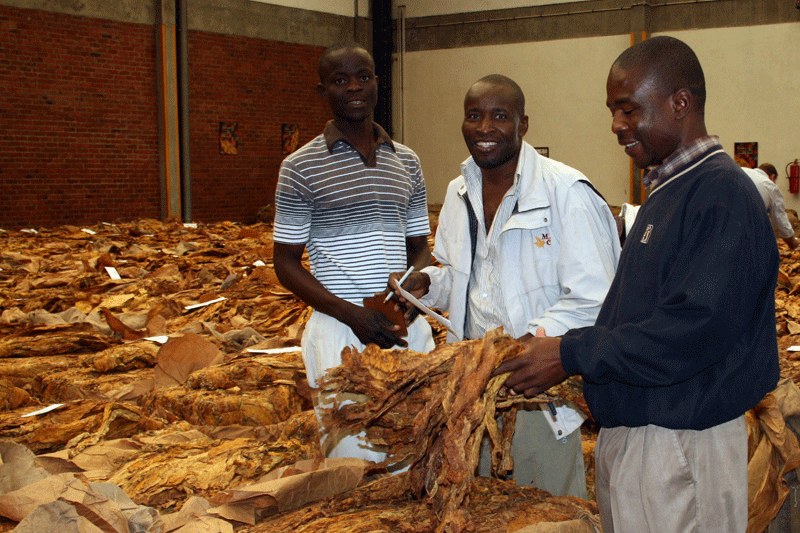
Zimbabwe Nears $1.1B From Tobacco Exports
Zimbabwe earned $1.1 billion from 201.4 million kg of semi-processed tobacco exported between January and November, according to the Tobacco Industry and Marketing Board. This compares with $1 billion from 208.4 million kg during the same period last year.
The Far East remained the top buyer, taking 89.1 million kg worth $630.7 million at an average $7.08/kg. Africa followed with 33 million kg valued at $154.6 million, while the Middle East bought 30 million kg for $88 million. The EU imported 27.2 million kg at $5.83/kg, and Europe purchased 12.8 million kg at $5.09/kg. The Americas bought 9.1 million kg, and Oceania, though a small buyer, paid the highest price at $8.45/kg.
Tobacco remains Zimbabwe’s top agricultural export and key foreign currency earner, generating $1.3 billion in 2024 and contributing roughly 30% of total exports.
-

Pakistan Tobacco Demand Slashed, Farmers Taking Losses
Tobacco purchasing companies in Pakistan have reduced their demand for the 2026 crop by 13.2 million kg, setting total requirements at 61.627 million kg. This marks the fourth consecutive year of cutbacks, with overall demand falling from 85.5 million kg in 2023 to 77.3 million kg in 2024, 74.8 million kg in 2025. The bulk of purchases will be made by multinational firms, led by Pakistan Tobacco Company and Philip Morris (Pakistan) Ltd, which together account for more than 36 million kg of flue-cured Virginia (FCV) tobacco. The remaining FCV demand will be met by 78 national companies, including Khyber Tobacco. While demand for FCV, dark air-cured, and sun-cured tobacco has declined, requirements for White Patta and burley tobacco have increased slightly.
Industry experts note that farmers are facing severe financial losses due to limited storage options and price discrepancies between the weighted average price (Rs 719 per kg) and the minimum indicative price (Rs 545 per kg [$1.96]). Companies profited by Rs 6.2 billion ($22.2 million) from surplus purchases at lower rates in 2025, while growers bore the losses. Despite reduced domestic demand, tobacco exports surged from 20 million kg in 2023-24 to 47 million kg in 2024-25, a 135% increase. However, Ayaz Khan, former director of the Pakistan Tobacco Board, said the benefits of rising exports have not reached farmers, who remain vulnerable to falling purchase prices and shrinking demand, leaving them at a disadvantage compared to multinational and national firms.
-

Philippines Defends Tobacco-Growers at COP11
The Philippine delegation at COP11 earned praise from agricultural and civil society groups for emphasizing the country’s sovereign right to evaluate proposed global measures according to national priorities and capacities. Ambassador Carlos Sorreta, head of the delegation, highlighted the need for “socially and economically responsible” transitions that protect communities dependent on tobacco cultivation, noting that the crop continues to support livelihoods across nearly 20 provinces.
Sorreta underscored that FCTC guidance is non-binding and should complement existing national efforts rather than impose restrictions. Local organizations, including the Northern Luzon Alliance, applauded this stance, warning that measures such as ending government support, imposing quotas, or phasing out tobacco sales would be “unrealistic, overly punitive and incompatible with the country’s agricultural and economic realities,” potentially threatening rural livelihoods and linked industries.
The Federation of Free Farmers echoed these concerns, noting tobacco’s critical role in sustaining rural communities. It commended the delegation for prioritizing farmers’ welfare, arguing that the approach reflects a clear understanding of on-the-ground realities and protects not only the economic stability of tobacco-growing regions but also the dignity and future of the families who rely on this crop.