Category: Agriculture & Sustainability

  • Malaysia: Could Kenaf Replace Tobacco?  

    Malaysia: Could Kenaf Replace Tobacco?  

    Anti-tobacco advocate Datuk K. Koris Atan is urging the Malaysian government to help the smoking rate in the country by getting tobacco farmers to switch to growing kenaf instead. Kenaf is a hibiscus, related to cotton and okra, used for a variety of purposes including paper pulp, textiles, and wood-based products. Koris argues that if tobacco becomes scarcer, the supply of cigarettes would dwindle, and thus smoking would decrease.

    Kenaf was first introduced as a commercial crop in 1998, and Datuk Wan Abdul Rahim Wan Abdullah, chairman of the National Kenaf and Tobacco Board says it has great potential but just hasn’t been given the attention it needs. That it thrives in hot, dry climates makes it easy to grow, according to Rahim Wan, and offers potential earnings of RM 5,000 ($1,100) per hectare per season.

    Wan Abdul Rahim said that kenaf can also be grown as a supplement to major plantations and farming such as rubber, oil palm, and padi. “It has gained global attention as a cost-effective plant,” he said.

  • Malawi Government Urged to Take Over Tobacco Diversification Agenda 

    Malawi Government Urged to Take Over Tobacco Diversification Agenda 

    A report by the Sustainable Development Initiative (SDI) in Malawi said the nation’s agricultural diversification programs are not yielding the desired results, with farmers struggling to access markets for alternative crops. Maynard Nyirenda, executive director of the SDI, said his organization understands that weaning Malawi off its reliance on tobacco will be a long and challenging process, given the crop’s entrenched history in the country dating back to colonial times, however he emphasized the need for a gradual transition to alternative crops.

    The SDI said that after decades of practice, the current tobacco diversification agenda hasn’t yielded economic prosperity, and that the tobacco industry’s diversification programs are driven by the industry itself, creating a conflict of interest. He emphasized the need for a farmer-centered approach, stating that the Malawi government should provide direct market access, technology, and infrastructure for alternative crops such as soya beans, sunflowers, and groundnuts.

    “We are saying, let the government own this particular diversification agenda so that the other crops are also given enough support that the tobacco industry has received,” Nyirenda said. “If you can support the same soya beans and whatever alternatives, give it a lot of support as we have been doing on tobacco, it will be sold outside, it will be exported. We will still be getting the same U.S. dollars.”

  • Cuban Tobacco Crops Continue to be Down

    Cuban Tobacco Crops Continue to be Down

    According to a report from Agencia Cubana de Noticias, Cuban farmers have only planted 10,378 hectares of tobacco through February, close to the revised target of 10,500 hectares set in September 2024, but well below the initial goal of 14,771 hectares.

    Cuba’s tobacco production has still not recovered since Hurricane Ian hit in 2022. In the fall of 2021, Tabacuba said that it planned to plant more than 16,000 hectares in Pinar del Río and harvest 17,600 tons. The 2023-2024 crop was originally targeted at nearly 13,000 hectares but was reduced to 10,200 hectares.

    “Since Hurricane Ian ravaged Pinar del Río, Cuba’s main growing region has been rebuilding,” Charlie Minato wrote for Halfwheel. “It was estimated that 90% of the curing barns in the province were damaged, something that remains an issue today. Osvaldo Santana Vera of Tabacuba, the state-owned company in charge of tobacco production, told ACN that he was hoping for more wood deliveries, which would allow for more curing barns and could increase the size of the crop. In addition, heavy rains in September 2024 led to the destruction of 10,000 seed beds and pushed back some of the planting until earlier this month.”

  • Virginia Tobacco Begins Trading in Philippines 

    Virginia Tobacco Begins Trading in Philippines 

    The National Tobacco Administration (NTA) said that growers who planted the last week of November have already started bringing flue-cured Virginia tobacco buying stations in Region 1 and Abra to open the 2024–2025 crop season.

    Administrator and Chief Executive Officer Belinda S. Sanchez said NTA extension workers have already calibrated and sealed the trading equipment and facilities of the two biggest tobacco trading outlets in the Ilocos region, as well as the scales of accredited field canvassers

    Trading warehouses of the Universal Leaf Philippines, Inc. in Agoo, La Union; Candon City and Cabugao, both in Ilocos Sur; Currimao, Ilocos Norte; and Bangued, Abra; and the warehouse of Trans Manila Incorporated (TMI) in San Juan, Ilocos Sur, are now open.

    Trading centers opened by purchasing a kilo of prime class of flue-cured tobacco at P107 ($1.89) while field canvassers in the first district of Ilocos Sur bought the same class of cured tobacco as high as P125 ($2.13) per kilo. With these, Sanchez said she is expecting another golden season for tobacco farmers this year, as the current tobacco buying prices are much higher than the approved tobacco floor prices during the tripartite conference in October 2023.

  • Cresco Labs Making Mark in KY Cannabis Market

    Cresco Labs Making Mark in KY Cannabis Market

    Chicago-based Cresco Labs Inc. today (March 11) announced it received a management services agreement with a Tier 3 Cultivation License in Kentucky, allowing it to operate a cannabis cultivation facility with up to 25,000 square feet of canopy. It is only the second such license issued in the state.

    Cresco offers cannabis in all forms nationally under brands such as High Supply, FloraCal, Good News, Wonder Wellness Co., Mindy’s, and Remedi, and sells under its Sunnyside brand dispensaries.

    “The Cultivation License allows for the construction of a state-of-the-art cultivation facility with up to 25,000 square feet of canopy, enabling us to deliver the quality and scale we are known for,” said Charlie Bachtell, CEO of Cresco Labs. “We’ve spent the last two years focused on solidifying the core and increasing our free cash flow. Kentucky is our first of many opportunities to reinvest that free cash flow back into high ROIC growth initiatives as we continue expanding into new markets.”

    Launched on Jan. 1, 2025, Kentucky’s medical cannabis program allows for a maximum of 115,000 square feet of approved canopy space and 48 retail licenses. Industry analysts predict the state’s market will generate $135 million in revenue by 2026 and grow to $228 million by 2028.

  • Opinion: Zimbabwe’s Tobacco Chain Needs to Come Together

    Opinion: Zimbabwe’s Tobacco Chain Needs to Come Together

    Zimbabwe’s tobacco marketing 2025 season opened last week with the first bale selling for $4.65 per kg. That price was predictably down from last year’s $4.92 as the El Nino drought created a shortage in the tobacco market. Last year’s output was 235 million kilograms, down from 2023’s record 296 million kg. For 2025, projections are in the 280 million kg region, however, more plantings and favorable weather keep the National Development Strategy’s ultimate 300 million kg goal a possibility.

    While growers are doing their part in the system, Obert Chifamba wrote in his opinion piece for The Herald that more needs to be done as a nation to make the cash crop profitable for the people doing the work.   

    “Just two seasons ago [we were] close to the target of 300 million kg,” Chifamba wrote, “which means production-wise, we have achieved our intentions, hence the need to identify and address the issues now standing between the country and its target.

    “Delays in disbursing the $60 million tobacco revolving fund meant to localize the crop’s funding and support growers have not made the situation any better, with the Reserve Bank of Zimbabwe said to be working on the modalities of disbursing it. Local funding should take care of 70% of the cost of production. This is also one of the strategies the government is pushing to effectively implement to ensure the country stops relying on foreign capital for the crop, which will see the funders taking between 80 and 90% of the money generated from tobacco out of the country leaving producers with very little.”

    Chifamba also points out that 95% of the tobacco produced gets exported out of the country raw, allowing countries that import and process it to reap the majority of the profits, and that local growers are often taken advantage of by foreign sponsors with “notorious price ceilings” and incomplete purchase contracts. 

    “It is critical for the tobacco industry to do some self-introspection and see where the wheels are always coming off,” Chifamba wrote. “Maybe it will take the intervention of the government or some independent observer to pinpoint where the tobacco juggernaut needs revitalization to function more fluidly and profitably for all parties involved.”

  • Pakistani Growers Getting Squeezed as Cultivation Begins

    Pakistani Growers Getting Squeezed as Cultivation Begins

    Growers in Pakistan started cultivating Virginia and white Patta tobacco last week, but news for them was not all good as purchasing companies have again slashed their quota. The quota was 85.5 million kg in 2023, 77.3 million in 2024, and now reportedly 74.8 million kg for this year. Making the matter worse, according to Liaqat Yousafzai, central president of Tobacco Growers Association Pakistan, is that purchasing companies again didn’t notify growers of their intentions, causing farmers to spend time and money growing surplus crop that will be thrown away.

    “The big issue is that the companies’ demands are decreasing while the tobacco production is increasing,” Yousafzai said. “It is the only cash crop with which the full-year expenditures of the farmers are linked. The companies have reduced their quota for the current year like 2024 without informing the growers in advance.”

    However, when contacted by reporters for The Dawn newspaper, officials for purchasing companies said they had made clear previously that the farmers who failed to execute agreements with the buyers of their choice should give up growing tobacco.

  • 3D Bio Traps Tobacco Pests Like a Spider

    3D Bio Traps Tobacco Pests Like a Spider

    3D BioSciences announced that it has been recognized as a “World’s Greatest Company” and will be featured on the Bloomberg Financial Channel’s show on March 8 and 15. The interest comes as the company’s “revolutionary approach to pest management” gains more attention. Its 3DIPNS technology physically immobilizes insects without harming the crop, people, animals, or the environment.

    “The 3DIPNS technology in our products forms an artificial spider web over the body of the insect, trapping it,” CEO Frank Jusich said. “There is nothing else like it available for pest control.”

    Approved for use on tobacco, the product is used widely in South America under the brand name Siltac and the company says growers have reported good efficacy with no phytotoxicity issue. Since 2022, the company has been selling the technology under the Stik-Kote and Pest-Kote brands in the United States. Jusich said most of the clients have used the products in greenhouses, nurseries, and specialty agriculture like berries and tree fruits, however, the company has recently “began focusing on other crops like tobacco and thus far those farmers who have tried it have used it again.”

    World’s Greatest TV show has been airing for 19 years, featuring behind-the-scenes looks at companies such as Coca-Cola, Crest, P&G, NASCAR, and more.

  • Zimbabwe’s Tobacco Market Opens

    Zimbabwe’s Tobacco Market Opens

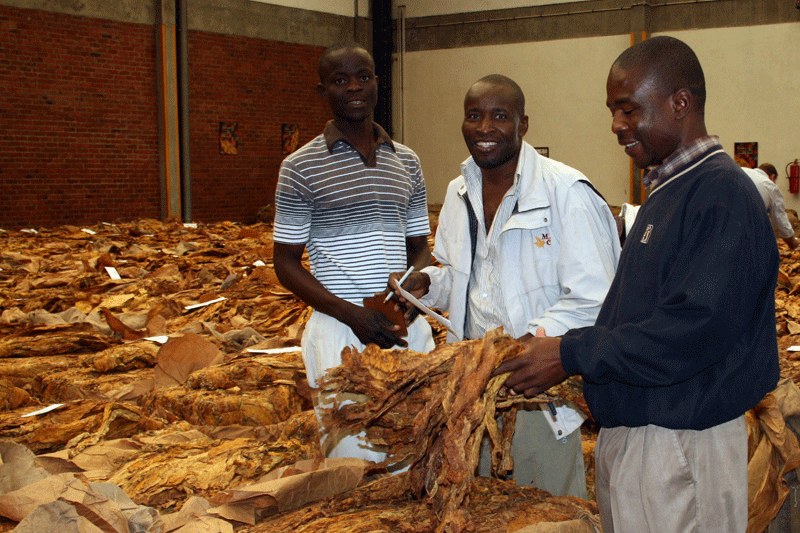
    Zimbabwe’s 2025 tobacco marketing season opened this week (March 5) with stakeholders upbeat about increased output due to favorable weather, contrasting to last year’s El Nino-induced drought.

    “We are expecting a bigger crop, much bigger than last year, over 280 million kg, and I think it will sell well,” said Patrick Devenish, chairman of the industry regulator Tobacco Industry and Marketing Board.

    Last year, Zimbabwe produced more than 240 million kg worth $1.4 billion in export earnings. China is the largest importer of Zimbabwe’s tobacco and is expected to have high demand for its top-quality leaf this year. 

  • Pakistani Tobacco Growers Told to Avoid Surplus

    Pakistani Tobacco Growers Told to Avoid Surplus

    As purchasing companies in Pakistan have slashed their quotas for the year, officials from those companies are advising farmers against growing surplus tobacco. Those officials said that the growers had again reverted to growing tobacco after they were unable to cover the costs incurred on wheat production as official wheat rates were slashed drastically.

    Pakistan Tobacco Company, Philip Morris International, and a few national tobacco-purchasing companies were executing agreements with the growers, however, sources said small cigarette manufacturers avoid those agreements and wait to exploit the growers with leftover tobacco.