Blog

  • Flow Stops Sales of Flavored Vapes in China

    Flow Stops Sales of Flavored Vapes in China

    Photo: Max

    E-cigarette manufacturer Flow will stop producing non-tobacco flavored e-liquid cartridges for the Chinese market to comply with new regulations, reports Pandaily.

    In November 2021, the Chinese government granted the State Tobacco Monopoly Administration jurisdiction over the vapor business. Since then, authorities have published a series of new rules. Among other things, e-cigarette manufacturers must sell their products through authorized channels. Retailers, meanwhile, are required to buy all vapor products through a “unified platform” and restrict the liquids sold on the Chinese market to tobacco flavors.

    According to the Blue Book of the E-Cigarette Industry, there were nearly 190,000 e-cigarette retail stores in China in 2021, including 138,000 authorized stores, 47,000 specialty stores, and 5,000-7,000 “collection” stores.

    Currently, fruit-flavored e-cigarettes account for more than 70 percent of sales in many retail outlets.

  • Canada Wants Warnings on Individual Sticks

    Canada Wants Warnings on Individual Sticks

    Photo: vchalup

    The Canadian government wants to require cigarette manufacturers to print written health warnings on individual cigarettes, reports Reuters, citing Mental Health and Addictions Minister Carolyn Bennett.

    If the plan moves forward, Canada would be the first country to implement such a rule. In 2001, Canada pioneered graphic health warnings on cigarette packs, an example that has since been followed by many other nations.

    Carolyn Bennett said the measure had become stale for the 13 percent of Canadians who smoke regularly.

    “Adding health warnings on individual tobacco products will help ensure that these essential messages reach people, including the youth, who often access cigarettes one at a time in social situations sidestepping the information printed on a package,” she was quoted as saying.

    A 75-day public consultation period will start on June 11, and this will inform the development of the proposed new regulations.

    Rothmans Benson & Hedges, the Canadian unit of Philip Morris International, said the proposals would not help cut the number of smokers.

    “We believe that better choices start with better information, and the millions of current adult smokers should be given access to the appropriate information about alternatives,” a spokesperson told Reuters.

    Action on Smoking & Health (ASH) welcomed the plan.

    “We are delighted to see proposed new graphic health warnings on all tobacco products, including smokeless tobacco” said Les Hagen, executive director of ASH Canada in a statement. “A picture is worth a thousand words and these pictures and messages will protect thousands of Canadians from tobacco dependence and disease. The new and improved warnings will replace the stale messages that have appeared on tobacco packages for over 10 years. The messages on cigarette sticks are a global precedent and will warn smokers about the grave risks of smoking with every puff. The visibility and intensity of these warnings will better reflect the enormous risks of smoking.”

    Tobacco use kills over 50,000 Canadians each year—more than all other drugs combined, according to ASH.

  • Pakistan: Illicit Cigarette Market Up Significantly

    Pakistan: Illicit Cigarette Market Up Significantly

    Photo: Taco Tuinstra

    Pakistan’s revenue losses from the illicit cigarette trade increased by 53 percent in two years, reports The Nation, citing a report by Oxford Economics. In fiscal year 2020-2021, the state missed PKR77.8 billion ($380.7 million) in tax collections due to illicit cigarette sales, compared with PKR50.9 billion in 2018-2019.

    Oxford Economics said that illegal cigarettes account for 38 percent of total consumption in Pakistan, compared with 32 percent in 2018-2019. The vast majority of illegal cigarettes (90 percent) are locally produced.

    The value of tax evaded by illegal cigarettes in Pakistan in 2021 amounts to 58 percent of the total tax revenues collected from legitimate sales in the previous financial year. To place this in context, it is equivalent to more than double the government’s education expenditure in 2020-21.

    According to Oxford Economics, the rise in the illicit cigarette market share in recent years coincided with a sharp rise in the excise rates. Excise rates on most legal cigarettes nearly doubled following the September 2018 supplementary budget and the June 2019 Federal Budget. Tier 2 excise rates—which represent 92 percent of the total industry volume—rose from PKR854 per 1,000 pieces to PKR1,650 per 1,000 pieces.

    Due to the instability of revenues and growing illicit share, Pakistan kept cigarette excise taxes unchanged in 2020-2021.

  • Call for Crackdown on Synthetic Nicotine

    Call for Crackdown on Synthetic Nicotine

    Photo: jozsitoeroe

    A coalition of more than 30 U.S. attorneys general have called on the U.S. Food and Drug Administration to reject marketing authorization for all nontobacco nicotine products, which they say are currently being sold without regulation of their contents, manufacturing, health effects, required warning labels or marketing claims.

    In a letter directed to FDA Commissioner Robert Califf, the coalition argues that these products currently don’t meet the FDA’s public health standard, and that the health of residents—especially young people—should not be gambled on the unknown effects of these products.

    The letter specifically calls for the FDA to reject a request by product manufacturers to grant marketing authorization for nontobacco nicotine products. The letter also insists that if the agency does grant marketing authorizations for these products, it imposes the same restrictions required of tobacco-derived nicotine products including a ban on all products with a flavor other than tobacco and strict regulatory requirements regarding their contents, manufacturing, and effect on users’ health.

    Products should carry warnings concerning their addictiveness, and manufacturers should be required to validate health claims made about their products, including claims that a product is safer than tobacco, according to the attorneys general.

    “The lack of regulation on non-tobacco nicotine products has created an unlevel playing field, as manufacturers of one category of nicotine products have evaded regulatory burdens and restrictions, while manufacturers of tobacco-derived nicotine products must undertake the expense and effort required to conform to FDA requirements,” wrote Massachusetts Attorney General Maura Healey in a statement.

  • Industry Braces for Reduced Nicotine Policy

    Industry Braces for Reduced Nicotine Policy

    Photo: chones

    The Biden administration intends to pursue a policy requiring tobacco companies to reduce the nicotine in all cigarettes sold in the U.S. to minimally or nonaddictive levels, reports The Wall Street Journal, citing people familiar with the matter. The policy could be announced as early as this week.

    Health advocates have long pushed for lower nicotine levels, arguing that it would prevent future generations from becoming addicted to cigarettes, and prompt current smokers to quit. In 2009, the Family Smoking Prevention and Tobacco Control Act authorized the Food and Drug Administration to mandate such a change—with the stipulation that the policy be based on scientific evidence.

    Research funded by the FDA and National Institutes of Health has shown that when nicotine was nearly eliminated in cigarettes, smokers were more likely to quit or seek their nicotine fix from less harmful alternatives such as e-cigarettes or gum compared with smokers who continued using cigarettes with normal nicotine levels.

    According to estimates published in the New England Journal of Medicine, mandating a reduction of nicotine levels in cigarettes to very low levels would prompt an additional 5 million adult smokers to quit within a year of implementation.

    The tobacco industry has cautioned that a reduced-nicotine mandate will lead people to smoke more, rather than less, because smokers would need a larger number of cigarettes to satisfy their nicotine cravings. This, in turn, would cause them to inhale more of the cancer-causing substances generated by combustion. Critics have also warned that requiring low-nicotine cigarettes would boost the illicit tobacco market.

    If the low-nicotine policy is indeed announced this week, it will still take several years to come into force. The FDA first must publish a proposed rule, then invite public comments before publishing a final rule. Tobacco companies could then challenge the rule in court, which could further delay the policy’s implementation.

  • Marketing Approvals for NJOY ‘Daily’ Vapes

    Marketing Approvals for NJOY ‘Daily’ Vapes

    Photo: NJOY

    The U.S. Food and Drug Administration has approved the premarket tobacco product applications (PMTA) for NJOY’s Daily Rich Tobacco 4.5% and NJOY Daily Extra Rich Tobacco 6%.

    “It should be noted that our determination that the marketing of these products is APPH [appropriate for the protection of public health] is based in part on the submitted microbial stability data,” the agency wrote in its marketing granted order (MGO).

    The designation does not mean the products are safe and they are not “FDA approved,” the agency said, but the MGOs allows the NJOY to legally market the authorized products in the United States.

    While approving NJOY’s Daily Rich Tobacco 4.5% and NJOY Daily Extra Rich Tobacco 6%, the FDA denied authorization for multiple other Daily e-cigarette products. These are presumed for products with nontobacco flavors. Any of those products that remain on the market must be removed or risk FDA enforcement, the agency said. Applications for two menthol-flavored Daily products remain under FDA review.

    Additionally, the authorization imposes marketing restrictions on the company to greatly reduce the potential for youth exposure to advertising for these products. The FDA said it will closely monitor how these products are marketed and will act as necessary if the company fails to comply with any applicable statutory or regulatory requirements, or if there is a notable increase in the number of non-smokers—including youth—using these products.

    On April 26, the FDA authorized four NJOY Ace products through the PMTA pathway.

  • EU Urged to Embrace Harm Reduction

    EU Urged to Embrace Harm Reduction

    Photo: courtyardpix

    Medical and addiction experts called on the EU to embrace tobacco harm reduction during an event organized by the Centre for Economic and Market Analysis (CETA) in Prague.

    Debating how a tobacco-free generation—where less than 5 percent of EU-citizens use tobacco—can be achieved by 2040, they concluded that the objectives laid out in Europe’s Beating Cancer Plan cannot be attained under current circumstances and that a revised tobacco control policy based on scientific evidence is needed.

    “If the European Commission is serious about its plans to reduce the number of smokers and the impact of smoking, it must start considering the concept of risk reduction in the area of smoking,” said Czech National Drug Coordinator Manager Jindřich Vobořil, in a statement.

    “The Czech Government has committed itself to this approach in its program statement for the upcoming [EU] Presidency. I will also promote it in relation to the ongoing evaluation of the Tobacco Products Directive, which is an effective policy to achieve a real reduction in the number of smokers of conventional cigarettes,” he added.

    “The data show that the abstinence approach is inadequate. The solution for smokers is to switch to less harmful alternatives,” noted Ernest Groman, of the Vienna Nicotine Institute. The only European country close to the 5 percent target is Sweden. According to the experts, the low number of smokers is mainly due to the availability of less harmful alternatives.

    During the event, the CETA published a study ranking EU member states according to their ability to implement the concept of risk reduction. The Czech Republic finished second.

    The Czech government should use the upcoming EU Presidency to undertake a comprehensive review of tobacco dependence policies based on science rather than emotion, according to CETA Research Director Aleš Rod, who also sits on a Czech government advisory board.

  • KT&G Publishes Ethics Charter

    KT&G Publishes Ethics Charter

    Photo: KT&G

    KT&G on June 8 published its business ethics charter, which contains common standards of conduct for its companies, the firm announced in a statement.

    Approximately 20 people attended the proclamation ceremony for the “KT&G Group Ethics Charter” at the Courtyard Marriott Namdaemun Hotel in Seoul, including KT&G President Baek Bok-in, representatives of seven domestic subsidiaries and compliance officers.

    The third revision of the charter since its inception in 2003 aims to reflect the altered business environment, and covers global business expansion and reinforced ESG management, among other provisions.

    Based on the company’s management philosophy of “An upright company, a conscientious company, and a shared company,” the ethics charter contains eight themes and 31 items. The primary topics are business ethics, protection of assets and information, domestic and international transactions, and social responsibility. Responsible research and development and social media use were added as new subcategories.

    This ethics charter is distributed in eight languages to 21 companies, including overseas corporations and domestic and foreign subsidiaries. Moving away from the legal text format, it provides a more specific and understandable code of conduct through the use of descriptive phrases and the addition of practically applicable examples.

  • U.K. to Consider Khan Recommendations

    U.K. to Consider Khan Recommendations

    Photo: Iakov Kalinin

    The U.K. government said it will consider the recommendations of a report on smoking and publish its own plan in due course, Health and Social Care Secretary Sajid Javid said in a written statement to Parliament.

    “The independent review will help to inform our upcoming White Paper on Health Disparities, which we plan to publish this summer. To complement this, the department will also be publishing a new tobacco control plan in due course,” Javid’s statement said.

    Earlier this year, Javid commissioned an independent review into ways the government can help more people quit smoking and live healthier lives, led by Javed Khan, former CEO of children’s charity Barnardo’s.

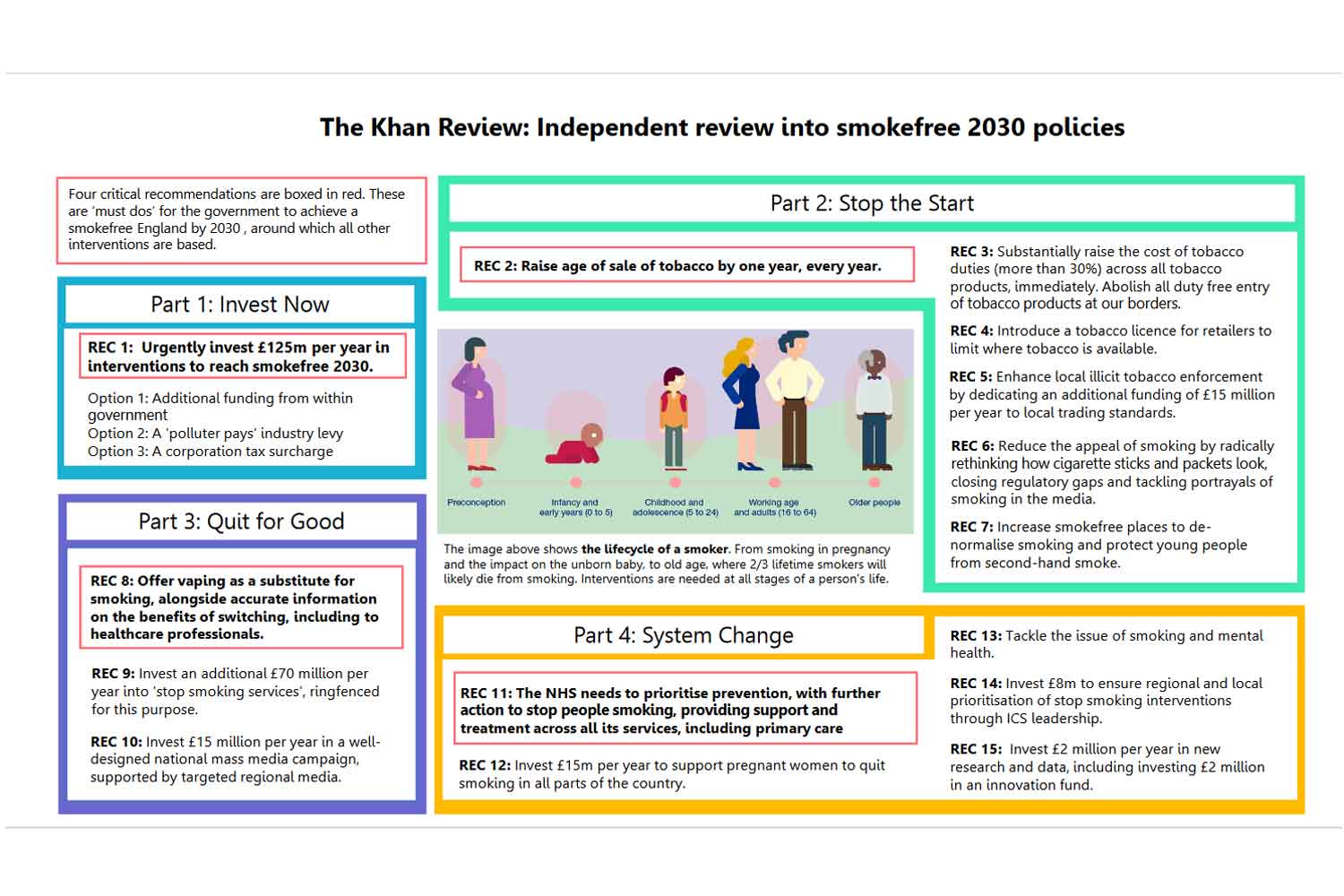
    That review was published today. The key recommendations are: increased investment of an additional £125 million ($156.66 million) per year in smoke-free 2030 policies, with an extra £70 million per year ringfenced for stop-smoking services; raising the age of sale from 18 by one year every year until eventually no one can buy a tobacco product in this country; promotion of vapes as an effective “swap to stop” tool to help people quit smoking; and improving prevention in the NHS so smokers are offered advice and support to quit at every interaction they have with health services.

    Other interventions recommended in the report include a tobacco license for retailers to limit the availability of tobacco across the country; a rethink of the way cigarette sticks and packets look to reduce their appeal; and a mass media campaign to encourage smokers to quit.

    Creeping prohibition won’t stop young adults smoking. It will simply drive the sale of tobacco underground and consumers will buy cigarettes on the black market where no-one pays tax and products are completely unregulated.

    “My proposals are not just a plan for this government, but successive governments too,” said Khan. “To truly achieve a smokefree society in our great country, we need to commit to making smoking obsolete, once and for all.” The U.K. aims having 5 percent or fewer smokers by 2030.

    Smokers rights activists condemned the proposal to raise the age of sale of tobacco.

    “Creeping prohibition won’t stop young adults smoking. It will simply drive the sale of tobacco underground and consumers will buy cigarettes on the black market where no-one pays tax and products are completely unregulated,” said Simon Clark, director of the smokers’ group Forest.

    “Ultimately this is about freedom of choice and personal responsibility and ministers must think very carefully before they adopt prohibition and coercion as tools to achieve their smoke-free goal.”

    Mr. Khan unambiguously states that one of the critical ways the government can get its ambitions for a smoke free society back on track is through greater promotion of vaping.

    Tobacco harm reduction activists welcomed the report’s recognition of vaping as a tool to help smokers quit.

    “We couldn’t agree more with this report’s stark message for the government, which is that, without immediate action, it will miss its smoke-free targets by seven years,” said John Dunne, director general of the U.K. Vaping Industry Association (UKVIA), in a statement.

    “The NHS [National Health Service] tells us that around 78,000 people in the U.K. die every year from smoking, with many more living with debilitating smoking-related illnesses, so the time for inaction is over.

    “Mr. Khan unambiguously states that one of the critical ways the government can get its ambitions for a smoke-free society back on track is through greater promotion of vaping, and the UKVIA, which represents vaping organizations including retailers, manufacturers and distributors, will do everything we can to support this.”

    Clark noted that encouraging smokers to switch to reduced-risk products such as e-cigarettes is sensible “as long as it is voluntary and based on educating consumers about the relative risks of different nicotine products.”

    Illustration: Office for Health Improvement & Disparities
  • BAT Reiterates Full Year Guidance

    BAT Reiterates Full Year Guidance

    Photo: BAT

    British American Tobacco reiterated its revenue guidance of £5 billion ($6.27 billion) for 2022, anticipating that its diversification into noncombustible products will pay off.

    The new business line “is increasingly contributing to group performance, and we are confident in delivering our £5 billion New Category revenue and profitability targets by 2025”, said BAT CEO Jack Bowles in a statement, adding that the company continues to drive value through its combustibles business.

    The noncombustible product consumer base reached 19.4 million in the first quarter of the year, according to BAT. In the first half of the fiscal year, the company invested more than £1 billion to build its brands in this product segment. Its portfolio of non-combustible products includes vapor products, nicotine pouches, tobacco heating products and other oral products.

    BAT’s Vuse vapor cigarette now holds a value market share of 35.9 percent in the U.S., up 3.4 percentage points in the year to date versus 2021. Vuse debuted in the U.K. in May and the company anticipates further rollouts for the second half of 2022.

    BAT said it continues to enjoy volume share leadership in Modern Oral in Europe, with 69.3 percent of the market.

    We are confident in delivering on our current financial targets, irrespective of the timing of the transfer of our Russian business.

    Like many multinationals, BAT has been impacted by the war in Ukraine, which has increased global uncertainty and disruption, further exacerbating inflationary pressures on supply chains. In March, BAT announced that its ownership of the business in Russia was no longer sustainable. The company is in the process of transferring its Russian business to a third party.

    “While we are not immune to these pressures, we are confident in delivering on our current financial targets, irrespective of the timing of the transfer of our Russian business,” said Bowles. “This is thanks to our well-established multi-category strategy, our strong portfolio of global brands and our resilient, highly cash generative business.”

    While considering BAT’s aspiration to reach £5 billion of sales and achieve profitability in its new products stream “achievable,” Ross Hindle, an analyst at Third Bridge, noted the significance of Russia and Ukraine to BAT. “Russia and Ukraine are very important heated tobacco markets, they are even more important for BAT than PMI, with 26 percent of their heated tobacco sales coming from the region historically,” he told Proactive.