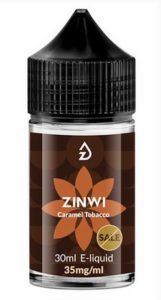
E-Liquid manufacturer Zinwi Bio-Tech is set to unveil its new logo at the Total Products Expo (TPE) in Las Vegas from Feb. 22 – 24. The company will also be highlighting 15 of its most popular e-liquid flavors for TPE attendees to experience.
Zinwi, a global integrated e-liquid solutions provider, upgraded its branding in December to better reflect the company’s dedication to providing high-quality products and the brand’s entry into a new development phase.
“In this new phase, Zinwi will place more emphasis on product research and development, and provide diversified products to meet the needs of global markets,” a Zinwi spokesperson told Tobacco Reporter. “Zinwi is committed to continuing to explore e-liquid technology, pursue innovation and provide cutting-edge integrated e-liquid solutions.”
Zinwi’s new logo resembles a drop of e-liquid oil, which alludes to the company’s unwavering commitment to product research and development. The Zinwi “Z” and oil design are integrated to symbolize the company’s dedication to continuous product research and development, according to a press release. The light blue color of the logo features Zinwi’s laboratories that conduct its scientific product research and development in the background.
Currently, new nicotine salt and glycerol alternatives are two major topics of research for Zinwi. The company’s product research and development team has produced a new nicotine salt that has distinct advantages compared with the traditional benzoic acid nicotine salt.
“This new innovation brings with it a significant reduction in the number of impurities released. Zinwi is also in the process of researching and developing glycerol alternatives,” the spokesperson said. “The research and development of glycerol alternatives is an effort to reduce the toxins released during atomization and to allow the products to be more environmentally friendly.”
The 15 e-liquid products Zinwi is set to showcase at TPE include five tobacco flavors and 10 non-tobacco flavors. They are Zinwi’s best-selling flavors and have been widely recognized by the company’s global client base. One of the flavors, Caramel Tobacco, has a distinctive caramel flavor along with a mild tobacco accent.
In order to allow the show attendees to experience the different flavors, Zinwi will provide disposable vaping devices pre-filled with the Zinwi e-liquids in the 15 flavor profiles. “Trade show attendees will be able to try out the different flavors in different devices with a variety of settings, enabling them to reach the optimal puff experience,” the spokesperson said.
The U.S. Food and Drug Administration has launched the Vaping Prevention and Education Resource Center, which provides free science-based, standards-mapped materials that teachers can use to help their students understand the risks associated with vaping and nicotine addiction. The Center for Tobacco Products also developed free materials for parents and teens.
Teachers will find lesson plans, interactive tools, infographics and videos with tobacco facts and tips about how to teach teens about the dangers of vaping.
Parents will find fact sheets, videos and resources to help them understand and recognize vapes, talk with their children and keep the conversation going over time.
According to the FDA, students will find real-life stories and relatable content to help them understand vaping, nicotine addiction, common myths about vapes and how to say no to vaping.
The resource center will be continuously updated, according to the FDA.
With Republicans in control of the U.S. House, some experts expect the vape industry to thrive.
By Timothy S. Donahue
The next two years should be better than the past two years. That was the overall outlook from vapor industry experts speaking during the Vapor Technology Association’s (VTA) 2022 Post-Election Round-Up webinar in late November. Tony Abboud, executive director of the VTA, told attendees that his organization has been working diligently with two Washington, D.C.-based firms, West Front Strategies, a lobbying group, and FORA Partners, a public affairs agency, to promote the interests of the vaping industry as Republicans take over the U.S. House of Representatives in 2023. “We have a very specific agenda, some of which we’ve discussed (as an overview of what) we are pursuing,” he said. “We’ve done an enormous amount of groundwork.”
Shimmy Stein
Shimmy Stein, a partner with West Front Strategies, said the change in leadership at the House could have a positive impact on the vaping industry until at least the next election cycle. “Anytime you can take over the gavels, take over the control of the messaging, take over control of the chairmanships and the legislation, that is an important piece of governing,” he explained. “And so, while it was not to the extent or to the size which Republicans were hoping for in terms of the majority in the House of Representatives, it’s still pretty significant and will change the manner in which Washington will function.”
Over the next two years, the vaping industry should feel “a little more comfortable, a little more secure” going into a divided Congress (the U.S. Senate leadership did not change), according to Craig Kalkut, a partner with West Front Strategies. However, the vaping industry has always faced threats from both Democrats and Republicans due to their concerns over teen vaping. “We still need to work with both parties. We still could face issues and threats of overregulation and poorly conceived legislation. But the bottom line is that we will have a more comfortable environment with Republicans controlling one house of Congress,” said Kalkut.
Craig Kalkut
Reconciliation, a way for Congress to enact legislation on taxes, spending and the debt limit with only a majority vote, is no longer a threat to the vapor industry, according to Kalkut. He said that’s just not something that can happen in a divided Congress. “What that means, ultimately, is that anything that passes will need to have bipartisan support,” said Kalkut. “And because of that, [legislation] will likely be more limited, more moderate, and hopefully, if there’s any legislation passed in our area, that will be something that allows us to thrive, which addresses the concerns that linger over teen vaping but does not overregulate and drive people away from vaping.”
Kalkut also confirmed that gridlock is a concern in a divided Congress; however, gridlock could also provide incentives for both parties to compromise. “They’re both seen as in charge, so they both sometimes want to get something done. And that will bring people to the table and often over issues that are not central to either party’s ideology,” he said. “It’s hard to come to a compromise on taxes, or it’s hard to come to a compromise on healthcare … but something like vaping, perhaps there will be opportunity for common sense provisions to prevail in an area where Democrats and Republicans can come together.”
Max Hamel
Max Hamel, founding partner of FORA, said when Congress is split, the White House typically relies heavily on its executive privilege. There is no known administration agenda on vaping, so a vaping-related rule is unlikely. With Republicans in control of the House, they also head committees. The House oversight committee and its subcommittees could present opportunity for the vaping industry, according to Hamel.
“We do have new personalities on both the majority and the minority side, so they’ll probably have some growing pains,” he said. “The big question is, how does this new authority, especially in the House, get wielded[?] … whether it’s one seat or 40 seats, the authority with the majority is the same, and it is substantial from [an] investigation and oversight standpoint; [that’s] probably not necessarily true from a legislative standpoint … the oversight subcommittee, we do have the opportunity to surface some things, but it’s really an opportunity for us now to not be on defense and [to] put forth an agenda and some messaging that really focuses on the things that are advantageous to us.”
Additionally, with Juul losing its stranglehold on the vaping market, Hamel said the vaping landscape is changing. Juul became the focus to save youth from vaping, and today, Juul isn’t the focus. The market is made up of a more diverse group of companies with different technologies dedicated to harm reduction. Hamel said this is the message that should be projected. “I think our priority will be focusing on the messages that really emphasize the harm reduction aspects,” he said.
Kalkut then added that the vaping industry has an opportunity now to change the conversation, particularly with Democrats but also Republican critics and skeptics of vaping through the ever-expanding body of science that shows the relative safety and incredible potential for harm reduction that next-generation tobacco products have. “That has become more and more clear as time has gone on over the last couple of years,” he said. “I think once we show that, once we demonstrate our commitment as an association in the industry to addressing teen vaping, we have a real chance of changing the narrative.”
Ashley Davis
Ashley Davis, a founding partner at West Front Strategies, told attendees that, looking back on industry challenges, there has been success. However, her concerns going into the last Congress (2020–2022) were that she didn’t really know in what direction or how forcefully Biden would lean on the vapor industry. She says the industry “dodged a bullet.” The industry could have suffered more than it did those first two years in a Biden administration. She also said the issue of youth use will remain at the forefront of any discussion concerning electronic nicotine-delivery system products.
“We do have to still deal with the youth issue. And I think we all realize that any negative press that comes up is around the youth issue … Everyone loves a microphone. It’s a member of Congress. If there’s an issue to discuss, that’s what they’re going to discuss,” explained Davis. “[We are] trying to make sure that any bad legislation is not passed—it’s much more unlikely in this Congress than it was before.”
Taking a question from the audience, Abboud closed the session speculating on the impact of the Reagan-Udall Foundation’s external review of the U.S. Food and Drug Administration’s Center for Tobacco Products, the results of which are expected in mid-December.
Abboud said that numerous comments from staffers of the FDA for the Reagan-Udall assessment suggest the regulatory agency is in a state of disarray and is being influenced by outside forces not scientific research. He said he hopes the foundation will advise the FDA that premarket tobacco product application (PMTA) decisions should be free from any external pressures, especially political pressure.
“[The review should recommend to the FDA that PMTA] decisions must be made based upon the science that is submitted as well as making sure that the agency does, in fact, review all of the science that has been submitted as part of any applications as well as [reviewing] all of the applications that have [been] submitted,” said Abboud. “Because that was another big failing of the current process where applications have been rejected [without a full review].”
A lawmaker in Scotland wants to ban the public display of e-cigarettes in retail shops. Scottish Greens MSP Gillian Mackay wants retailers to treat them in the same way as cigarettes and hide them from view.
“This is beyond the days of smoking behind the bike sheds—this is a multi-million industry leading the nation’s health down a path to disaster,” Mackay said. “It is a ticking time bomb, and, until we know more, that’s not a risk I or anyone else should be asked to accept.”
She has written to shops and vape manufacturers ahead of taking her campaign to the Scottish Parliament, according to the Daily Record.
Mackay, the Green Party’s health spokesman, said there is growing concern that the number of underage people being attracted by “deliberately sweet-toothed tactics” to market products is spiraling.
She is calling on retailers to lead by example by writing to them urging that they hide the products from view.
The Reagan-Udall Foundation today submitted its recommendations to Robert Califf , commissioner of the U.S. Food and Drug Administration. The findings are what many in the industry are calling “meaningless” and “less than compelling.”
The report concludes that vaping industry stakeholders observed a lack of “consistent implementation” of what the industry understood to be the policies of the Center for Tobacco Products (CTP), particularly with respect to tobacco harm reduction and the requirements needed to navigate the premarket tobacco product application (PMTA) process.
The “Operational Evaluation of FDA’s Tobacco Program” was facilitated at Califf’s request. The announcement came as Califf attempted to push past several controversies that dominated his second stint running the agency, including his issuing of a marketing denial order (MDO) to e-cigarette maker Juul Labs and later having to rescind that order.
The report did highlight several wide-ranging problems that the report states hinder its ability to regulate the industry and reduce tobacco-related disease and death. The report stated that the CTP should make “process improvements and identify and address the policy and scientific questions” that underpin its regulatory framework. The review concluded that CTP’s implementation of its program also has been affected by “changes in leadership and administrations.” In its first 13 years, CTP has operated under seven different commissioners in three different administrations, and recently hired a third CTP director, Brian King.
“From the stakeholders’ perspective, policy shifts with broad impact on the industry occurred without notice. The Center has faced significant challenges in clearing its policies through the career and political infrastructure. It took years to establish requirements and standards governing application reviews, frustrating industry and creating problems for the Center itself when it received deficient applications,” the report states. “Issues in application reviews resulted in litigation necessitating re-review of some applications. The current environment reflects an unintended shift from what was structured by law as a pre-market authorization framework to the reality of a post-market regulatory environment, which is much more difficult to deal with given that there are few incentives for industry to come into compliance and many incentives for industry to delay the process.”
The evaluation and resulting recommendations focused on four program areas: regulations and guidance, application review, compliance and enforcement, and communication with the public and other stakeholders, according to the review. The review and recommendations are meant to assist the agency in making changes to better carry out its regulatory responsibilities; to strengthen its relationships with stakeholders
The report identified several fundamental issues that the center needs to address and it states that the report offers “cross-cutting as well as program-specific recommendations to help CTP operate more effectively,” according to the authors of the review.
The key points from the report can be summarized as follows:
The panel observes that CTP has been forced to operate primarily in a reactive mode, moving from one challenge to the next, mainly provoked by the outside forces. The Center should transition to becoming a more proactive and strategic program. With more substantial engagement with stakeholders and the public, CTP should take the time now to think strategically about where it is today and where it needs to go in the next several years.
Although CTP has a critical mission to protect the public health from tobacco-related disease and death and is regulating products that have no inherent benefit and huge societal costs, it is a government regulatory program with a duty to run efficiently, fairly, and transparently. This responsibility to function as an effective product regulator should be captured in the Center’s mission, vision, and goals and carried out to the best of the Center’s ability.
The panel recognizes that to improve the effectiveness of its application review, the Center should make process improvements and identify and address the policy and scientific questions that underpin its regulatory framework.
CTP needs to work with other entities on strategies to clear the market of illegal tobacco products more rapidly and provide more transparency to the public on its efforts to do so. This work is challenging but essential as CTP adopts a more strategic approach. While there is much the Center can do on its own, the panel notes that enforcement of the premarket requirements in the tobacco laws, particularly to help prevent youth use of tobacco products, requires the involvement and support of agencies other than FDA. The authors encourage the agency to elevate this issue and pursue a more comprehensive approach that leverages the resources of other agencies with a declared role in tobacco control.
“Overall, the panel is confident that many of the concerns raised in this report can be addressed by CTP’s talented and dedicated staff, with the support of FDA leadership,” the report states.
Numerous comments from purported staffers of the FDA for the Reagan Udall assessment claimed the regulatory agency is in a state of disarray and being influenced by outside forces, not scientific research. One comment stated that reviewers of premarket tobacco product applications (PMTAs) in the CTP Office of Science (OS) lack the autonomy to exercise “best scientific practices” in their reviews of PMTAs. The report fails to address these issues.
The panel was comprised of former federal public health leaders, regulatory strategists, and process improvement specialists. Lauren Silvis, served as chair of the group, which included Jane Axelrad, Keith Flanagan, Charlene Frizzera, and Alberto Gutierrez.
“The panel provided recommendations to help the Agency’s tobacco program strengthen its operations as it works to reduce the harm associated with tobacco use,” said Lauren Silvis. “The Center for Tobacco Products has made significant progress in establishing a regulatory program for tobacco products and our recommendations are intended to help the Center develop additional tools for achieving its public health objectives.”
Through multiple listening sessions, interviews, and an online portal, the group received and carefully reviewed input from a range of stakeholders, including FDA staff and the public, according to the report. The author’s claim the report offers “cross-cutting and program-specific recommendations” for the FDA to consider, “focusing on regulations and guidance, application review, compliance and enforcement, and communication with the public and other stakeholders.”
The report did not address tobacco policy issues, which are outside the scope of the evaluation, according to a Reagan-Udall Foundation.
One industry stakeholder, who asked not to be named for fear of retribution from the FDA for its brands under PMTA review by the agency, said the report’s findings were “a joke” and “completely ignorant of the real problems at the CTP.”
Califf said Monday he will review the recommendations with the aim of outlining the agency’s next steps by February.
Earlier this month, Reagan-Udall delivered its food report that was commissioned at the same time as the tobacco report. The food response suggests the agency’s leadership be restructured to improve its response to emergencies, including the recent shortage of baby formula
Reagan-Udall was created by Congress to help further FDA’s mission. The non-profit receives funding from both the FDA and the industries it regulates, including drugmakers.
While Canada’s Tobacco and Vaping Products Act (TVPA) is making progress toward meeting the objectives it set out in relation to vaping, more works remains to be done, particularly in terms of protecting youth, according to the first review of the legislation, which was recently tabled in Parliament by Minister of Mental Health and Addiction and Associate Minister of Health Carolyn Bennett, reports Health Canada.
The review identifies areas for potential action, including examining access to vaping products by youth, communicating the potential benefits of vaping as a less harmful source of nicotine for people who smoke and completely switch to vaping as well as the health hazards, strengthening compliance and enforcement, and addressing scientific and product uncertainty to better understand the vaping product market and the health impacts of vaping.
“Vaping products offer the 3.8 million Canadians who smoke a less harmful source of nicotine than tobacco products and do help people to stop smoking,” said Bennett. “These products, however, are not without risk—particularly to youth and people who do not smoke cigarettes. This first legislative review of the Tobacco and Vaping Products Act is a valuable opportunity to take stock of the progress we’ve made to address youth vaping—but there is more to do. Our government will continue to work to put the right safeguards in place to protect young people from the harms of vaping and nicotine addiction.”
The TVPA was implemented in 2018 to respond to the increasing availability of vaping products in Canada and to help ensure that Canadians would be informed about and protected from the health hazards associated with vaping. It regulates the manufacture, sale, labeling and promotion of vaping products sold in Canada.
The TVPA includes a requirement for a legislative review three years after coming into force and every two years thereafter to provide a means to examine and respond to tobacco-related and/or vaping-related issues that may emerge over time.
The review was informed by a public consultation that ran from March 16, 2022, to April 27, 2022.
The U.S. Food and Drug Administration ban on flavored tobacco products, except for menthol and tobacco flavors, did not stop consumers from vaping, reports EurekAlert!, citing a study published in Tobacco Control.
The study showed that less than 5 percent of the 3,500 adult e-cigarette users surveyed quit using e-cigarettes in response to the ban. The remaining respondents switched to other forms of tobacco products or flavors of e-cigarettes that are not covered by the ban.
“An increasing body of literature shows that e-cig flavors themselves cause damage when inhaled, so it makes sense to ban flavors,” said Deborah J. Ossip, a tobacco research expert and professor in the Department of Public Health Sciences and Center for Community Health and Prevention at the University of Rochester Medical Center (URMC) who co-authored the study. “But the ban doesn’t appear to be working. People—including youth—can still get flavored products and are still using them.”
Lead study author Dongmei Li, associate professor of clinical and translational research, obstetrics and gynecology and public health sciences at URMC, stated that a big issue is that the ban did not cover products such as disposable e-cigarettes and e-cigarettes that use tanks rather than cartridges or pods.
“Other forms of flavored e-cigs, especially disposable e-cigs, have become very popular after the FDA policy,” Li said. “The FDA policy also did not ban menthol[-flavored] or tobacco-flavored products—and our study shows many people switched to menthol-flavored e-cigs after the ban. It seems many people find menthol to be a nice flavor.”
Of the survey respondents, nearly 30 percent switched to tank or disposable flavored e-cigarettes and another 30 percent switched to menthol-flavored or tobacco-flavored pods; 14 percent switched to combustible products, like cigarettes, and 5 percent switched to smokeless tobacco. Less than 5 percent quit using e-cigarettes following the ban.
If enacted, Spain’s proposed regulations on vaping products will hamper tobacco harm reduction.
By Stefanie Rossel
In mid-May, a shockwave hit Spain’s vaping industry: The government presented a bill that would end the independent domestic vaping sector. The proposal calls for limiting vapor product sales to state-owned tobacconist shops within five years. Specialized vape shops can stay in business only if they transition into licensed tobacconists—a step that would oblige them to sell combustible products as well. The bill would also ban online sales of vape products.
At a recent conference, Angeles Muntadas-Prim Lafita, chair of the Spanish Association Supporting Vapers (ANESVAP) explained that the proposed legislation means the government wants to monopolize the nicotine market. “A country that is a member state of the European common market wants to monopolize a free and independent market. That’s like going back to a time when Spain wasn’t even a democracy—or even to the Spanish Inquisition,” she said.
Muntadas-Prim Lafita considered it unlikely that vape shop owners would sell combustibles. Established tobacconist shops, on the other hand, might or might not sell vaping products under the planned rules. “This would be harmful for consumers who would be forced to go to a tobacconist to get their vape products—or as many as they could find because it would be up to the tobacconist to decide what he is going to sell,” she said. “In addition, smokers who use vaping to quit more hazardous products might be tempted to purchase combustibles again. It’s like forcing an Alcoholics Anonymous meeting to be held in a liquor store.”
If the bill, which is now in the stage of public consultation, passes, it would also mean the loss of 1,200 direct and 3,000 indirect jobs in times of emerging economic crisis, according to Muntadas-Prim Lafita. Vape shops would have only six months to notify the commission for the tobacco market that they wanted to transition to become tobacconists. “The result of this legislation would be black markets, disobedience and lots of people going back to smoking,” she predicted. “Tobacco control in Spain is one of the fiercest and most stalled in the European Union.”
A Worrying Precedent
Criticism also came from the Independent European Vape Alliance (IEVA), the trade representative of independent producers and retailers of vaping products in the EU.
In a statement, the organization pointed out that the proposed legislation went against the main principles of EU competition law. “Considering the consequences of the proposed measures, the [draft bill] will set a worrying precedent in which legally established business can be unilaterally closed in an EU member state and handed over to a state-owned network of tobacco shops,” the IEVA wrote.
The planned legislation also violates the freedom of movement of goods in the EU and would generate severe adverse economic impacts in Spain and the EU, according to the group. It would drastically cut the European distribution value chain and negatively impact the exports to Spain from other EU member states, as the sales of vaping products in tobacco shops are expected to be extremely limited compared to the ones in specialized shops. Tobacco shops, after all, aim to maximize sales of combustible cigarettes and will be disinclined to devote time to explaining electronic devices to smokers looking to switch to less harmful alternatives.
An online sales ban for vape products would also drastically reduce the movement of goods in the EU as retailers in other countries would no longer be allowed to sell their products in Spain. Lastly, the IEVA said, the proposed law fails to distinguish between combustible tobacco products and noncombustible products as established in the EU’s 2014 Tobacco Products Directive (TPD).
The association called on the Spanish government, medical authorities and other stakeholders that will provide comments on the draft bill to critically reconsider the measure and insisted authorities review the proposed legislation for competition issues.
A Small Market
Compared with markets such as the U.K., vaping in Spain is relatively rare. After pharmaceutical companies lobbied the government for tougher legislation on vape products, the number of vape shops dropped by 90 percent in 2014. Today, there are around 535,000 vapers, which represents an adult vaping prevalence of 1.33 percent, according to the Global State of Tobacco Harm Reduction. This compares to a smoking rate of 27.9 percent, or 11.1 million people.
Vaping devices, like heated-tobacco products, are legal in Spain and can be sold to those aged 18 or older. E-liquids are currently untaxed. Statista estimates that the Spanish revenue service will collect the equivalent of $183.4 million in e-cigarette taxes in 2022. The market is expected to grow annually by 2.89 percent.
The bill is part of a wider effort by the Spanish government to bring its regulatory framework for tobacco products in line with World Health Organization and TPD standards.
The manufacture, advertising and sale of vape products in Spain is regulated under the Royal Decree 579/2017, implemented five years ago, which basically translates the TPD into Spanish national law. The rules ban smoking and vaping in all indoor state-owned public places, on public transport and in some outdoor places, such as parks. Advertising of vape products on TV is allowed, though there are regulations about the type of program and the times of day in which advertisements may be broadcast. Cross-border sales of e-cigarettes are prohibited.
A Tough Stance
In December 2021, the government published the draft of its “Comprehensive Plan for Smoking Prevention and Control 2021–25,” which aims to extend anti-smoking legislation from 2006 to include vaping products. During the consultation period, several Spanish medical societies took a hard stance on vaping, saying e-cigarettes are an ineffective tool for smoking cessation and asking the government to regulate them like combustible tobacco products.
Among other things, the plan aims to make more places—including private vehicles—smoke-free and vape-free, ban all e-liquid flavors except tobacco and introduce plain packaging for combustible cigarettes, vape devices and e-liquids.
Following a June 2021 report by the National Committee for the Prevention of Smoking, the plan also called for the taxation of vapor products. The report proposed a general e-liquid tax at the EU average rate of €0.15 ($0.15) per milliliter and an additional tax of €0.006 per milligram of nicotine. This would amount to an average tax rate of 35.6 percent, enabling the Spanish government to collect €35 million in taxes per year, according to the National Committee. With all measures combined, the government aims to reduce the percentage of the population that smokes to 10 percent by 2040.
Uncertain Outcome
According to the World Vapers Alliance analysis, the draft plan is biased against vaping, selectively citing studies, many of which have already been refuted. However, it didn’t consider studies acknowledging the harm reduction potential of vape products, such as the findings of Public Health England that vaping is 95 percent less harmful than smoking and may serve as an important smoking cessation tool.
“What this means is that the government wants to make it harder to vape than to smoke,” the organization stated. “Overall, the government draft shows the lack of knowledge politicians have on harm reduction tools, such as vaping, and the need for vapers to press them and tell their stories. Public health laws need to be based on evidence and not on stigma.”
The ANESVAP has started collecting signatures for a petition urging Spain to keep vapor taxes low and e-cigarettes accessible for customers. It also calls on regulators to keep online sales legal, allow an appropriate range of flavors and differentiate between vapor products and combustible cigarettes in smoke-free places.
The busy schedule of the Spanish government leading up to next year’s general election presently plays into the hands of the country’s vape community. Already more than a year behind schedule, the plan is now less likely to be brought before the Spanish Parliament soon, according to ECigIntelligence, which expects the bill to be discussed next year at the earliest.
Stefanie Rossel is Tobacco Reporter’s editorial contributor. An experienced trade journalist, she combines sharp reporting skills with in-depth knowledge of the tobacco and vapor industries. Prior to joining Tobacco Reporter, Stefanie was editor-in-chief at Tobacco Journal International, where she worked for a decade. Fluent in English, German and French, Stefanie covers tobacco news around the world. She is based in Germany.
During an exclusive interview with the Associated Press, the director of the U.S. Food and Drug Administration’s Center for Tobacco Products (CTP), Brian King, said the FDA is well on its way in setting a foundation for substantial reductions in combustible tobacco smoking with the product standards such as a menthol ban and flavor bans for e-cigarettes and cigars.
When asked about several surveys that have shown many adults think e-cigarettes are as dangerous as traditional cigarettes, King said he was fully aware of the misperceptions surrounding vaping products those misperceptions aren’t consistent with the known science.
“We do know that e-cigarettes — as a general class — have markedly less risk than a combustible cigarette product,” King said. “That said, I think it’s very critical that we inform any communication campaigns using science and evidence. It has to be very carefully thought out to ensure that we’re maximizing impact and avoiding unintended consequences.”
King also said he believes “there’s a lot of really important science and innovations” that have occurred in the vaping industry in recent years, adding that the most notable is nicotine salts in e-liquids.
“We know that when you smoke a tobacco product, it’s a very efficient way to deliver nicotine across the blood-brain barrier. So it’s been very difficult to rival that efficiency in another product,” said King. “But in the case of nicotine salts you have the potential to more efficiently deliver nicotine which could hold some public health promise in terms of giving smokers enough nicotine that they would transition completely.
“But you also have to consider the opposite side of the coin, which is the inherent risks of initiation among youth. So I do worry about that … there’s a lot happening and I think that it could be promise or peril. But I think it’s important that the science drives that.”
The U.S. Court of Appeals for the Eleventh Circuit has ruled that the U.S. Food and Drug Administration’s marketing denial orders (MDOs) for Kaival Brands’ Bidi Vapor products are arbitrary and capricious.
“The Administration refused to consider the marketing and sales access restrictions plans based on both its need for efficiency and its experience that the marketing and sales access restrictions do not sufficiently reduce youth use of electronic nicotine products,” Chief Judge William Pryor wrote. “Because ‘agency action is lawful only if it rests on a consideration of the relevant factors,’ and the Administration failed to consider the marketing and sales access restrictions plans, the marketing denial orders were arbitrary and capricious.”
In the court’s 2-1 split decision, additionally, the majority stated:
The court recognizes relevant distinctions between closed/cartridge systems (that are easy to conceal and use) and the open tank liquids sold in vape shops;
FDA’s refusal to review marketing plans was error and not harmless (disagreeing with Fifth and DC Circuits).
In the 70-page opinion, Bidi Vapor, Diamond Vapor, Johnny Copper, Vapor Unlimited, Union Street Brands and Pop Vapor, the petitioners in the case, had all appeals granted, denial orders vacated and remanded.
In her dissent, Judge Robin Stacie Rosenbaum wrote, “Spoiler alert: This opinion contains spoilers on how the U.S. Food and Drug Administration will resolve petitioner vaping product companies’ premarket tobacco product applications on remand from this appeal.”
She then stated “never mind. There’s nothing to spoil here. Anyone who knows all the relevant facts necessarily already knows how this one ends.”
She stated that the while the majority faulted the FDA for not considering the companies’ proposed restrictions on youth use, the FDA’s framework for evaluating PMTAs leaves “no room for doubt that the FDA will deny—in fact, under the Family Smoking Prevention and Tobacco Control Act, must deny—the applications on remand. To paraphrase the Borg, then, remand is futile.”