Elections in several European countries could affect support of reduced-risk nicotine products like e-cigarettes, according to Tamarind Intelligence Policy Radar research.
Governments in Europe are the most likely to officially support reduced-risk products.
According to Tamarind Intelligence, forthcoming elections in Finland, Spain, Ireland and the Czech Republic as well as elections for the European Parliament could be significant in determining the future of the products.
“Our analysis of official attitudes toward e-cigarettes and other tobacco harm reduction products shows some clear global trends,” said Tamarind Intelligence Editorial Director Barnaby Page. “For example, European countries tend to have more favorable attitudes while Asian countries tend to be much more polarized.
“However, the laws in this area can change very rapidly—sometimes because government itself changes or at other times because issues such as underage vaping or the environmental impact of disposable vapes come into the spotlight.”
Researchers expect worldwide regulation of reduced-risk products to become stricter, especially in upper-middle-income and high-income countries. Flavored products are expected to receive the most attention with countries proposing bans on the products.
McKinney Regulatory Science Advisors stated today that it has appointed Ian Fearon as its new Chief Scientific Officer.
Fearon will play a pivotal role in enhancing the regulatory science consulting firm’s capabilities and expanding its range of services to clients, according to a press release.
“Fearon brings over 15 years of invaluable experience in the field of Tobacco Harm Reduction, with a specific focus on clinical and behavioral studies of these products,” the release states. “His deep understanding of regulatory submissions in the United States and Europe will enable McKinney Regulatory Science Advisors to provide unparalleled support and guidance to clients navigating the complex regulatory landscape.”
Prior to joining McKinney, Fearon held key leadership positions at several industry organizations such as senior director of Clinical and Regulatory Affairs EMEA at Juul Labs, where he helped advance the scientific understanding of tobacco and nicotine products and supported the company’s premarket tobacco product application (PMTA) submission to the U.S. Food and Drug Administration.
Fearon also served as the director of Tobacco Research at Celerion, where he contributed to the development of clinical evidence to support regulatory filings, and as principal scientist and head of Clinical Research at British American Tobacco.
Fearon has published more than 60 papers, including more than 20 on tobacco/nicotine product assessment, which generated more than 3,200 citations, according to the release.
“We are thrilled to welcome Ian as our Chief Scientific Officer,” said company CEO Willie McKinney. “His extensive experience and deep knowledge of tobacco and nicotine science and worldwide regulations make him an invaluable asset to our team. With Ian’s guidance, we will continue to provide exceptional scientific and regulatory consulting services to our clients, facilitating their success in bringing innovative consumer products to market.”
As the Chief Scientific Officer at McKinney Regulatory Science Advisors, Fearon will oversee the company’s scientific operations, lead strategic initiatives, and drive innovation in the regulatory science domain, according to the release.
The U.S. Food and Drug Administration Center for Tobacco Products (CTP) has hired Charlene Le Fauve as its first senior advisor for health equity.
“Dr. Le Fauve is a behavioral scientist and addiction researcher with 25 years of federal work experience related to health equity and health disparities research,” the CTP wrote on its website. “She has dedicated her career to advancing health equity and the health of underserved and underrepresented populations through research and research workforce development.”
Most recently, Le Fauve served as the senior advisor to the chief officer for scientific workforce diversity at the National Institutes of Health (NIH). In this role, she educated national audiences about NIH’s role in scientific workforce diversity and health equity research.
Prior to her NIH role, Le Fauve held various leadership roles, such as the deputy director of disparities research and global mental health at the National Institutes of Mental Health and the senior policy coordinator and lead for the Center for Medicare and Medicaid Services Team at the Department of Health and Human Services.
“Diversity, Equity, Inclusion, and Accessibility are core values of CTP, and efforts are underway to ensure that the full scope of the Center’s work is reflective of these principles. In this new position, which is the first of its kind for any Center at FDA, Dr. Le Fauve will work with all of CTP’s Offices to ensure health equity is integrated into the Center’s programmatic plans and priorities,” the CTP said.
“She also will serve as CTP’s primary representative in a variety of activities that promote and facilitate the reduction of tobacco-related health disparities, including during external meetings, conferences, and presentations.”
The U.S. Food and Drug Administration has issued “Import Alert 98-06” that states the regulatory agency will detain new tobacco products such as e-cigarettes without marketing authorization at the border.
The companies impacted would include all importers, manufacturers and transporters of vaping product brands such as ELFBAR, EBDESIGN, Eonsmoke, Esco Bar and Stik that are on the agency’s “Red List.”
The alert covers China, South Korea and the United States.
“Divisions may detain, without physical examination, the tobacco products identified on the Red List of this Import Alert. If the division is not sure whether a tobacco product is the same product as one identified on the Red List, the division should consult with the Center for Tobacco Products (CTP)” the alert states. “CTP concurrence is required to add a product to the Red List.”
In order to remove a firm’s product from the Red List, companies must provide information to the FDA that adequately demonstrates that the firm has resolved the conditions that gave rise to the appearance of the violation.
“The purpose of this is so that the Agency will have confidence that future shipments/entries will be in compliance with the Federal Food Drug and Cosmetic Act (FD&C Act). For further guidance on removal from detention without physical examination, refer to FDAs Regulatory Procedures Manual (RPM), Chapter 9-8, ‘Detention without Physical Examination (DWPE),’” the alert states.
The FDA states that the import alert is to prevent the sale of potentially illegal goods in America; Releasing agency resources to inspect other goods; provide uniform coverage across the country; shift the blame back to the importer to ensure that products imported into the United States comply with FDA laws and regulations, according to the agency.
In June 2009, the Family Smoking Prevention and Tobacco Control Act gave the FDA the authority to regulate tobacco products, recognizing that it is the primary federal regulator for the manufacture, marketing, and distribution of cigarettes, cigarette tobacco, and smokeless tobacco.
The designation rule, published in the Federal Register on May 10, 2016, and effective August 8, 2016, extends FDA’s authority to designated tobacco products, such as e-cigarettes, cigars, hookahs, and pipe tobacco, as well as their components and parts, but not their accessories.
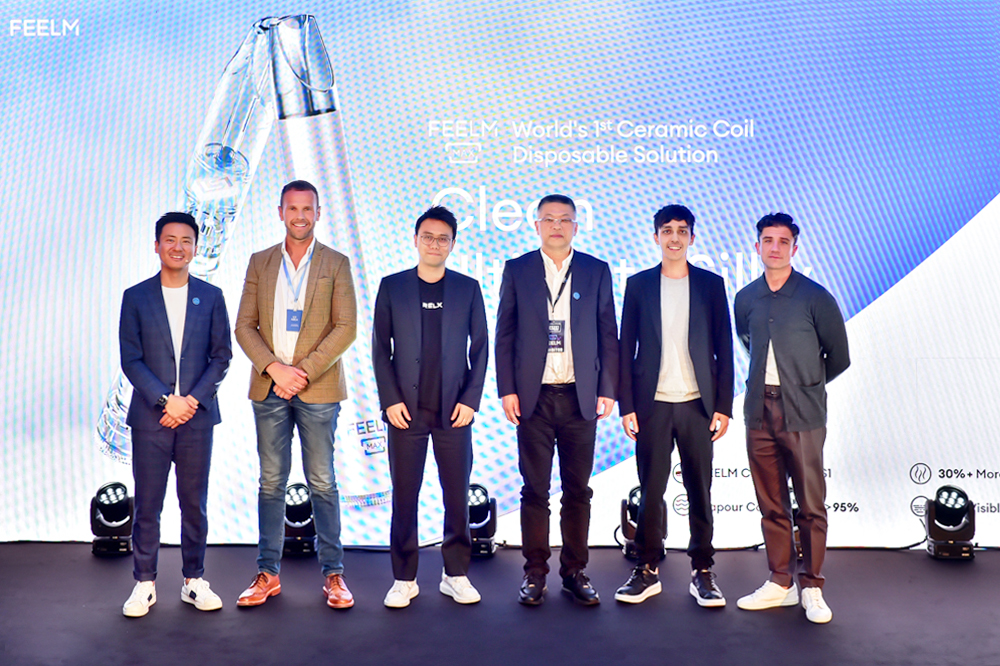
The innovative new disposable vaping system FEELM Max was launched during the UK Vaper Expo in Birmingham on May 13.
The FEELM Max is now available in the UK and EU markets. The event was attended by many top-level e-cigarette industry representatives and FEELM clients, including BAT, RELX International, Totally Wicked and KIWI.
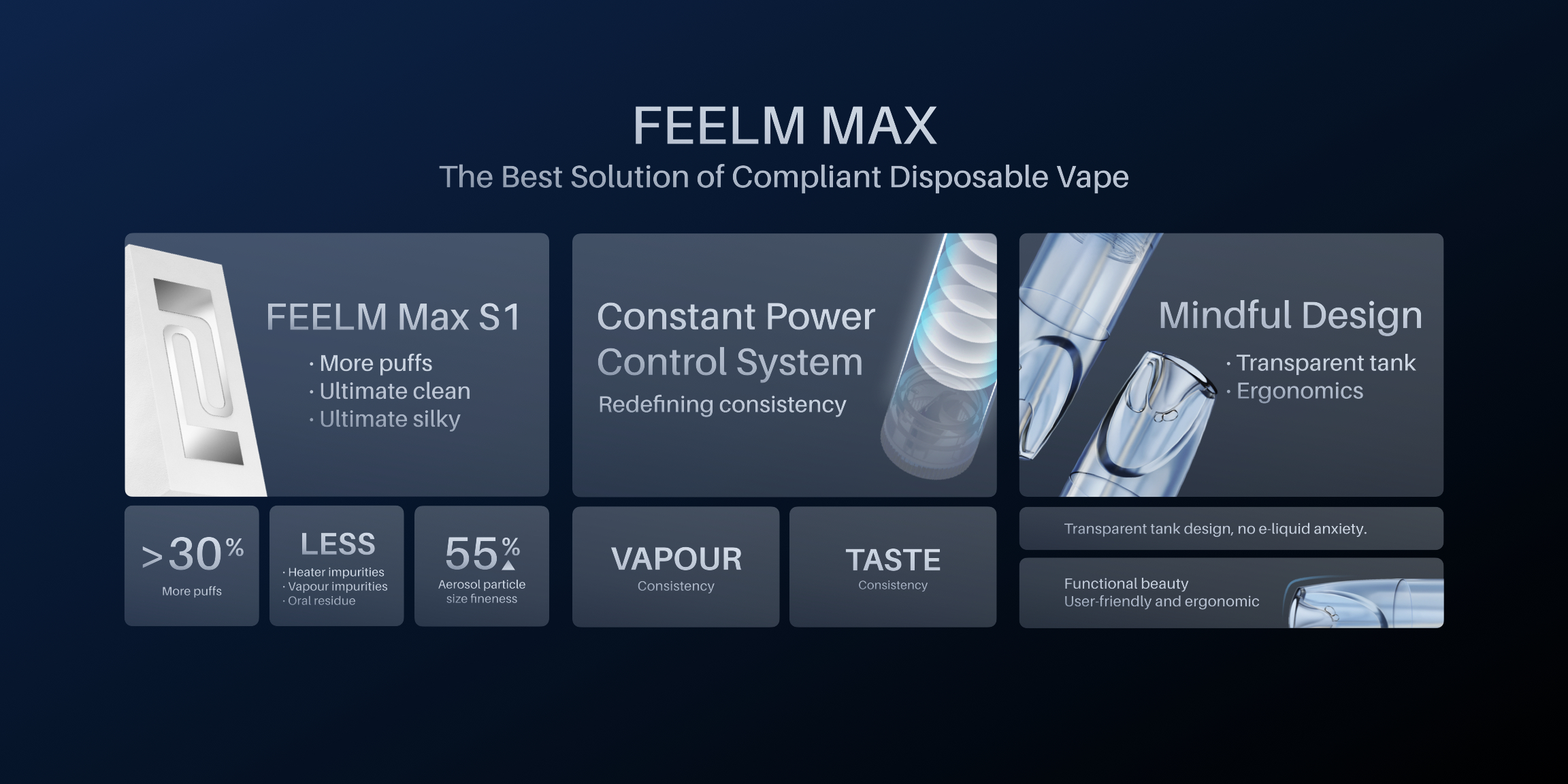
A subsidiary of Smoore Technology, the world’s largest vaping company, SMOORE, FEELM unveiled the advanced FEELM Max solution that the company says brings three major breakthroughs to vaping, including the advanced heating technology of the Ceramic Coil S1, a constant power control system and “mindful design,” according to a press release.
The FEELM Max uses the new Ceramic Coil S1, which is designed to deliver “a superior vaping experience” and offers an increased puff count that sets a new benchmark in the market.
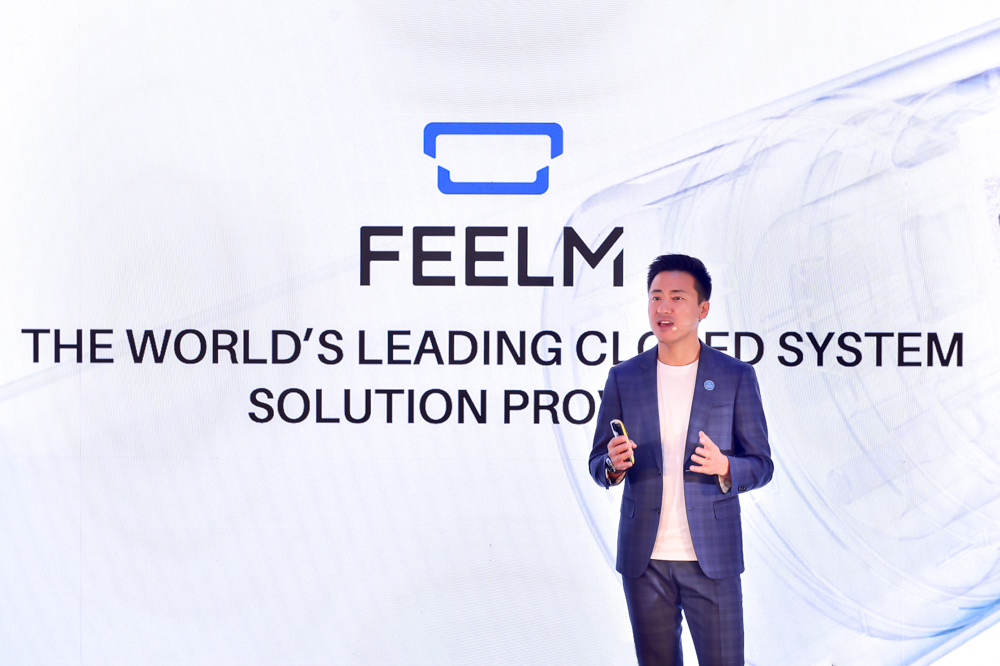
Johnny Zhang, assistant president at FEELM
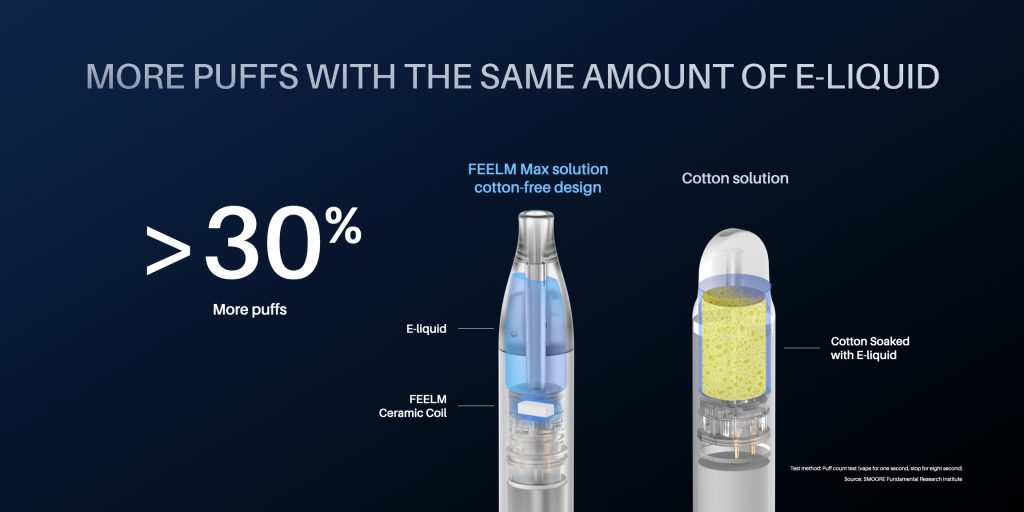
“Benefitting from its cotton-free design and the resulting improvement of e-liquid utilization, the FEELM Max is able to boost puff count by more than 30 percent compared to cotton coil disposable solutions, providing 800 more puffs and setting a new benchmark for 2ml (e-liquid volumes),” said Johnny Zhang, assistant president at FEELM. “This innovation allows products using the FEELM Ceramic Coil S1 to offer increased puff counts while remaining totally compliant with all local regulations.”
Additionally, the new S1 coil decreases the number of impurities created in the heating process by 78 percent, resulting “in fresher breath and no unpleasant aftertaste.”
The new system also has several technological innovations. The FEELM Max solution uses a constant power energy management system for stable vaping. This technology improves taste consistency by 35 percent, which further enhances the user experience, according to the release.
FEELM Max products have a transparent e-liquid tank for both aesthetics and user convenience that allows consumers to easily see how much e-liquid is left in the device.
The first industrial whole-chain recycling program was also introduced by FEELM during the UK event. Collaborating with RELX International in the UK, FEELM has “taken the responsibility for implementing a scheme that will facilitate vape recycling to a fuller extent, thereby minimizing the environmental impact.”
Bing Du, the CEO and founder of RELX International stated at the event: “Thanks to the groundbreaking technology of FEELM Max, and driven by our legendary partnership with FEELM, RELX International is on course to revolutionize the vaping experience across the globe.”
The company’s commitment to making recycling more accessible demonstrates its dedication to environmental sustainability, according to the release. As the initiative gains traction, it could serve as a model for other industries looking to implement eco-friendly practices and engage adult customers in sustainability efforts.
FEELM intends to continue pushing the boundaries of what’s possible in vaping technology, while keeping its commitment to sustainability and compliance at the heart of its operations, according to the release. “The company’s mission to shape a better vaping industry, not only for today but for generations to come, remains stronger than ever,” Zhang said.
New legislation aims to restrict the use and sale of all tobacco products in Portugal, including e-cigarettes and heated tobacco.
A new bill would ban smoking in outdoor spaces next to public buildings such as schools, colleges and hospitals. It will also tighten control over the sale and marketing of cigarettes and other tobacco products in the country.
The aim is that by 2025 tobacco products will only be available for purchase in tobacconists, petrol stations and airports, reports EuroNews.
If enacted, it will no longer be possible to sell tobacco directly or through vending machines in places such as restaurants, bars, concert halls and venues, casinos, fairs and exhibitions. The products will also be prohibited at music festivals.
Portugal is also complying with the European directive of June 29, 2022, which puts heated tobacco products on an equal footing with other tobacco products.
Zinwi Biotech, a major Chinese e-liquid manufacturer, has announced it will bring its Good Flavor products to the UK Vaper Expo from May 12 – 14 in Birmingham. Attendees of the occasion will have the opportunity to witness firsthand Zinwi’s Good Flavor and will be able to customize their own flavors during the event.
“Zinwi’s products are known to be equivalent to three keywords in the industry: high return to flavor, high smoothness and high stability,” stated to a Zinwi spokesperson. “The primary reason behind the ‘high return to flavor’ characteristic is the stringent fragrance selection process.”
The “high return to flavor” concept is the requirement that each component of Zinwi’s e-liquids to have the highest levels of quality and purity. One of the most important components of an e-liquid is fragrance and the fragrance selection process begins in Quality Control where Zinwi analyzes a fragrance’s physical and chemical indicators and the legality of the components used, according to the spokesperson.
“It is then followed by our sensory evaluation team to evaluate the richness and purity level of the fragrances,” the spokesperson said. “The samples and the finished products will then be evaluated by Quality Control to ensure the highest level of quality of the e-liquid after the fragrances have been added to the products in the testing and manufacturing stage.”
Another reason Zinwi’s e-liquid has an enhanced flavor profile is the company’s Atomization Technology Research Center, which has self-developed nicotine salts and the sweeteners used in the e-liquids to ensure the highest quality of those components of the e-liquid formula, according to the spokesperson.
“Nicotine salt has been delicately developed taking into close consideration the stirring time, the temperature, and the amount of nicotine added in combination with other components such as benzoic acid. The diverse range of sweeteners are also developed to match different vaping devices, for example, different puff-range disposable devices and ceramic core vaping devices,” the spokesperson explained.
“Sweeteners can easily affect the flavor either to be ‘too sweet’ or ‘not enough sweet.’ Having a diverse range of sweeteners can avoid the “too sweet” or “not enough sweet” challenge and help the finished products to maintain the ‘high return to flavor’ characteristic.”
Additionally, Zinwi’s flavoring team are some of the most experienced in the industry. Apart from flavorist’s own flavoring experiences, Zinwi’s flavoring team together has created over 50, 000 formulas, and hundreds more are added every day on average.
“Zinwi’s good flavor products are not attributed by one single factor,” said the spokesperson. “It is the combined factors including the raw materials selection, the self-developed e-liquid components such as nicotine salts and sweeteners, the quality control procedures and the well-trained flavoring team that guarantee the good flavor.”
Established in 2016 and headquartered in the Guangming District of Shenzhen, China, Zinwi Biotech is a high-tech company that specializes in providing integrated e-liquid solutions including R&D, production and sales services to global e-cigarette manufacturers and brands. Due to its strong R&D capabilities, stringent quality control procedures and premium client network, Zinwi has become the world’s leading integrated e-liquid solutions provider.
The U.S. Food and Drug Administration says it is on track to finish reviewing premarket tobacco product applications (PMTAs) for the most prevalent e-cigarettes by the end of the year, reports CSP.
The FDA has reviewed 52 percent of covered applications as of March 31. Covered applications are for new tobacco products on the market as of Aug. 8, 2016, with a PMTA filed by Sept. 9, 2020, and sold under the brands Juul, Vuse, Njoy, Logic, Blu, Smok, Suorin or Puff Bar and reach 2 percent or more of total retail sales volume per NielsenIQ reports, according to CSP.
Based on the latest status report, the FDA plans to have 53 percent of covered applications acted on by June 30, 55 percent of covered applications acted on by Sept. 30 and 100 percent of covered applications acted on by Dec. 31.
The court-ordered deadline for FDA review of PMTAs was Sept. 9, 2021, but the agency did not meet that deadline and now has to file regular status reports on progress. The next status report is due by July 24.
The withdrawal of European and American tobacco manufacturers and the gradual reduction of foreign e-cigarette brands doing business in Russia due to its war with Ukraine has allowed for the growth of Chinese e-cigarettes in Russia.
As Russia’s tobacco industry relies heavily on the support and investment of foreign brands, the withdrawal of international tobacco companies will cause a large shortage in the Russian tobacco market, which will lead to a sharp increase in the price of tobacco products sold in Russia, according to iGeekPhone.
By the end of 2021, there were more than 5,000 stores selling e-cigarettes in Russia, including more than 1,100 in the Moscow region.
According to real estate platform DNA REALTY, the number of tobacco shops in Russia grew by at least 20 percent in 2022, with the bulk of their profits coming from e-cigarette sales.
BAT announced it will withdraw from the Russian and Belarusian tobacco markets in 2023. Philip Morris International (PMI) and its subsidiary Fimo International, are also considering retaining their business in Russia because Russia is the seventh-largest tobacco market for PMI.
Japan Tobacco suspended investments in Russia and Imperial Brands transferred its Russian operations to a successor in Russia.
“E-cigarettes have great potential as alternatives to the tobacco market in Russia, where e-cigarette consumers account for 6.8 percent of the total number of smokers,” the article states. “After the United States and Europe, Russia is the world’s third-largest importer of electronic nicotine delivery systems (ENDS).
“China accounts for 90 percent of the global market. In 2021, China’s exports to Russia reached 82.5 billion rubles. This year it could increase by 35 percent to 111 billion rubles.”
Media reports claim the removal effectively legalizes e-cigarettes with nicotine without any regulations in place, as the current Control of Tobacco Products Regulations 2004 under the Food Act 1983 only cover conventional cigarettes and other tobacco products.
The Control of Tobacco Product and Smoking Bill 2022 – which seeks to regulate both tobacco and vape products, besides a ban on these products for anyone born from 2007 – has yet to be tabled in the current 15th Parliament, reports Code Blue.
Health Minister Zaliha Mustafa gazetted an order Friday to exempt nicotine “preparation of a kind used for smoking through electronic cigarette and electric vaporizing device, in the form of liquid or gel” from the Poisons List under the Poisons Act 1952 – overriding the Poisons Board that unanimously rejected the proposal last Wednesday.
The Excise Duties (Amendment) Order 2023 – which subjects e-liquid or gel containing nicotine to excise duty of 40 sen ($0.004 cents) per milliliter – gazetted by Finance Minister Anwar Ibrahim, who is also the prime minister, was dated last March 29, the same day as the Poisons Board meeting.
The tax on e-liquids with nicotine went into effect on April 1.
CodeBlue reported that the Poisons Board, an independent body formed under the Poisons Act, wholly objected to the government’s proposal to exclude nicotine-containing e-liquid from the Poisons List on the basis that the harm of allowing e-cigarettes to be sold to anyone, including children, outweighed the benefit of tax revenue from such products containing nicotine, a highly addictive substance.




 Zinwi Biotech, a major Chinese e-liquid manufacturer, has announced it will bring its Good Flavor products to the UK Vaper Expo from May 12 – 14 in Birmingham. Attendees of the occasion will have the opportunity to witness firsthand Zinwi’s Good Flavor and will be able to customize their own flavors during the event.