Tag: Canada

  • Canada Targets Zonnic Marketing ‘Loopholes’

    Canada Targets Zonnic Marketing ‘Loopholes’

    Image: Imperial Tobacco Canada

    Canadian Health Minister Mark Holland announced that the health department will address “loopholes” surrounding Zonnic, a flavored nicotine pouch product from Imperial Tobacco Canada, reports the Canadian Broadcasting Corp.

    Health Canada previously approved the sale of Zonnic without any advertising or sales method restrictions.

    According to Holland, “the behavior and intentions of the tobacco industry have raised serious concerns as they appear to want to addict new young people to nicotine, which is appalling, and we want to address this issue.”

    In November, six national health organizations called on the government to immediately regulate the advertising and sale of flavored nicotine products; Zonnic is not included in any existing federal or provincial tobacco or e-cigarette legislation as it does not contain tobacco, contains less than 4 mg of nicotine and is not inhaled.

    Holland reportedly takes responsibility for the oversight and plans to review the approval process for nicotine products.

    Imperial Tobacco Canada must conduct annual self-reports and “identify any appeal or abuse of their products among young people,” Health Canada stated.

    “Marketing targeted at young people will be considered deceptive advertising and may trigger post-listing compliance action,” the Canadian Ministry of Health stated. Decisions regarding product sales locations and age restrictions are determined by individual provinces and territories, according to Health Canada.

    In response to earlier criticism, Imperial Tobacco Canada said that it has already taken measures to prevent youth access to its products.

  • The Potential of Pot

    The Potential of Pot

    Photo: Konrad

    Despite regional setbacks, global cannabis sales are still getting higher.

    By Stefanie Rossel

    Global cannabis sales continue to grow, albeit at a slightly slower pace than before, facing headwinds in comparatively mature markets, such as Colorado or California. Euromonitor International expects the value of the global legal cannabis market to grow from $41 billion in 2022 to $98 billion by 2027. Despite increasing access and acceptance, the stigma around cannabis remains and regulatory uncertainty prevails.

    The main growth drivers are innovation, investments from tobacco companies and consumer perception. Cannabis caters to the needs of consumers unnerved by economic, environmental and political uncertainties along with the spread of armed conflicts. Indeed, data from Israel’s ministry of health shows a spike in demand for a medical marijuana program one month into the war with Hamas. Meanwhile, the government of Ukraine—another country at war—is preparing to legalize medical cannabis.

    Euromonitor expects noncombustible cannabis products to gain share as consumers become more concerned about their health. Further legislation of adult-use cannabis would have significant implications for other fast-moving consumer goods, according to the market intelligence providers, with innovations in cannabis involving topicals, beverages or edibles.

    Alert to opportunity, the major tobacco players have already ventured into the sector. Philip Morris International has invested in Vectura Fertin Pharma, a contract development and manufacturing organization specializing in gums, pouches, tablets and other solid oral systems for the delivery of active ingredients. According to news reports dated July 2023, PMI is also planning to take over Syqe Medical, an Israeli company, which manufactures a metered-dose inhaler for pain reduction using medical marijuana.

    BAT, for its part, has stakes in 13 cannabis startups. In April, the company entered a joint venture with Charlotte’s Web Holdings, a cannabidiol (CBD) producer based in Denver, Colorado, USA. Since 2021, it also holds a minority stake in Organigram, Canada’s second-largest licensed cannabis producer. In early November 2023, BAT boosted its interest in the company through a cad124.6 million ($90.15 million) investment. Last year, it invested $37.6 million in a leading German cannabis company called Sanity Group.

    Imperial Brands acquired a stake in Auxly in 2019, while Altria is represented in the cannabis market through Cronos of Canada.

    Despite the growth of the market, Canadian companies are struggling to profit from legal cannabis.
    (Image: JHVEPhoto)

    Successful Experiment

    Presently, two markets are of particular interest for investors in the cannabis space: Canada, which in October celebrated the fifth anniversary of legal recreational cannabis; and Germany, which was supposed to legalize cannabis in November.

    Canada’s government had committed itself to reviewing its Cannabis Act after three years, but the Covid-19 pandemic delayed that exercise. In October, the government published a summary of feedback provided by industry, healthcare and community groups. Its conclusions were sobering. Despite the growth of the market, companies across the supply chain are struggling to profit from legal cannabis. Legal producers are burdened by significant regulatory fees, distributor markups and taxes in a hyper-competitive market. The illicit market, meanwhile, still represents 40 percent of the business.

    In their rush to compete with illegal products, sellers of legal cannabis have dropped their prices dramatically, selling products for as low as cad3 per gram instead of the cad10 per gram originally envisaged by the government. Due to advertising and packaging restrictions, communication with consumers, even to inform them about different varieties of cannabis and their effects, is nearly impossible. As a result of such challenges, several first players have exited the market or reduced manpower.

    Legalization has also impacted public health: The Canadian Institute for Public Health noted that cannabis-related emergency department visits and hospitalizations increased 14 percent between 2019 and 2021. Despite its shortcomings, Deepak Anand, principal of Vancouver-based ASDA Consultancy Services, deems legalization a success. “Legalization has resulted in about a 50 percent reduction in illicit market sales,” he says, quoting a recent survey in which 48 percent of cannabis-using respondents stated that they purchased all their products at a licensed retailer.

    “Retailer availability and proximity is an important metric in increasing overall market penetration and facilitating access,” says Anand. “No one expected the illicit market to disappear on day one or year five of legalization. The fact that we are at almost 50 percent reduction says a lot about the progress made.”

    Altogether, 64 percent of Canadians supported legalization, according to the probe. The survey also showed that people aged 45 and older increased their cannabis intake the most of all age groups following legalization, whereas those under 17 reduced their consumption.

    Legalization has resulted in about a 50 percent reduction in illicit market sales.

    Lessons to be Learned

    Anand emphasizes that legalization is a process rather than an event and that the experiences of Canada show other countries what works and what doesn’t. Lessons, he says, include the importance of avoiding over-taxation and overregulation of a nascent industry, particularly when one of the goals of legalization is to transition consumption from illicit to licit channels.

    What’s more, tax earnings derived from legalization must not be used solely to fill government coffers. “Revenues must be reinvested by providing the industry with data, research and tools to support the nascent industry and transition supply from criminal and illicit channels.”

    Governments must also guard against setting the age of access too high or the THC limits too low, according to Anand. Furthermore, they should make sure that social justice reform is baked into any legalization programs.

    Anand expects the final report on Canada’s Cannabis Act, which will be tabled before Parliament in March 2024, to take into account industry suggestions on taxation and THC levels, concerns from academics about the lack of research and a call for an overhaul of the medical system.

    The Canadian cannabis market, he predicts, will see only the fittest companies surviving. “Strong business fundamentals and financial discipline will be rewarded,” says Anand. ”Companies and teams that focus on the plant and the consumer will thrive as we are seeing in the market currently. Cannabis isn’t going anywhere; it is an industry that is here and will not only stay but also thrive in the future.”

    Disappointing Move

    Meanwhile in Germany, legalization appears to have lost some of its momentum. Hopes were high when, in 2021, a new coalition government announced it would permit licensed shops to sell recreational cannabis to adults, i.e., those from the age of 18. The move would have made Germany the biggest EU cannabis market by far. With the legalization, the government aimed to starve the illegal market, decriminalize occasional users, lower criminal justice expenditures and protect public health. The expected cannabis tax, experts predicted, could contribute up to €1.8 billion ($1.92 billion) annually to the state treasury.

    Two years on, all that remains of the lofty plans is a watered-down version. After realizing that full legalization of recreational cannabis would interfere with the U.N. Single Convention on Narcotic Drugs (1961) and EU legislation, the cabinet on Aug. 16, 2023, approved a bill that would allow adults to possess up to 25 grams of the drug, grow a maximum of three plants and acquire weed as members of nonprofit cannabis clubs. The government said it would also launch a pilot project to test the effects of a commercial supply chain for recreational cannabis over five years—a proposal for which it will need to present separate legislation.

    The legislation was scheduled to pass Parliament on Nov. 16, 2023, making cannabis legal from Jan. 1, 2024. However, after meeting fierce opposition from numerous parties, among them conservative policymakers who warned that legalization would encourage cannabis use and create more work for authorities, industry associations and consumer advocacy groups, the final reading was delayed to mid-December.

    In a Nov. 6 parliamentary hearing, the German Cannabis Association (DHV) pointed out that the possession cap of 25 grams per year made home cultivation impossible, as it referred to fresh flowers, which tend to lose weight after drying. “Under these conditions, no one will take the trouble to cultivate cannabis,” says DHV Managing Director Georg Wurth. “The limit would be a promotion scheme for the black market.”

    DHV also advocates to allow private growers to cultivate more than three plants and criticizes the distance rule, which stipulates that consumption will neither be allowed in cannabis clubs nor within a 200-meter distance of schools, kindergartens, playgrounds or cannabis clubs. “Such a distance—or any obligatory distance—would mean that in populated areas there would be no space left for legal consumption,” he says. “The idea to completely prohibit consumption on the premises of clubs whose only aim is to cultivate cannabis is unrealistic and makes no sense. The envisaged distance rule for cannabis clubs is similarly absurd, as it does nothing for youth prevention.”

    Furthermore, the punishments for violations described in the proposed legislation are too harsh, according to Wurth. The bill stipulates imprisonment of up to three years for the possession of 26 grams of cannabis or the cultivation of four plants. Consumption-related offences involve high fines. Smoking pot in a 190-meter radius from a school, for example, could cost the user up to €100,000. The DHV also calls for a legal opportunity to consume self-cultivated cannabis with friends. “After all, the goal is to deprive the black market of as much consumed cannabis as possible,” Wurth says. The association also calls for equal treatment of cannabis and alcohol in road traffic and an alignment of sanctions.

    At press time, an amended version of the bill that takes into account stakeholders’ input had not been released. The first part of the planned cannabis reform in Germany is now expected to become effective on April 1, 2024, at the earliest.

  • BAT Ups Investment in Organigram

    BAT Ups Investment in Organigram

    Credit: Roxxy Photos

    Organigram Holdings Inc. has extended its relationship with British American Tobacco. The move boosts the Canadian cannabis producer’s financial strength and positioning it to expand globally.

    Organigram said in a statement that BAT is investing a further $90.5 million in the business, building on an initial $160 million injection back in 2021.

    Organigram said the investment will allow it to extend its footprint beyond Canada, and also strengthen its financial position for long-term, sustainable growth, according to media reports.

    “This investment bolsters an already strong balance sheet and solidifies our position as a leading cannabis company,” said Beena Goldenberg, chief executive of Organigram.

    The firm said the deal enables it to invest in growing the topline of its core business, while optimizing operations to deliver on cost-saving efficiencies, thus accelerating earnings growth.

    Organigram will use the majority of the investment to create a strategic investment pool, named Jupiter.

    Jupiter will target investments in emerging cannabis opportunities that will enable Organigram to apply its industry-leading capabilities to new markets, it said.

  • Ontario to Double Vaping Tax

    Ontario to Double Vaping Tax

    Image: JHVEPhoto

    Ontario, in partnership with Canada’s national government, will double the tax on all vaping products sold in the province.

    The federal/provincial tax partnership scheme that was announced in 2022 allows provinces to double the current federal vape tax and keep half the proceeds, according to Vaping360.

    The Canadian Vaping Association (CVA) urged the federal government to reconsider its proposal to impose an additional provincial levy, as this would effectively double the already substantial tax burden. “The CVA suggests a more equitable approach where the federal government shares the revenue generated by the current levy with the provinces,” the industry group wrote in a statement.

    “With the introduction of the excise tax, depending on product type, vape products are now almost as expensive as cigarettes despite the significant reduction in risk,” the statement says.

    The CVA cautioned that the increased tax may lead to more illicit trade. “Legal businesses will find it nearly impossible to compete with the unregulated market that remains largely unchecked. The consequence of such punitive taxation will be widespread business closures, significant job losses and an increase in criminal activity.”

    “The CVA encourages the province to leverage its negotiating influence with the federal government to establish a fair revenue-sharing framework for the existing tax revenue. Preserving the regulated market, rather than destroying it, will lead to higher tax revenues. The additional revenue generated can be used by the province to increase enforcement resources and support educational programs for youth,” said Darryl Tempest, government relations counsel to the CVA.                     

  • Quebec: Flavor Ban Takes Effect

    Quebec: Flavor Ban Takes Effect

    Image: Pixel-Shot

    Quebec’s ban on flavored vapes took effect Oct. 31.

    The measure includes vaping products with flavors other than tobacco and will prohibit e-liquid sold in bottles with a capacity greater than 30 mL and prefilled devices with a capacity greater than 2 mL.

    The ban was announced in a draft published in April. More than 30,000 citizens of Quebec commented on the proposed ban, according to the Quebec Vaping Rights Coalition, but the health ministry reportedly didn’t make any changes to the rules in response.   

    Quebec is the largest province in Canada to enact a flavor ban. Four other provinces and territories already ban flavors, and one has passed a ban but has not set an effective date yet. Three other provinces restrict flavored products to adult-only stores.

    Darryl Tempest

    “It’s high time for provinces like Quebec, New Brunswick, Nova Scotia and PEI to reevaluate their stance and stop yielding to the influence of big tobacco companies. These regions must come to the realization that they are inadvertently supporting the very issues they claim to be combating.”

    The Canadian Vaping Association (CVA) has expressed concerns to the Quebec government, arguing that this regulation will not achieve its intended goal of curbing youth experimentation.

    According to the CVA, the consequences will include the closure of specialty vape shops within the province, the loss of over 1,000 jobs and a shift in consumer demand toward foreign suppliers and the illicit market.

    “It’s high time for provinces like Quebec, New Brunswick, Nova Scotia and PEI to reevaluate their stance and stop yielding to the influence of big tobacco companies. These regions must come to the realization that they are inadvertently supporting the very issues they claim to be combating,” said Darryl Tempest, government relations counsel to the CVA.

    The available data consistently finds that flavor bans fail to effectively protect youth and lead to increased tobacco sales among both young people and adults.

  • Health Canada Licenses Nicotine Pouch

    Health Canada Licenses Nicotine Pouch

    Photo: Andrii

    Health Canada has granted Nicoventures Trading permission to sell Zonnic, a nicotine pouch that can help adult smokers quit smoking by delivering nicotine to the body. The product will be distributed in Canada exclusively by BAT subsidiary Imperial Tobacco Canada (ITCAN).

    “This is a first for Canada. No other nicotine pouch has received Health Canada’s authorization. Zonnic will give smokers a new option to help them quit smoking,” said ITCAN President and CEO Frank Silva, President in a statement.

    “We all agree, smoking is the cause of serious diseases, and we are committed to reducing the health impact of our business. The addition of Zonnic to our product portfolio is the next step in this journey.’’

    Zonnic, which temporarily relieves cravings and nicotine withdrawal symptoms, is licensed as a Natural Health Product and has been authorized for sale by Health Canada for use as a form of Nicotine Replacement Therapy (NRT). Zonnic contains no tobacco.

    As part of its license application, Nicoventures provided all information required by Health Canada, including a pharmacokinetics study that assessed the bioavailability of nicotine in Zonnic in comparison to other commercially available NRTs. The study showed that Zonnic nicotine pouches effectively deliver nicotine, and are comparable to other commercial brands.

    “Canada has a golden opportunity to achieve its reducing smoking rates below 5 percent by 2035. We just have to look at Sweden to see how it can be done. Sweden is about to become the first smoke free country,” said Silva. “This is being achieved by embracing new, less harmful nicotine products and creating a policy environment which encourages smokers to move away from smoking. With Canadian smoking rates at an all-time low, we believe that Zonnic can reduce rates even further, and help Canada get the same results as Sweden.”

    ‘’I am immensely proud to add Zonnic to our product portfolio that hit the shelves this week in convenience stores and later this year in pharmacies. Offering a range of less harmful products to smoking will benefit our adult consumers and society as a whole,’’ concluded Silva.

  • Stick Warnings Take Effect in Canada

    Stick Warnings Take Effect in Canada

    Image: Health Canada

    A new rule requiring warning labels on individual cigarettes in Canada takes effect today, reports The Canadian Press.

    The move, announced earlier this year, makes Canada the first country to take that step to deter smoking.

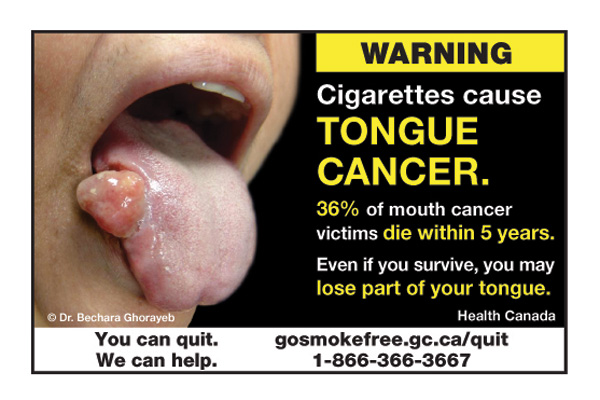
    Under the new law, cigarette manufacturers will be required to print messages in English and French on the paper around the filter, warning smokers about the risk of damage to organs, impotence and leukemia, among other diseases.

    Manufacturers have until the end of July 2024 to ensure the warnings are on all king-size cigarettes sold, followed by regular-size cigarettes and little cigars with tipping paper and tubes by the end of April 2025.

    Rob Cunningham, a senior policy analyst at the Canadian Cancer Society, believes the labels will dissuade teens leaning toward taking up the habit and encourage nicotine-dependent adults to quit.

    Dozens of studies in Canada and elsewhere show the effectiveness of printing warnings on each cigarette, he noted.

    Tobacco advertising, promotion and sponsorship are banned in Canada, with warnings on cigarette packs dating back to 1972.

    In 2001, Canada became the first country to require tobacco companies to print pictorial warnings on the outside of cigarette packages and include inserts with health-promoting messages.

    Federal rules ban packaging that includes brand colors or trademarks.

    The tobacco industry has warned against unintended consequences. The National Coalition Against Contraband Tobacco, which is funded by Canada’s leading cigarette manufacturers, warned in June that cheaper, colorful black-market packs free of health warnings attract young smokers and funnel more money to organized crime.

    While acknowledging that big tax hikes or sales bans would indeed benefit the black market, Cunningham believes that gradual price boosts and more strident messaging can bring down smoking rates.

    “The only real reason that they can oppose something is because it’s going to have a reduction in sales— and that is exactly the point,” he said of the manufacturers.

  • Tobacco Smuggling Costs Billions

    Tobacco Smuggling Costs Billions

    Image: somemeans | Adobe Stock

    Cigarette manufacturers estimate that tobacco smuggled across Canada costs billions in lost taxes, according to a report to Parliament, reports Western Standard.

    “The excise reporting gap was estimated to be on average $400 million of federal excise revenue for the tax years 2014 to 2018,” the Cabinet wrote in an Inquiry of Ministry tabled in the Commons. The $400 million figure included tax revenue lost to contraband of all kinds.

    “How much does the government collect in tobacco taxes annually, and what is the amount of federal tax revenue that is lost from the sale of illegal, untaxed tobacco?” asked Conservative Member of Parliament Philip Lawrence.

    “Illegal tobacco costs around $2 billion annually in lost tax revenue with that money diverted to some of Canada’s most notorious organized crime groups,” wrote Ralf Wittenberg, Imperial Tobacco Canada CEO. “Despite this, the federal government has barely mentioned illegal tobacco since 2015, let alone taken any measures to address it.”

    “Canada’s illegal tobacco problem is now a national issue that spills beyond our borders, with illegal Canadian product turning up in the United States, Mexico, the Caribbean and Central America,” said Wittenberg. “Domestically, after several years of relative stability, the illegal market is growing again.

    “This has been driven mainly by persistently high rates in Ontario estimated at 35 percent to 40 percent and a recent explosion in British Columbia, where we estimate the rate has grown to 35 percent.

    “Numerous reports from law enforcement agencies, think tanks and media have drawn clear links between illegal tobacco and other criminal activities, including drug and weapons trafficking.”

  • Individual Stick Warnings Coming

    Individual Stick Warnings Coming

    Image: Tobacco Reporter archive

    Canada will soon require that health warnings be printed directly on individual cigarettes—becoming the first country in the world to take this approach, according to the Government of Canada.

    The new Tobacco Products Appearance, Packaging and Labeling Regulations will be part of the government of Canada’s continued efforts to help adults who smoke to quit, to protect youth and nontobacco users from nicotine addiction and to further reduce the appeal of tobacco. Labeling the tipping paper of individual cigarettes, little cigars, tubes and other tobacco products will make it virtually impossible to avoid health warnings altogether. In addition, the regulations will support Canada’s Tobacco Strategy and its target of reaching less than 5 percent tobacco use by 2035, according to a government press release.

    These regulations will come into force on Aug. 1, 2023, and will be implemented through a phased approach that will see most measures on the Canadian market within the year. Retailers will carry tobacco product packages that feature the new health-related messages by the end of April 2024. King-size cigarettes will be the first to feature the individual health warnings and will be sold by retailers in Canada by the end of July 2024 followed by regular size cigarettes, little cigars with tipping paper, and tubes by the end of April 2025.

    Other measures include strengthening and updating health-related messages on tobacco product packages; extending the requirement for health-related messaging to all tobacco product packages; and implementing the periodic rotation of message.

    The new regulations will be published in the June 7, 2023, edition of the Canada Gazette—Part II. In the interim, copies of the full regulations are available upon request by contacting pregs@hc-sc.gc.ca.

  • Group Blasts Quebec Flavor Ban Proposal

    Group Blasts Quebec Flavor Ban Proposal

    Photo: vmargineanu

    A proposal by the government of Quebec to ban nontobacco-flavored nicotine vaping products will have negative consequences for public health if enacted, according to the Canadian Vaping Association (CVA).

    In addition to the flavor restrictions, the recently released draft legislation proposes a volume limit of 2 mL on prefilled devices and a limit of 30 mL on refill containers. Additionally, the regulations would restrict nicotine concentrations to 20 mg/mL and prohibit the use of any form, appearance or function that may be attractive to minors, both of which have already been regulated by the federal government.

    If the draft rules are implemented, Quebec, with its population of 8.5 million, will become the largest Canadian province to prohibit flavors, according to Vaping360. Quebec is the country’s second-most populous province. According to the Alliance of Vape Shops in Quebec, there are over 400 independent vape shops in the province, employing over 2,200 people and generating more than $300 million in economic activity. The trade group predicts the shops will all close.

    Quebec’s decision to ban flavors is a major win for tobacco companies, out-of-province vendors and contraband sellers.

    In 2021, federal health agency Health Canada proposed a flavor ban that was scheduled to take effect in early 2022, but that plan seems to have been abandoned or postponed indefinitely without explanation. Health Canada’s updated vaping products regulations page makes no mention of the flavor restrictions.

    The CVA says Quebec proposed its rules despite warnings by the industry about their negative impacts. Vaping is proven to be significantly less harmful than smoking, according to the CVA, which says there is substantial evidence from jurisdictions that have already implemented flavor bans that the public health outcome is negative, as many vapers will return to smoking and fewer smokers will switch to vaping.

    “Quebec’s decision to ban flavors is a major win for tobacco companies, out-of-province vendors and contraband sellers,” said Darryl Tempest, government relations counsel to the CVA board, in a statement. “What Quebec has done is shift demand to tobacco owned products, retailers outside of Quebec and criminals. Quebec’s small businesses and domestic industry will be irreparably harmed in favor of multinational corporations,” said Tempest.